

Louis Armand, Jane Lewty, Andrew Mitchell (eds.): Pornotopias: Image, Desire, Apocalypse (2008)
Filed under book | Tags: · art, body, gender, image, masochism, pornography, sex, sexuality, theory

Bodily existence is an existence lived in constant fascination with a world beyond one’s reach. Embodiment, desire, metaphor. To exist on the verge of nonexistence. In the headlong pursuit of the real, of the other. Of the base materiality of the world, of religious hypothesis, of absolute relativity. Every utopia is a pornography, a recrudescence and pathological disillusionment, a lure into the vortex–paradoxical annulment of pure reason, compulsion, repetition, consumption.
A fact of bodily existence is to know that the body is our most complex and multi-faceted machine in a world of incessant technological progress. The body is a marvel of engineering; it is the outward face of primal nature; it is a disgusting vessel in which to house the soul; it is a primitive device, fragile and disposable. Bodies are re-produced, experimented upon to the limits of their tolerance, dissected and debated to every last cell, mended, prosthetically enhanced, moralised, abused and adored. The interface with the world we live in means that the body is always laid open to scrutiny without ever simply constituting some thing within our grasp: it is the site where violence and metaphysics interchange, technicity and catatonia, the sublime and the grotesque.
The body cannot be neutral or indifferent. Its design is such that it must respond to both exterior challenge and interior impulse. Our means of survival, the sex act, galvanizes the body into a unique state of existence, which, though transient, becomes the essence of being; the concentration of an idea, the heightening of sense, the ultimate dissolution.
How to write this purposeful transformation? How to write this instantaneous, ephemeral shattering of perception? This is the task of pornography. Our project will present the body in its most extreme of forms and behaviour, all of which demonstrate the human attempt to satisfy, and solve, the oft-inchoate needs of our psychology and physicality. We seek papers which deal with pornography as condition, symptom, addiction, spectacle, product, simulacrum. Above all as a fundamentalism embedded in the very structures of representation, knowledge, non-knowledge and the unpresentable.
Contributors include Georges Bataille, Johannes Birringer, Karmen MacKendrick, Benjamin H. Bratton, Lara Portela, Louis Armand, Stewart Home, Jane Lewty, Thierry Tillier, Ruark Lewis, Malwina Zaremba, Darren Tofts, Bonita Rhoads, Stuart Kendall, Ian Haig, Jena Jolissaint, Pierre Daguin, Vadim Erent, Florian Cramer, Beth Lazroe, Andar Nunes.
Publisher Faculty of Philosophy of the Charles University, Prague, December 2008
Litteraria Pragensia Books series
ISBN 9708073082918
272 pages
PDF (69 MB, updated on 2013-5-11)
Comments (4)Colin MacCabe: Godard: Images, Sounds, Politics (1980)
Filed under book | Tags: · cinema, film, film theory, maoism, montage, photography, politics, sexuality, technology, television
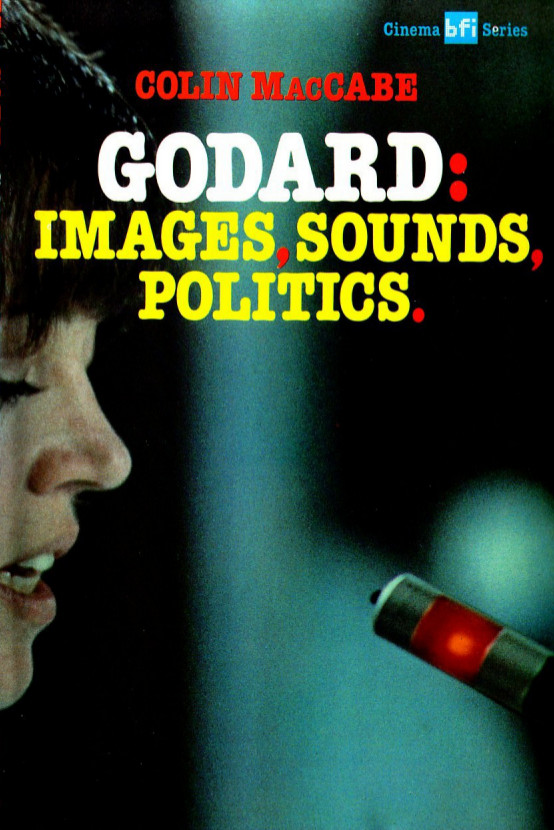
Godard: Images, Sounds, Politics is an important step in making Godard’s experiments in image and sound beyond the institutions of cinema and television visible. It reads the earlier films through the more recent work, focusing on politics, technology and sexuality. These insistent themes dominate Godard’s investigation of our representation in the image, a representation always inflected by sound. These terms enable us to understand more critical the circulation of money and images in which we participate, a circulation which Godard’s work cuts across.” (from the back cover)
Includes essays by Colin MacCabe, Laura Mulvey, and Mick Eaton. Also features interviews with Godard, a filmography, and a selected bibliography. Printed in black-and-white.
With Mick Eaton and Laura Mulvey
Design Richard Hollis
Publisher The Macmillan Press, London and Basingstoke, 1980
British Film Institute Cinema series
ISBN 0333290739, 9780333290736
175 pages
review of the book’s design (Eye Magazine)
Comment (0)Linda M. Montano (ed.): Performance Artists Talking in the Eighties: Sex, Food, Money/Fame, Ritual/Death (2000)
Filed under book | Tags: · 1980s, art, art history, art system, feminism, food, performance, performance art, religion, sexuality, video art

“Performance artist Linda Montano, curious about the influence childhood experience has on adult work, invited other performance artists to consider how early events associated with sex, food, money/fame, or death/ritual resurfaced in their later work. The result is an original and compelling talking performance that documents the production of art in an important and often misunderstood community.
Among the more than 100 artists Montano interviewed from 1979 to 1989 were John Cage, Suzanne Lacy, Faith Ringgold, Dick Higgins, Annie Sprinkle, Allan Kaprow, Meredith Monk, Eric Bogosian, Adrian Piper, Karen Finley, and Kim Jones. Her discussions with them focused on the relationship between art and life, history and memory, the individual and society, and the potential for individual and social change. The interviews highlight complex issues in performance art, including the role of identity in performer-audience relationships and art as an exploration of everyday conventions rather than a demonstration of virtuosity.”
Publisher University of California Press, 2000
ISBN 0520210220, 9780520210226
537 pages