

Yochai Benkler: The Penguin and the Leviathan: How Cooperation Triumphs Over Self-Interest (2011)
Filed under book | Tags: · biology, business, collaboration, economics, floss, neuroscience, politics, psychology, society, sociology, software, technology, web
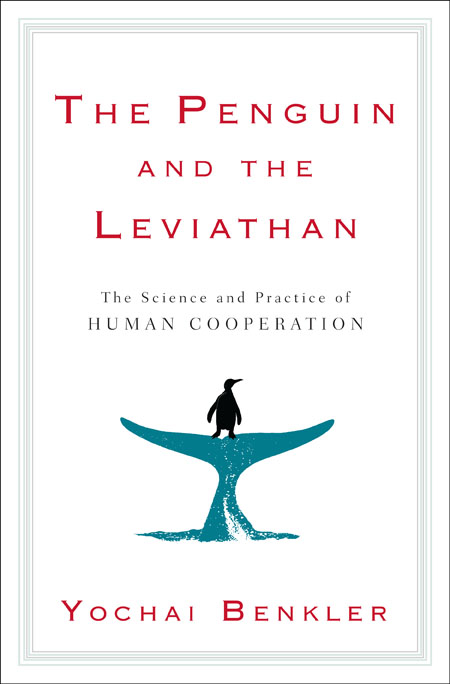
What do Wikipedia, Zip Car’s business model, Barack Obama’s presidential campaign, and a small group of lobster fishermen have in common? They all show the power and promise of human cooperation in transforming our businesses, our government, and our society at large. Because today, when the costs of collaborating are lower than ever before, there are no limits to what we can achieve by working together.
For centuries, we as a society have operated according to a very unflattering view of human nature: that, humans are universally and inherently selfish creatures. As a result, our most deeply entrenched social structures – our top-down business models, our punitive legal systems, our market-based approaches to everything from education reform to environmental regulation – have been built on the premise that humans are driven only by self interest, programmed to respond only to the invisible hand of the free markets or the iron fist of a controlling government.
In the last decade, however, this fallacy has finally begun to unravel, as hundreds of studies conducted across dozens of cultures have found that most people will act far more cooperatively than previously believed. Here, Harvard University Professor Yochai Benkler draws on cutting-edge findings from neuroscience, economics, sociology, evolutionary biology, political science, and a wealth of real world examples to debunk this long-held myth and reveal how we can harness the power of human cooperation to improve business processes, design smarter technology, reform our economic systems, maximize volunteer contributions to science, reduce crime, improve the efficacy of civic movements, and more.
For example, he describes how:
• By building on countless voluntary contributions, open-source software communities have developed some of the most important infrastructure on which the World Wide Web runs
• Experiments with pay-as-you-wish pricing in the music industry reveal that fans will voluntarily pay far more for their favorite music than economic models would ever predic
• Many self-regulating communities, from the lobster fishermen of Maine to farmers in Spain, live within self-regulating system for sharing and allocating communal resources
• Despite recent setbacks, Toyota’s collaborative shop-floor, supply chain, and management structure contributed to its meteoric rise above its American counterparts for over a quarter century.
• Police precincts across the nation have managed to reduce crime in tough neighborhoods through collaborative, trust-based, community partnerships.
A must-read for anyone who wants to understand the dynamics of cooperation in 21st century life, The Penguin and the Leviathan not only challenges so many of the ways in which we live and work, it forces us to rethink our entire view of human nature.
Publisher Crown Publishing Group, 2011
ISBN 0307590194, 9780307590190
272 pages
PDF (EPUB)
Comment (0)The Machinery of Stability Preservation (2011) [Chinese/English]
Filed under report | Tags: · china, human rights, politics, riot, security, short-circuit, social decay, social unrest, society
“There is widespread agreement in China, from high officials to ordinary people, about the importance of maintaining social stability. There is rather less consensus, though, about how best to ensure and promote stability. Considering the costs, both fiscal and human, of continued pursuit of the policy of “stability above all else,” some have begun to question whether, perhaps, the effort might actually be counterproductive.
In a recent article (translated below) posted on the website of Caijing magazine, two reporters who have been covering China’s social stability problem offer an excellent introduction to the organizational structure behind China’s stability management effort. Their detailed portrait of this structure as it exists at both the central and local levels leads into a trenchant analysis of China’s paradoxical pursuit of stability and a look at how that structure actually undermines that effort. Their conclusion—that the only escape from this paradox is to accelerate the pace of political and judicial reform—is a clear articulation of an aspiration that is gathering momentum in China but that will still have to overcome much resistance if it is to be realized.”
by Caijing magazine reporters Xu Kai & Li Weiao, 6 June 2011
Translated by Dui Hua Human Rights Journal, 8 June 2011
View online [Chinese]
View online [English]
related:
Stability Preservation in China (English extracts from three pieces written by Leung Man Tao, a recognized media professional and public intellectual from Hong Kong, Du Guang, a veteran Central Party School scholar, and Sun Liping, a sociology professor at Tsinghua University; 2010)
Riot erupts in southwest China town: reports (Reuters; 12 Aug 2011)
Praktyka Teoretyczna, No. 1-3 (2010-2011) [Polish]
Filed under journal | Tags: · biopolitics, commons, philosophy, society, theory

No. 2-3: Biopolityka, 2011

No. 1: Wspólnota, 2010
“Theoretical practice is what interests us most: to continuously question the relation between theory and practice. We consider the tension that arises from combining those two variant “practices” a mere source of both forms of activity: “theoretical” (philosophy, sciences) and “practical” (politics, technology, arts). Staying in a domain of broadly understood philosophy, we are attempting to develop it in correlation with the whole abundance of practices, but equally with a reference to the sciences building those practices. For us, philosophy is an element that develops all practice, but also interrupts this very theory and practice, as they exist only in a fundamental relation with their exterior (matter, life, time and space). We are interested in a possibility of enriching that philosophical element with notions and figures excluded from it, as well as reflecting upon a necessity of reinterpreting exhausted ideologies and discourses. We wish for our own teoretical practice to stay in a continuous reference with material and symbolic aspects of our existence, with time and space in which we think. We also want it not to be blind to the conditions of life in which others live.
We are aiming for a development of an ability to practice the theory: rebuilding and deconstruction of the existing theoretical vocabularies, finding new spaces for application of theorems in developing sciences, penetrating newborn inter- and transdisciplinary scientific discourses, interpretation of social and technological changes. Our objective is also to create circumstances in which young researchers, Master and Ph.D. students, could practice their theories. This offer is especially aimed at those, who are not scared to cross boundaries of disciplines they study.”
Editor-in-chief: Krystian Szadkowski
The board: Piotr Juskowiak, Agnieszka Kowalczyk, Wiktor Marzec, Mikolaj Ratajczak, Krystian Szadkowski, Maciej Szlinder, Anna Wojczyńska
Publisher: Międzywydziałowa „Pracownia Pytań Granicznych” UAM, Poznań
ISSN: 2081-8130
Published under Creative Commons 3.0 BY SA licence