

Nicole Shukin: Animal Capital. Rendering Life in Biopolitical Times (2009)
Filed under book | Tags: · animal, biology, biopolitics, capitalism, life, mimesis, neoliberalism

Illuminates the profound contingency of market life on animal figures and flesh
The juxtaposition of biopolitical critique and animal studies—two subjects seldom theorized together—signals the double-edged intervention of Animal Capital. Nicole Shukin pursues a resolutely materialist engagement with the “question of the animal,” challenging the philosophical idealism that has dogged the question by tracing how the politics of capital and of animal life impinge on one another in market cultures of the twentieth and early twenty-first centuries.
Shukin argues that an analysis of capital’s incarnations in animal figures and flesh is pivotal to extending the examination of biopower beyond its effects on humans. “Rendering” refers simultaneously to cultural technologies and economies of mimesis and to the carnal business of boiling down and recycling animal remains. Rendering’s accommodation of these discrepant logics, she contends, suggests a rubric for the critical task of tracking the biopolitical conditions and contradictions of animal capital across the spaces of culture and economy.
From the animal capital of abattoirs and automobiles, films and mobile phones, to pandemic fear of species-leaping diseases such as avian influenza and mad cow, Shukin makes startling linkages between visceral and virtual currencies in animal life, illuminating entanglements of species, race, and labor in the conditions of capitalism. In reckoning with the violent histories and intensifying contradictions of animal rendering, Animal Capital raises provocative and pressing questions about the cultural politics of nature.
Publisher University of Minnesota Press, 2009
ISBN 0816653429, 9780816653423
288 pages
PDF (updated on 2012-8-1)
Comment (0)Erin Manning: Relationscapes: Movement, Art, Philosophy. Technologies of Lived Abstraction (2009)
Filed under book | Tags: · abstract machine, art history, biopolitics, body, dance, film theory, language theory, new media, painting, perception, philosophy

With Relationscapes, Erin Manning offers a new philosophy of movement challenging the idea that movement is simple displacement in space, knowable only in terms of the actual. Exploring the relation between sensation and thought through the prisms of dance, cinema, art, and new media, Manning argues for the intensity of movement. From this idea of intensity—the incipiency at the heart of movement—Manning develops the concept of preacceleration, which makes palpable how movement creates relational intervals out of which displacements take form.
Discussing her theory of incipient movement in terms of dance and relational movement, Manning describes choreographic practices that work to develop with a body in movement rather than simply stabilizing that body into patterns of displacement. She examines the movement-images of Leni Riefenstahl, Étienne-Jules Marey, and Norman McLaren (drawing on Bergson’s idea of duration), and explores the dot-paintings of contemporary Australian Aboriginal artists. Turning to language, Manning proposes a theory of prearticulation claiming that language’s affective force depends on a concept of thought in motion.
Relationscapes is a radically empirical book, working directly out of examples and delving into the complexity of relations these examples suggest. It takes a “Whiteheadian perspective,” recognizing Whitehead’s importance and his influence on process philosophers of the late twentieth century—Deleuze and Guattari in particular. Relationscapes is truly a transdisciplinary book, not aiming to cover the ground of a particular discipline but making clear how the specificity of a particular inquiry can alter key questions that emerge in the interstices between disciplines. It will be of special interest to scholars in new media, philosophy, dance studies, film theory, and art history.
Publisher MIT Press, 2009
ISBN 026213490X, 9780262134903
272 pages
PDF (updated on 2013-1-29)
Comment (0)Sean Cubitt: EcoMedia (2005)
Filed under book | Tags: · bioethics, biopolitics, cinema, ecology, film, popular culture, technology, television
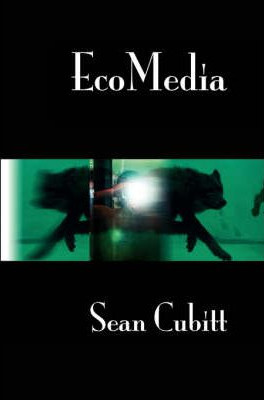
“For the last twenty years ecology, the last great political movement of the 20th century, has fired the imaginations not only of political activists but of popular movements throughout the industrialised world. EcoMedia is an enquiry into the popular mediations of environmental concerns in popular film and television since the 1980s. Arranged in a series of case studies on bio-security, relationships with animals, bioethics and biological sciences, over-fishing, eco-terrorism, genetic modification and global warming, EcoMedia offers close readings of Peter Jackson’s The Lord of the Rings, Miyazake’s Princess Mononoke, The Perfect Storm, X-Men and X2, The Day After Tomorrow and the BBC’s drama Edge of Darkness and documentary The Blue Planet. Drawing on the thinking of Flusser, Luhmann, Latour, Agamben and Bookchin, EcoMedia discusses issues from whether animals can draw and why we like to draw animals, to how narrative films can imagine global processes, and whether wonder is still an ethical pleasure. Building on the thesis that popular film and television can tell us a great deal about the state of contemporary beliefs and anxieties, the book builds towards an argument that the polis, the human world, cannot survive without a three way partnership with physis and techne, the green world and the technological.”
Publisher Rodopi, Amsterdam, 2005
ISBN 9042018852, 9789042018853
x+168 pages
PDF (updated on 2021-3-3)
Comment (0)