

Gordon Pask: The Cybernetics of Human Learning and Performance: A Guide to Theory and Research (1975)
Filed under book | Tags: · abstract machine, cybernetics, learning, machine
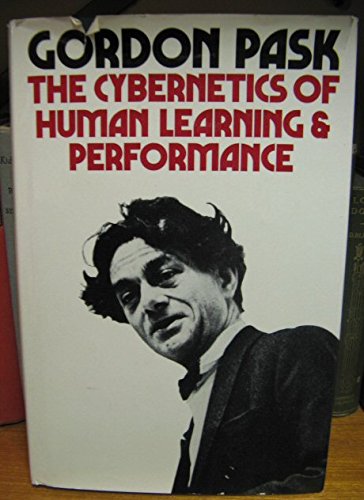
“This book assumes a background knowledge commensurate with having read its predecessor An Approach to Cybernetics (1961) of which some passages are a direct continuation. All that is needed from a system/cybernetic point of view is available in Ashby’s lucid and still up-to-date Introduction to Cybernetics (1965), though the reader with a bent and liking for mathematics will find Glushkov’s Introduction to Cybernetics (1966) profound and comprehensive (the nearly identical title is due to translation). There is a glossary covering all essential technical terms at the end of the book. Readers may find this helpful, not so much because of obscure symbolism (very little is employed) but because ordinary language phrases are used, from time to time, with rather exact meaning; in order to avoid symbols. This trick is played quite often with logical and mathematical terms; sometimes with the relatively comprehensible jargon of psychology, educational science, and philosophy. The other offending speciality is electronics. Knowledge of the subject is unimportant, since the function of components is explained or illustrated. Some otherwise abstract notions are made tangible by the description of electrical machinery; people who are versed in the field may find the details interesting and amusing (especially in Chapter 5 where methods are quaintly redolent of the late 1950s and early 1960s). But there is no need to labour these points; only the function of the machinery bears directly upon the main theme.” (from Preface)
Publisher Hutchinson Educational, 1975
ISBN 0091194903, 9780091194901
347 pages
via pangaro.com
PDF (28 MB, updated on 2017-10-25)
Comment (0)Gordon Pask: Conversation, Cognition and Learning. A Cybernetic Theory and Methodology (1975)
Filed under book | Tags: · cognition, communication, cybernetics, education, learning, psychology
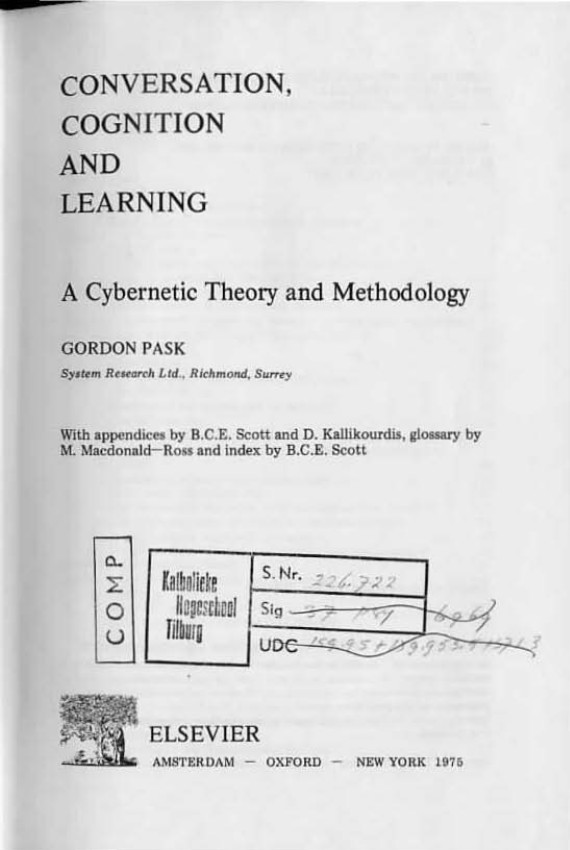
“The work on which the content of this book is centred took place over more than a decade. It started, in the middle fifties, with the construction of adaptive training machines, with superficially disconnected studies of chemical computing systems, and, towards 1960, with experiments on machine-monitored small group inter-action. Since that period an underlying theory has emerged from a gaggle of prescient concepts. It owes a great deal of its present shape to the ideation and criticism of friends and colleagues, only some of whom can be mentioned directly.
First of all, it is noteworthy that parallel work has gone on in two places; my own laboratory at System Research Ltd and in Heinz Von Foerster’s Biological Computer laboratory, at the University of Illinois. Both endeavours were encouraged by Warren McCulloch; the reader will detect the influence of his ideas and guidance appearing repeatedly throughout the discussion. Apart from this, the parallel development was not specially contrived and it was sustained by irregular personal liason. Hence, it is gratifying to find that recent publications from the Biological Computer Laboratory image our own conclusions, differing, chiefly, in the notation employed and the area of application. People familiar with the field will probably find the threads of mutualism quite obvious; for the benefit of others, a few of these threads are picked out. For example, Loefgren worked with Von Foerster whilst refining the formalism on which the currently-used type of abstract reproductive and evolutionary process is founded; Maturana (whose theory of autopoietic systems is the analogue, in a biologist’s mind, for certain stable cognitive organisations in the present theory) worked there as well; Maturana’s theory is to appear in a subsequent monograph in this series. Both Ashby, the system theorist, and Gunther, the philosopher, taught and researched with Von Foerster; much of the present theory hinges upon their ideas.
On home ground, the theory, and the experiments as well, owe a great deal to two colleagues of long standing: Brian Lewis and Bernard Scott. Prof. Lewis and I shared a common interest in cognition since early in the 1960s and brooded jointly (as we still do) over problems of learning and teaching. Bernard Scott came to the laboratory at the time when Lewis went off to study education in the large and since that time we have maintained a comparably symbiotic intellectual relationship. At about the time I started to write this manuscript (having discarded many previous drafts of it as inadequate) both circumstance and research interest brought all of us into close contact again and we were joined, in the last year, by Dionysious Kallikourdis (who contributes one Appendix, explicitly).” (Gordon Pask, from Preface)
With appendices by B.C.E. Scott and D. Kallikourdis, glossary by M. Macdonald-Ross and index by B.C.E. Scott
Publisher Elsevier, Amsterdam/Oxford/New York, 1975
ISBN 0444411933, 9780444411938
570 pages
via pangaro.com
PDF (updated on 2012-7-16)
Comment (0)Gordon Pask: An Approach to Cybernetics (1961/1968)
Filed under book | Tags: · cybernetics, engineering, environment, machine, technology
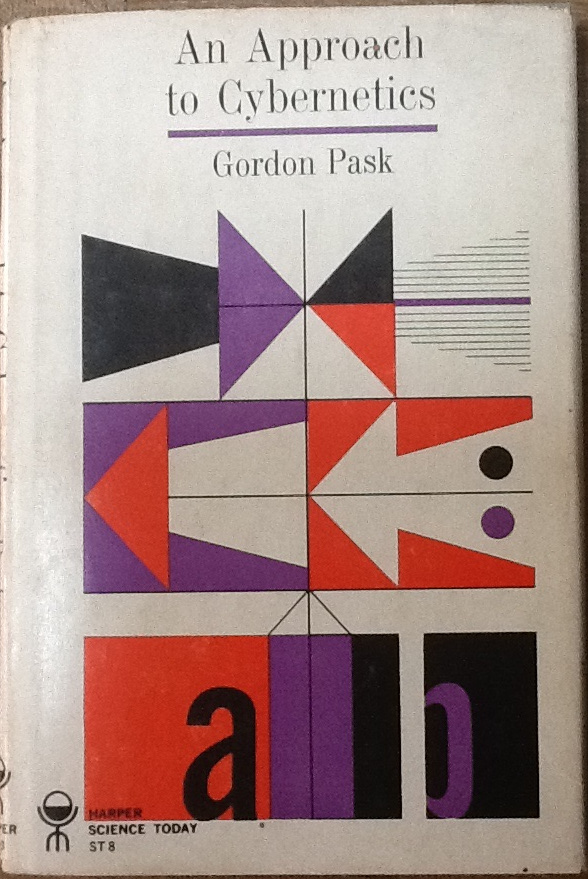
“This book is not for the engineer content with hardware, nor for the biologist uneasy outside his specialty; for it depicts that miscegenation of Art and Science which begets inanimate objects that behave like living systems. They regulate themselves and survive: They adapt and they compute: They invent. They co-operate and they compete. Naturally they evolve rapidly.
Pure mathematics, being mere tautology, and pure physics, being mere fact, could not have engendered them; for creatures to live, must sense the useful and the good; and engines to run must have energy available as work: and both, to endure, must regulate themselves. So it is to Thermodynamics and to its brother SUM(p) log p, called Information Theory, that we look for the distinctions between work and energy and between signal and noise.
For like cause we look to reflexology and its brother feedback, christened Multiple Closed Loop Servo Theory, for mechanical explanation of Entelechy in Homeostasis and in appetition. This is that governance, whether in living creatures and their societies or in our lively artifacts, that is now called Cybernetics.
But under that title Norbert Wiener necessarily subsumed the computation that, from afferent signals, forecasts successful conducts in a changing world.
To embody logic in proper hardware explains the laws of thought and consequently stems from psychology. For numbers the digital art is as old as the abacus, but i came alive only when Turing made the next operation of his machine hinge on the value of the operand, whence its ability to compute any computable number.
For Aristotelian logic, the followers of Ramon Llull, including Leibniz, have frequently made machines for three, and sometimes four classifications. The first of these to be lively computes contingent probabilities.
With this ability to make or select proper filters on its inputs, such a device explains the central problem of experimental epistemology. The riddles of stimulus equivalence or of local circuit action in the brain remain only as parochial problems.
This is that expanding world of beings, man-made or begotten, concerning which Ross Ashby asked, ‘How can such systems organize themselves?’ His answer is, in one sense, too general and its embodiment, too special to satisfy him, his friends or his followers.
This book describes their present toil to put his ideas to work so as to come to grips with his question.” (Warren S. McCulloch, Preface)
With a preface by Warren S. McCulloch
Publisher Hutchinson & Co, London, 1961
This edition March 1968
ISBN: 0090868102, 0090868110
128 pages
via pangaro.com
PDF (updated on 2012-7-16)
Comment (0)