

Shelley Green: Radical Juxtaposition: The Films of Yvonne Rainer (1994)
Filed under book | Tags: · avant-garde, cinema, dance, experimental film, film, film criticism, gender, performance
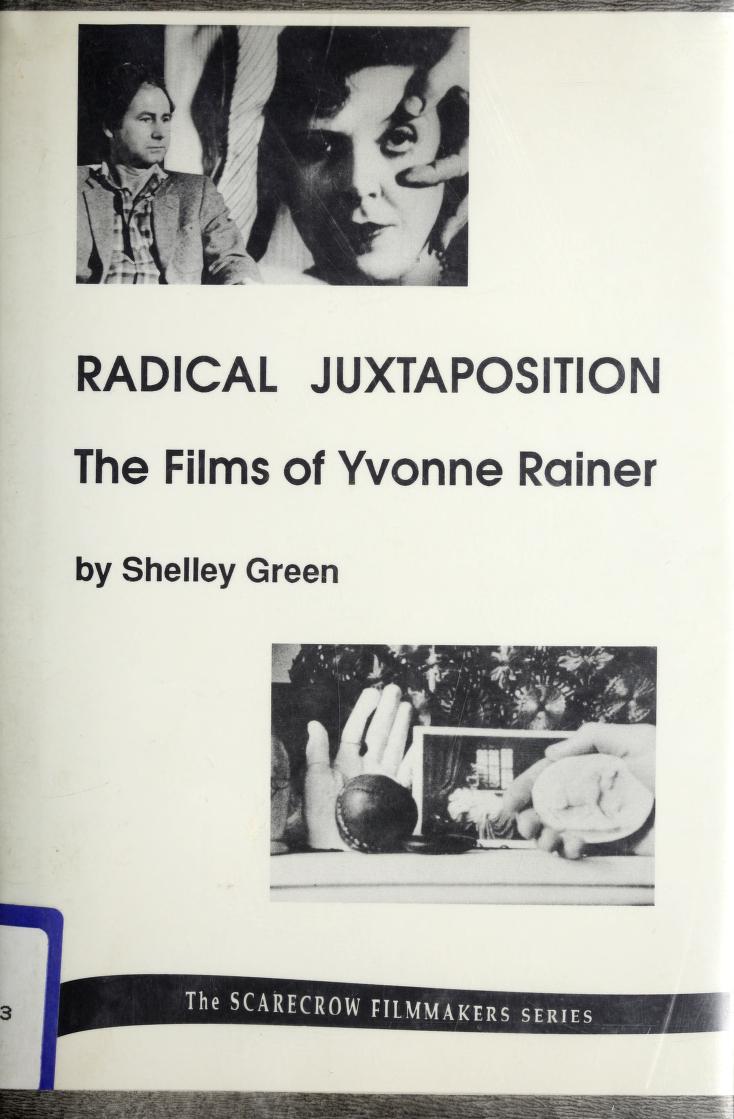
“This volume examines the work of one of the central figures of the avant-garde from her first feature-length film in 1972, Lives of Performers, through Film About a Woman Who… (1974), Kristina Talking Pictures (1976), Journeys from Berlin/1971 (1980), The Man Who Envied Women (1985), to Privilege (1990). The comprehensive study surveys critical reaction and includes Rainer’s critical writings, photos, full biographical information, a complete filmography and bibliography.
The book also investigates dominant structural elements which enliven Rainer’s filmic texts: her complex and disjunctive use of language, speech, repetition, interpolated texts, fragmentation, self-conscious camera movement, autobiography and the formulation of alternative narrative codes. A focal point is the unique relationship established between the filmmaker and the spectator.
Rainer’s narrative strategies have been considered in a radical political context; the author specifically analyzes Rainer’s aggressive reexamination of form as it contributes to the politics of the personal and the political. Resonances created in complex construction of sound, image, editing, characterization, camera movement, and the obliteration and calculated reevaluation of these techniques often directly lead to a new construction of the female subject as well as the female spectator. By creating a cinema that may both construct and include its audience, Rainer’s work has vast implications. The author develops this significant aspect and addresses issues of race, age, and class, especially in later films.” (from the back cover)
Publisher Scarecrow Press, Metuchen, N.J., 1994
The Scarecrow Filmmakers Series, 41
ISBN 0810828634, 9780810828636
174 pages
Commentary: Strictly Film School (2005).
PDF (20 MB, no OCR)
See also Rainer’s films on UbuWeb.
Comment (0)Susanne Knaller (ed.): Realität und Wirklichkeit in der Moderne. Texte zu Literatur, Kunst, Fotografie und Film (2013) [German]
Filed under online resource | Tags: · art, art theory, cinema, film, literary theory, literature, media, modernity, philosophy, photography, reality, theory
An online anthology of 78 theoretical and philosophical texts from the last two centuries presenting a range of conceptions of the reality, in particular exploring the ambiguity of the German notions of Realität and Wirklichkeit. The website also allows reading of the texts through occurrences of 40 selected concepts.
Maintained by Karl-Franzens-Universität Graz
Open Access
Concept
Texts (HTML)
Themes
Categories
Kristin Romberg: Aleksei Gan’s Constructivism, 1917-1928 (2010)
Filed under thesis | Tags: · architecture, art, art history, art theory, cinema, constructivism, film, theory
“This is the first monograph about the Russian constructivist Aleksei Gan (1887-1942) and an experiment in the formal analysis of a materialist practice.
Best known as co-founder of the First Working Group of Constructivists and author of the group’s agitational and theoretical texts, Gan’s own oeuvre was comprised of amateur performances and mass-media objects (texts, books, journals, and films). This dissertation shows that the same qualities of ephemerality and dependency that make Gan’s work resistant to art-historical analysis were also what made it representative of constructivism’s ambitions for a materialist approach to art. In exploring these forms, Gan redefined the ‘work of art’ as a labor process through which the material world, human beings, and normative (common or social) frameworks simultaneously produced one another. The result was an alternative modernism, what I call an aesthetics of embeddedness, whose objects were extensive and responsive structures designed to permeate and shape their environment. Through close readings, the dissertation redefines art-historical concepts such as style and medium in ways specific to Gan’s historical moment, also examining them as manifestations of tensions in the early Soviet imagination. Most crucially these involve the cult of labor, the politics of group formation, and the power of the mass media to mold the normative frameworks governing social reality.
Chapter 1 reevaluates the origins of Russian constructivism by examining Gan’s early career in cultural and political enlightenment organizations, particularly his work in amateur theater and as a ‘constructor of mass action’. Chapter 2 focuses on the crystallization of constructivism as a movement and aesthetic theory in 1921. Chapter 3 looks closely at Gan’s book Constructivism (1922), developing an understanding of constructivism based on a typographic rather than sculptural model of material making. Chapters 4 and 5 examine Gan’s journal projects in terms of architecture and cinema, defining a set of constructive paradigms that run throughout Gan’s work. Finally, chapter 6 treats Gan’s work as a filmmaker in relation to contemporary efforts to rationalize artistic labor.” (Abstract)
Ph.D. Dissertation
Columbia University, New York, 2010
576 pages
PDF (24 MB, illustrations missing, updated on 2017-3-21)
Comment (0)