

Tidal: Occupy Theory, Occupy Strategy, 1 (2011)
Filed under magazine | Tags: · activism, debt, economy, money, occupy movement, politics, protest, theory
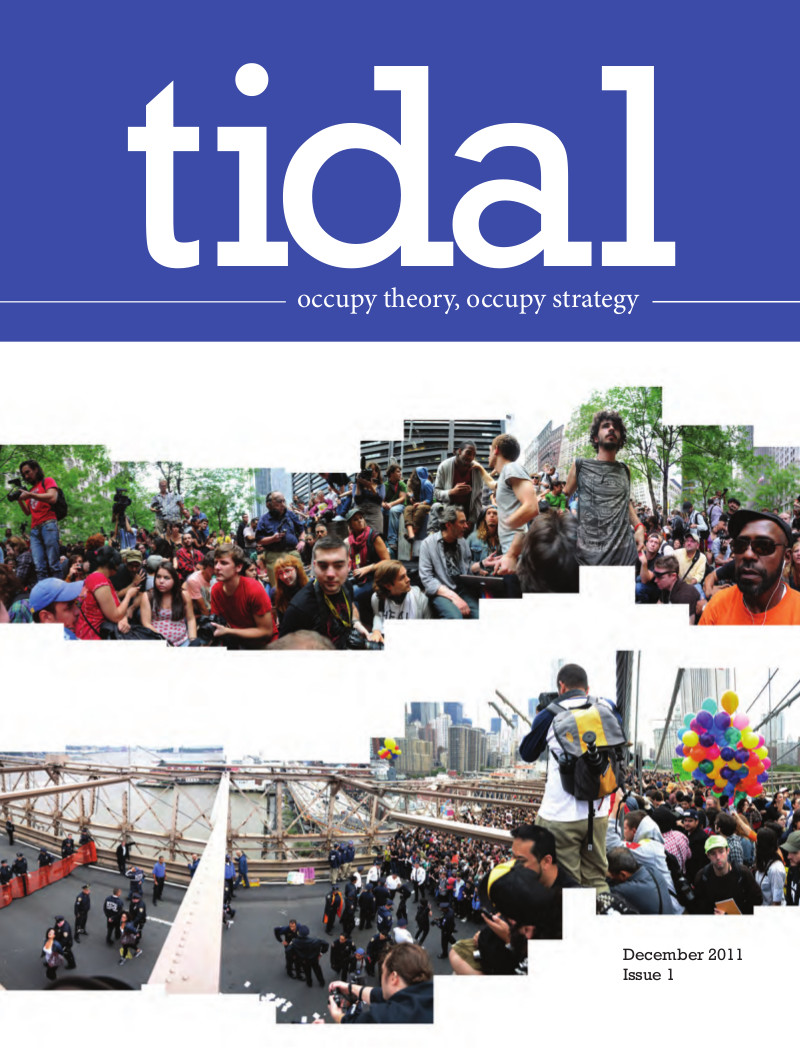
“We believe we can’t have radical action without radical thought.
Tidal offers theory and strategy as a means of empowering occupiers, whether actual or potential, to envision actions that ultimately transforms existing power structures.
In Tidal, theory means an assumption based on limited information or knowledge. Strategy means the art of devising or employing plans or stratagems towards a goal. Action means this. This moment; This struggle. many voices. history. and process. collectively, imagine.
We are an ongoing horizontal conversation among those who have spent most of their lives thinking about this moment, and the people in the Occupy Movement that are making decisions every day about its future. Aware that ability is a privilege, Tidal endeavors to offer challenging ideas in language that’s accessible to the common person. We hope these writings positively impact the Occupy Movement, propel it forward and clarify its goals.” (Editorial statement)
Edited by Natasha Bhagat Singh, Amin Husain, Babak Karimi, Laura Gottesdiener, and Isham Christie
Publisher Occupy Media, December 2011
24 pages
PDF, PDF (2 MB, updated on 2017-12-2)
Comment (0)Christopher Kullenberg, Jakob Lehne (eds.): The Resistance Studies Reader (2009)
Filed under book | Tags: · activism, culture jamming, hacking, internet activism, politics, resistance, social movements, surveillance

Collected articles from the Resistance Studies Magazine, issue 1-3, 2008.
With contributions by Tim Gough, Carol Jo Evans, Shane Gunderson, Patit Paban Mishra, Jeffrey Shantz, Ojakorotu Victor, Adrian Bua Roberts, Patrick Hiller, Thomas Riegler, Pei Palmgren, Ayo Whetho, Christine Whyte
Publisher The Resistance Studies Magazine & The Resistance Studies Network, Gothenburg and London, 2009
Creative Commons Attribution-NonCommercial-ShareAlike 2.0
ISBN 9789197802109
173 pages
Theory & Event 14(4): Occupy Wall Street Movement (2011)
Filed under journal | Tags: · activism, debt, economy, money, occupy movement, politics, protest, social movements, theory

“As we go to press, the Occupy Wall Street movement is in its third month. Inspired in part by the Arab Spring and the acampadas in Madrid and Barcelona, the occupation movement has reinvigorated left politics in the US and spread to more than a thousand cities worldwide. In the place of hopelessness and stagnation, there is an open sense of possibility. Now, as a vivid and undeniable feature of our political setting, outrage over inequality, unemployment, debt, and the political power of money and corporations has a form for its expression. Occupation is that form.
Several weeks ago, we invited political and media theorists to reflect on the event of Occupy Wall Street. Given our intermediated setting as well as the open, horizontal, and practically viral nature of the movement, these reflections aren’t outside the event. Rather, they are part of it, pushing its momentum and understanding in some directions rather than others. Some of the contributions began their lives as blog posts. Some are interventions aiming to influence and advise. Some draw out the global dimensions of the movement. Some attend to the affective and sensory modes of being occupation enables. One was initially delivered as a speech in Zuccotti Park. Together the pieces collected for this supplement to 14.4 produce a theorization of a movement that is just beginning and that in this movement of beginning insists on, claims, and asserts, perhaps more than anything else, the freedom to configure its own space of action.” (from Introduction)
With contributions by Franco Berardi, Wendy Brown, John Buell, William E. Connolly, Jodi Dean, Richard Grusin, John Protevi, McKenzie Wark, Slavoj Zizek
Edited by Jodi Dean
Published in November 2011
E-ISSN: 1092-311X
EPUB (thanks to Marcell Mars; updated on 2012-7-29)
HTML articles