

Aristotle: Poetics (c347-335 BCE–)
Filed under book | Tags: · literary theory, mimesis, philosophy, poetics, poetry, theatre

Aristotle’s Poetics is the earliest surviving work of dramatic theory and the first extant philosophical treatise to focus on literary theory.
The Monoskop wiki hosts passages from the Poetics selected to highlight the ambiguity of the terms central to theory of art and literature, particularly poiêsis, mimêsis and technê (in two Greek versions and three English translations), and an annotated source bibliography of editions and translations of this work into various languages.
Comment (0)Max Planck Institute (ed.): Epistemology and History: From Bachelard and Canguilhem to Today’s History of Science (2012) [EN, FR, DE]
Filed under proceedings | Tags: · discourse, epistemology, historical epistemology, history, history of science, knowledge, philosophy, science, theory
“Over the past few years, “historical epistemology” has had quite a successful international career. Starting with a week-long conference organized by Ian Hacking in Toronto in 1993, historical epistemology was and continues to be used as a label for a wide variety of projects and programs: from Hacking’s own discussion of styles of scientific reasoning to Lorraine Daston’s historicization of epistemological categories and values, Arnold Davidson’s investigations into the conceptual formation of new kinds of knowledge and experience and the attempt undertaken by Peter Damerow et al. to broaden the scope of Jean Piaget’s “genetic epistemology” by historical means.
These conference proceedings attempt to historicize and contextualize historical epistemology and, by the same token, to create a prerequisite for concrete and critical updates.” (from the Introduction)
Contributions by Camille Limoges, François Delaporte, Monika Wulz, Thomas Ebke, Stefanos Geroulanos & Todd Meyers, Claude Debru, Pierre-Olivier Méthot, Françoise Balibar, Sandra Pravica, Cornelius Borck, Andrea Cavazzini, Maria Muhle, Cristina Chimisso, Frieder Otto Wolf, and Anselm Haverkamp.
Publisher Max-Planck Institute for the History of Science, Berlin, 2012
MPG Preprint 434
Open Access
232 pages
PDF (1.4 MB)
Comment (0)Peter Gay: Weimar Culture: The Outsider As Insider (1968–) [EN, CR]
Filed under book | Tags: · 1910s, 1920s, 1930s, architecture, art, bauhaus, cinema, expressionism, film, germany, literature, modernism, music, nazism, philosophy, politics, psychoanalysis, theatre, weimar republic
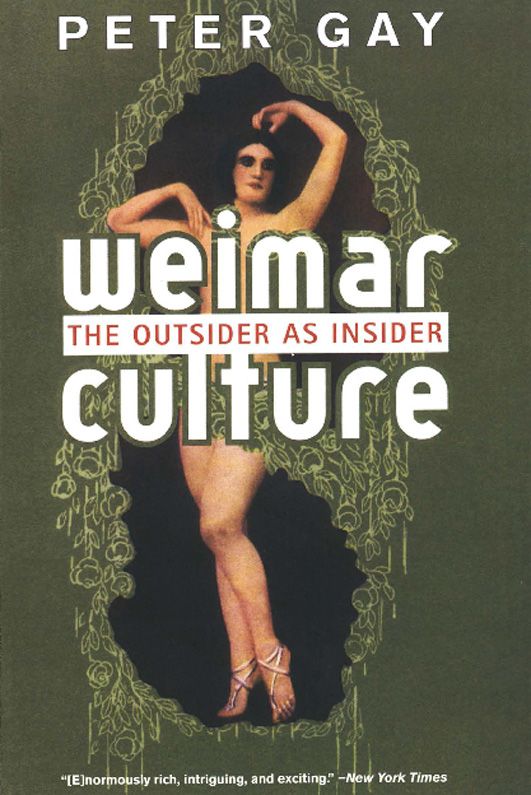
First published in 1968, Weimar Culture is one of the masterworks of Peter Gay’s career. A study of German culture between the two wars, the book brilliantly traces the rise of the artistic, literary, and musical culture that bloomed ever so briefly in the 1920s amid the chaos of Germany’s tenuous post-World War I democracy, and crashed violently in the wake of Hitler’s rise to power. Despite the ephemeral nature of the Weimar democracy, the influence of its culture was profound and far-reaching, ushering in a modern sensibility in the arts that dominated Western culture for most of the twentieth century.
First published by Harper & Row, New York, 1968.
Publisher W. W. Norton, 2001
ISBN 0393322394, 9780393322392
205 pages
via chef
Review (Walter Laquer, The New York Times Books, 1968)
Review (Elizabeth Wiskemann, The Spectator, 1969)
Review (Sterling Fishman, History of Education Quarterly, 1970)
Weimar Culture: The Outsider As Insider (English, 1968/2001, EPUB)
Weimarksa kultura: Isključenik kao uključenik (Croatian, trans. Danja Šilović-Karić, 1999, added on 2014-8-3)