

Christoph Klütsch: Computergrafik: Ästhetische Experimente zwischen zwei Kulturen. Die Anfänge der Computerkunst in den 1960er Jahren (2007) [German]
Filed under book | Tags: · aesthetics, art, computer art, computer graphics, cybernetics, information aesthetics
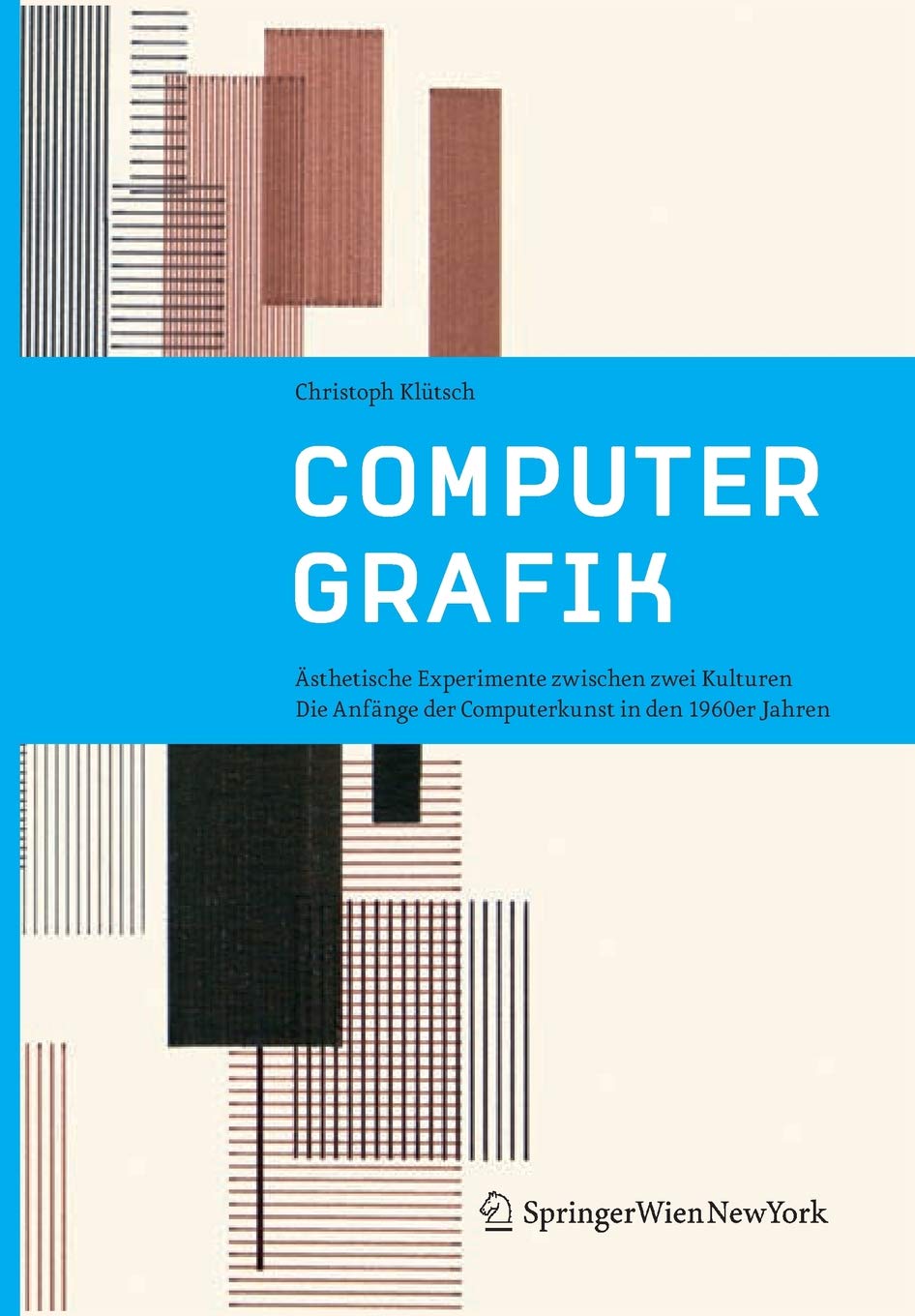
“Computergrafik ist ein innovativer Beitrag zur ungeschriebenen Geschichte der Computergrafik der 60er Jahre. Vor dem Hintergrund C. P. Snows “zwei Kulturen” Diskussion entwickelte sich in der Stuttgarter Schule um Max Bense eine neue Form generativer bzw. algorithmischer Kunst, die die Anfänge der digitalen Computergrafik markieren. Zentrale theoretische und künstlerische Konzepte werden anhand der Werke von Frieder Nake, Georg Nees, A. Michael Noll und Manfred Mohr diskutiert. Pionierleistungen, theoretische Diskussionen und die Bezüge zu zeitgenössischen Kunstbewegungen sind systematisch aufgearbeitet und ermöglichen die Einordnung einer ästhetischen Debatte, wie sie bisher weder im Kontext einer neuen Informationsästhetik noch in der Kunstgeschichte oder in medienwissenschaftlichen Untersuchungen geleistet worden ist. Interviews mit Pionieren der Computergrafik in Deutschland und den USA, die Aufarbeitung schwer zugänglichen Quellenmaterials und eine umfangreiche Bibliographie runden das Werk ab.”
Publisher Springer, 2007
ISBN 3211394095, 9783211394090
288 pages
Key terms: Computerkunst, Frieder Nake, Max Bense, Manfred Mohr, Computergrafik, Informationsästhetik, Bell Labs, Zagreb, Serendipity, Op-Art, C. P. Snow, Informationstheorie, Konkrete Kunst, Semiotik, Kybernetik, Helmar Frank, Computerkünstler, Bridget Riley, Turing test
Review: Mihai Nadin (Image, 2007).
PDF (updated on 2020-11-20)
Academia.edu (from author, added on 2020-11-20)
Grant D. Taylor: The Machine That Made Science Art: The Troubled History of Computer Art 1963-1989 (2004)
Filed under thesis | Tags: · aesthetics, art, art history, computer art, computing, cybernetics, programming, technology
“This thesis represents an historical account of the reception and criticism of computer art from its emergence in 1963 to its crisis in 1989, when aesthetic and ideological differences polarise and eventually fragment the art form. Throughout its history, static-pictorial computer art has been extensively maligned. In fact, no other twentieth-century art form has elicited such a negative and often hostile response. In locating the destabilising forces that affect and shape computer art, this thesis identifies a complex interplay of ideological and discursive forces that influence the way computer art has been and is received by the mainstream artworld and the cultural community at large. One of the central factors that contributed to computer art’s marginality was its emergence in that precarious zone between science and art, at a time when the perceived division between the humanistic and scientific cultures was reaching its apogee. The polarising force inherent in the “two cultures” debate framed much of the prejudice towards early computer art. For many of its critics, computer art was the product of the same discursive assumptions, methodologies and vocabulary as science. Moreover, it invested heavily in the metaphors and mythologies of science, especially logic and mathematics. This close relationship with science continued as computer art looked to scientific disciplines and emergent techno-science paradigms for inspiration and insight. While recourse to science was a major impediment to computer art’s acceptance by the artworld orthodoxy, it was the sustained hostility towards the computer that persistently wore away at the computer art enterprise. The anticomputer response came from several sources, both humanist and anti-humanist. The first originated with mainstream critics whose strong humanist tendencies led them to reproach computerised art for its mechanical sterility. A comparison with aesthetically and theoretically similar art forms of the era reveals that the criticism of computer art is motivated by the romantic fear that a computerised surrogate had replaced the artist. Such usurpation undermined some of the keystones of modern Western art, such as notions of artistic “genius” and “creativity”. Any attempt to rationalise the human creative faculty, as many of the scientists and technologists were claiming to do, would for the humanist critics have transgressed what they considered the primordial mystique of art. Criticism of computer art also came from other quarters. Dystopianism gained popularity in the 1970s within the reactive counter-culture and avant-garde movements. Influenced by the pessimistic and cynical sentiment of anti-humanist writings, many within the arts viewed the computer as an emblem of rationalisation, a powerful instrument in the overall subordination of the individual to the emerging technocracy.” (Abstract)
Ph.D. Thesis
Landscape and Visual Arts, The Faculty of Architecture, The University of Western Australia, 2004
via MediaArtHistories
PDFs (updated on 2016-2-17)
Comment (0)Jacques Rancière: The Politics of Aesthetics: The Distribution of the Sensible (2000-)
Filed under book | Tags: · aesthetics, art, art theory, avant-garde, philosophy, politics, subjectivation

“The Politics of Aesthetics rethinks the relationship between art and politics, reclaiming “aesthetics” from the narrow confines it is often reduced to. Jacques Rancière reveals its intrinsic link to politics by analysing what they both have in common: the delimitation of the visible and the invisible, the audible and the inaudible, the thinkable and the unthinkable, the possible and the impossible.
Presented as a set of inter-linked interviews, The Politics of Aesthetics provides the most comprehensive introduction to Rancière’s work to date, ranging across the history of art and politics from the Greek polis to the aesthetic revolution of the modern age.”
First published as Le partage du sensible: esthétique et politique, La Fabrique, 2000.
Translated with an introduction by Gabriel Rockhill
With an afterword by Slavoj Žižek
Published by Continuum, 2004
ISBN 0826489540, 9780826489548
116 pages
PDF (updated on 2024-2-20)
Comment (0)