

Friedrich Kittler: Optical Media: Berlin Lectures 1999 (2002–)
Filed under book | Tags: · art, art history, computer art, computing, film, film history, history of photography, image, media archeology, painting, philosophy, photography, technology

“This major new book provides a concise history of optical media from Renaissance linear perspective to late twentieth-century computer graphics. Kittler begins by looking at European painting since the Renaissance in order to discern the principles according to which modern optical perception was organized. He also discusses the development of various mechanical devices, such as the camera obscura and the laterna magica, which were closely connected to the printing press and which played a pivotal role in the media war between the Reformation and the Counter-Reformation.
After examining this history, Kittler then addresses the ways in which images were first stored and made to move, through the development of photography and film. He discusses the competitive relationship between photography and painting as well as between film and theater, as innovations like the Baroque proscenium or “picture-frame” stage evolved from elements that would later constitute cinema. The central question, however, is the impact of film on the ancient monopoly of writing, as it not only provoked new forms of competition for novelists but also fundamentally altered the status of books. In the final section, Kittler examines the development of electrical telecommunications and electronic image processing from television to computer simulations.
In short, this book provides a comprehensive introduction to the history of image production that is indispensable for anyone wishing to understand the prevailing audiovisual conditions of contemporary culture.”
Publisher Merve, Berlin, 2002
Internationaler Merve Diskurs series, 250
ISBN 3883961833, 9783883961835
331 pages
English edition
Translated by Anthony Enns
With an introduction by John Durham Peters
Publisher Polity, 2009
ISBN 0745640915, 9780745640914
vi+250 pages
Reviews: Anthony Enns (Electronic Book Review 2004), Nicholas Gane and Hannes Hansen-Magnusson (Theory Culture Society 2006), Kiss (2006, HU), Bohár (HU), Jussi Parikka (2011).
Publisher (DE)
Publisher (EN)
Worldcat (DE)
Worldcat (EN)
Optische Medien. Berliner Vorlesung 1999 (German, 2002, added on 2016-8-13, removed on 2017-8-10 upon request from publisher – read first two chapters)
Optical Media: Berlin Lectures 1999 (English, trans. Anthony Enns, 2009)
Journal of Sonic Studies, Vol. 3: Rethinking Theories of Television Sound (2012)
Filed under journal | Tags: · acoustics, cinema, film, music, sound, television, voice

“The essays collected in this special issue of the Journal of Sonic Studies are intended to rethink the existing theories of television sound by offering a reexamination of some of the most persistent accounts of television sound from the 1980s to the present. These essays examine the technological and aesthetic changes that have accompanied the rise of new technologies, production practices, and listening perspectives over the past few decades, and they draw on a wide range of genres and categories of television sound, including commentary, voice-over, sound effects, and music soundtracks.” (from the Editorial)
Edited by Carolyn Birdsall, Anthony Enns
Publisher Leiden University Press
View online (HTML articles)
Previous two issues
René Clair: Cinema Yesterday and Today (1970/1972)
Filed under book | Tags: · cinema, film, film criticism, film history, screen, silent film, theatre
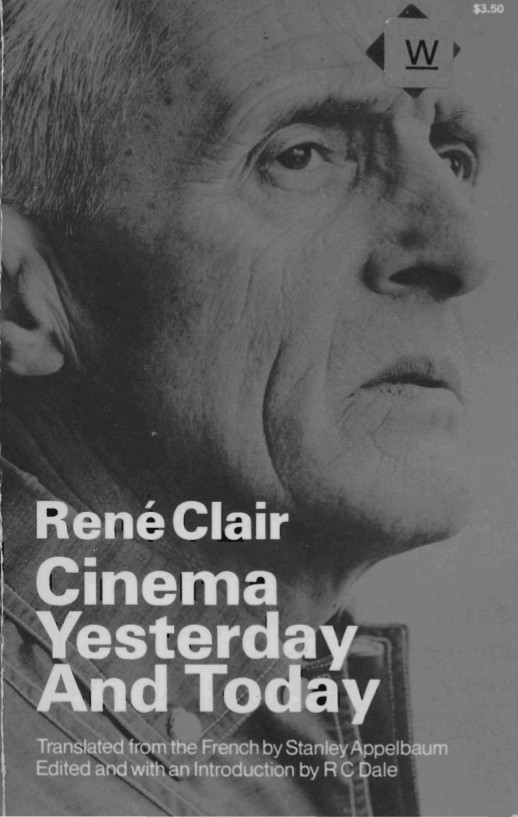
This is the first English translation of Rene Clair’s Cinema d’hier, cinema d’aujourd’hui, which, when it appeared in France in 1970, easily won the prize for best film book of the year. In it the master of French film comedy plays with time in much the same way that a film editor might – he combines reviews written during the twenties and thirties with comments made in 1950 and again in 1970, and includes brief notes from other years as well as an imaginary dialogue with himself across time. The result is surprisingly unified. It is Clair’s coherent vision of the cinema as he surveys his entire career and the whole of film history. In the best sense of the term, it is an essay, and one of the very few such works written by a giant in the world of film.
Mixing personal memories with critical perception and aesthetics, he discusses the making of Entr’acte and comments specifically on a large number of European and American films. He recounts his struggle through the birth of the sound film, hailing it for its potential but regretting the loss of a world of dreams.
Clair does not consider cinema in a vacuum but alludes frequently to the works of Rimbaud, Jarry, Shakespeare, Moliere, Racine, De Quincey and a host of others. His own writing is full of intelligence, freedom and elegance. His defense of comedy is striking, and he gives ample play to his own comic sense in the many anecdotes that everywhere enliven the text. Perhaps his love of cinema is best illustrated by his use of three words in describing it–“miracle,” “faith” and “grace.”
Originally published in French as Cinéma d’hier, cinéma d’aujourd’hui, Gallimard, 1970
Translated by Stanley Appelbaum
Edited and with an Introduction by R C Dale
Publisher Dover Publications, 1972
ISBN 0486227758, 9780486227757
260 pages