

Amy E. Wendling: Karl Marx on Technology and Alienation (2009)
Filed under book | Tags: · alienation, capitalism, communism, labour, machine, philosophy, philosophy of technology, revolution, technology, thermodynamics, value, women, work
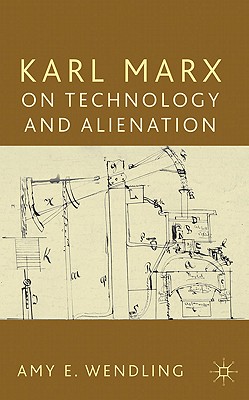
“In Karl Marx on Technology and Alienation, Amy Wendling draws on lesser known archival materials, including Marx’s notebooks on women and patriarchy and technology to offer a new interpretation of Marx’s concept of alienation as it develops throughout his works. For Marx, technology exemplifies the interaction between human beings and nature. Marx’s description of this interaction is in transition throughout his works. An older, humanist and vitalist paradigm sets the human being against nature as a qualitatively different type of force. A newer, thermodynamic paradigm sets the human being and nature in continuity. Marx’s work occurs at the juncture of these paradigms and contains elements of each. This affects his deployment of the concept ‘labor’. Labor is demoted from its status as a meaningful human activity that confers political status and mastery of the natural world, and it becomes a mere nodal point where energy is transferred. Against this backdrop, Marx increasingly appealed not to meaningful labor but to the abolition of labor as the culmination of human freedom. He also shows how the labours of members of the working class, including women, are interpreted in the old and new paradigms.”
Publisher Palgrave Macmillan, 2009
ISBN 0230224407, 9780230224407
272 pages
Reviews: Chris Arthur (Marx & Philosophy Review of Books, 2010), Richard Cotter (LSE Review of Books, 2013), Tom Bunyard (Historical Materialism, 2014), McKenzie Wark (Public Seminar, 2015).
Comment (0)transversal, 01/13: The Languages of the Banlieues (2013) [EN, DE, FR, Arabic]
Filed under journal | Tags: · capitalism, cognitive capitalism, geopolitics, knowledge, knowledge production, labour, theory
“The crises within cognitive capitalism and cognitive labor are mirrored in the reproduction and exacerbation of global divisions of labor and the emergence of new forms of exploitation as part of a regime of flexible capital accumulation. While drastic austerity measures and heightened control mechanisms lead to a radical transformation of the welfare state on the one hand, new networks of communication, struggle and alternative forms of knowledge emerge on the other.
This issue of transversal attempts to review some of the general assumptions of a theory of cognitive capitalism and to unsettle the very notions of knowledge and its production, discussing the conditions of its capture, its “re-invention” and its capacity for creating worlds. The individual essays follow the lines of a (post-)colonial historicity and a feminist and geopolitical critique of capitalist valorization, thereby questioning the materiality of knowledge and its production in relation to resources and bodies, as well as how art and knowledge production are interwoven with political struggles.” (Editorial)
With contributions by Anne Querrien, Marc Hatzfeld, Amina Bensalah/Myriam Suchet, Boris Seguin, Sonia Chikh (Les engraineurs), Abdoulah Bensaid (Musik à Venir), Françoise Dibotto Soppi.
Editors: Lina Dokuzović, Therese Kaufmann, Raimund Minichbauer, Radostina Patulova
Publisher eipcp – European Institute for Progressive Cultural Policies, Vienna/Linz
Copyleft
ISSN 1811-1696
HTML (updated on 2020-4-18)
Previous issue
Tiqqun: Raw Materials for a Theory of the Young-Girl (1999–) [EN, DE]
Filed under book | Tags: · biopolitics, biopower, body, capitalism, consumerism, desire, feminism, labour, love, metaphysics, philosophy, reification, seduction, sexuality, theory
“First published in France in 1999, Preliminary Materials for a Theory of the Young-Girl dissects the impossibility of love under Empire. The Young-Girl is consumer society’s total product and model citizen: whatever “type” of Young-Girl she may embody, whether by whim or concerted performance, she can only seduce by consuming. Filled with the language of French women’s magazines, rooted in Proust’s figure of Albertine and the amusing misery of (teenage) romance in Witold Gombrowicz’s Ferdydurke, and informed by Pierre Klossowski’s notion of “living currency” and libidinal economy, Preliminary Materials for a Theory of the Young-Girl diagnoses — and makes visible — a phenomenon that is so ubiquitous as to have become transparent.
In the years since the book’s first publication in French, the worlds of fashion, shopping, seduction plans, makeover projects, and eating disorders have moved beyond the comparatively tame domain of paper magazines into the perpetual accessibility of Internet culture. Here the Young-Girl can seek her own reflection in corporate universals and social media exchanges of “personalities” within the impersonal realm of the marketplace. Tracing consumer society’s colonization of youth and sexuality through the Young-Girl’s “freedom” (in magazine terms) to do whatever she wants with her body, Tiqqun exposes the rapaciously competitive and psychically ruinous landscape of modern love.” (from Semiotexte, the publisher of the 2012 edition)
Announcement and discussion about the translation
Commentary (Rob Horning, 2012)
More commentaries (compiled by 1000 Little Hammers, 2013)
Originally published in French as Premiers matériaux pour une Théorie de la Jeune-Fille in Tiqqun 1, 1999
Revised, republished by Éditions Mille et une nuits, 2001.
Translator unknown
Published on younggirl.jottit.com, Jan 2010
PDF (2010)
HTML (2010)
HTML (2012 edition, trans. Ariana Reines, Preliminaries + Chapters 6 & 7)
German edition (2009)