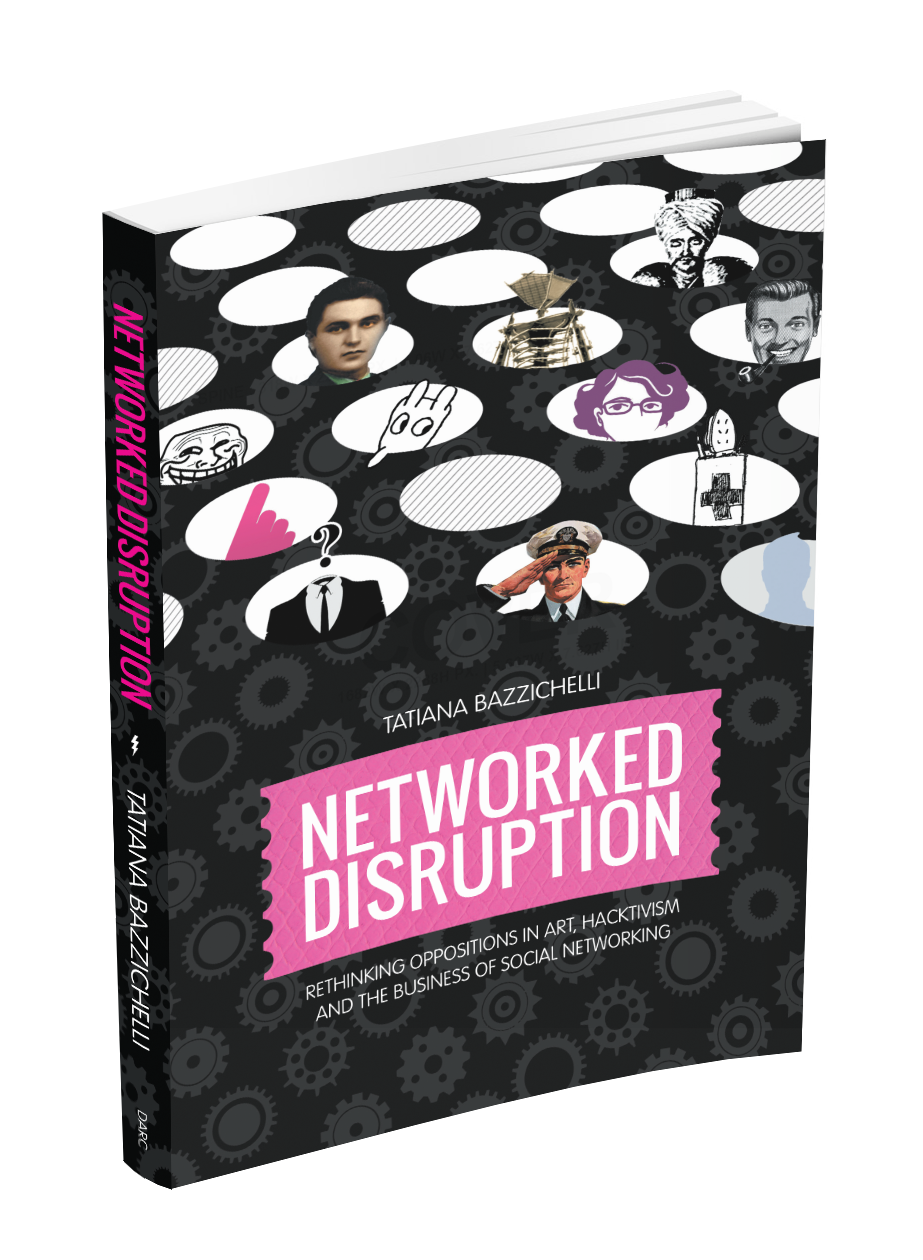

Tatiana Bazzichelli: Networked Disruption: Rethinking Oppositions in Art, Hacktivism and the Business of Social Networking (2011)

19 May 2012, dusan

“The objective of this research is to rethink the meaning of critical and oppositional practices in art, hacktivism and the business of social networking. The aim is to analyse hacker and artistic practices through business instead of in opposition to it. By identifying the emerging contradictions within the current economical and political framework of Web 2.0, my aim is to reflect on the status of activist and hacker practices as well as those of artists in the new generation of social media (or so called Web 2.0 technologies), analysing the interferences between networking participation and disruptive business innovation.” (author)

PhD Dissertation
Department of Information and Media Studies, Aarhus University, December 2011
Supervisor: Søren Pold, Department of Information and Media Studies, Aarhus University
Co-supervisor: Fred Turner, Communication Department, Stanford University, California
Peer Production License
272 pages

author

Download
Download (new version from 2013-3-15)

UNDP: Social Media, Accountability, and Public Transparency in Eastern Europe and CIS (2011)

23 March 2012, dusan

The domination of the executive over other branches of the government and the media is frequent in Eastern Europe and the Commonwealth of Independent States (CIS), but the rapid development of social media is changing this pattern by transforming personal conversations and individual opinions into a subject of public debate.

Publisher UNDP Bratislava Regional Centre, October 2011

review (Eva Vozárová, Fair-play Alliance)

Download
View online (Issuu.com)

Information Economics and Policy, Vol 24, No 1: The Economics of Digital Media Markets (2012)

11 March 2012, dusan

IEP is a broad-based, international journal that aims to publish policy-oriented research about the production, distribution and use of information.

“This issue brings together a series of contributions related to the economics of digital media markets. The special issue covers eight papers, each highlighting areas where digital technology is altering markets in ways not fully captured by existing research.” (from Editorial)

Guest edited by Lapo Filistrucchi and Catherine Tucker
Editor-in-chief: Lisa M. George
Publisher Elsevier B.V., March 2012
90 pages

via andrejchudy

publisher

Download (single PDF)
Download (PDF and HTML articles)

Barbora Buchtová: Mapování internetových memů v prostředí blogosféry a sociálních sítí (2011) [Czech]

20 February 2012, dusan

S nástupem fenoménu, který bývá mnohdy označován jako web 2.0, se začal značně rozmáhat trend sociálních sítí a blogingu. Pokud se na sociální sítě a blogosféru podíváme pod drobnohledem, zjistíme, že jsou uskupeny z mnoha memů, které v jednotlivých blozích a sociálních sítích kolují a tím je navzájem propojují. Zároveň se však jednotlivé memy v průběhu doby vyvíjí a proměňují. Tato magisterská diplomová práce popisuje vývoj a pohyb internetových memů prostřednictvím teorie sítí. Na základě aplikace blogové ontologie (BloOn) se pokuší vylíčit blogosféru a sociální sítě jako komplexní systém skládající se z mnoha vzájemně propojených elementů a vazeb mezi nimi. Zároveň se snaží memy v prostředí blogosféry a sociálních sítí klasifikovat a systematizovat nástroje, které dokáží internetové memy mapovat, dle metod webové memetiky. V závěru práce je možné naleznout analýzu komparující tři komerční nástroje určené pro monitoring sociálních sítí a blogosféry.

Diplomová práce
Masarykova Univerzita, Filozofická fakulta, Informační studia a knihovnictví/Informační studia a knihovnictví
Vedoucí práce: Michal Lorenz
Brno: FF MU, 2011

via andrejchudy

more info

Direct download

Allison H. Fine: Momentum: Igniting Social Change in the Connected Age (2006)

17 February 2012, dusan

A new and empowering way of looking at and organizing social change! How can we move from serving soup until our elbows ache to solving chronic social ills like hunger or homelessness? How can we break the disastrous cycle of low expectations that leads to chronic social failures?

The answers to these questions lie within Momentum, a fresh, zestful way of thinking about and organizing social change work. Today’s digital tools—including but not limited to e-mail, the Web, cell phones, personal digital assistants (PDAs), even iPods—promote interactivity and connectedness. But as Momentum shows, these new social media tools are important not for their wizardry but because they connect us to one another in inexpensive, accessible, and massively scalable ways.

Publisher John Wiley & Sons, 2006
ISBN 0787984442, 9780787984441
220 pages

author
publisher
google books

Download

Lee Siegel: Against the Machine: Being Human in the Age of the Electronic Mob (2008)

17 February 2012, dusan

From the author hailed by the New York Times Book Review for his “drive-by brilliance” and dubbed by the New York Times Magazine as “one of the country’s most eloquent and acid-tongued critics” comes a ruthless challenge to the conventional wisdom about the most consequential cultural development of our time: the Internet.

Of course the Internet is not one thing or another; if anything, its boosters claim, the Web is everything at once. It’s become not only our primary medium for communication and information but also the place we go to shop, to play, to debate, to find love. Lee Siegel argues that our ever-deepening immersion in life online doesn’t just reshape the ordinary rhythms of our days; it also reshapes our minds and culture, in ways with which we haven’t yet reckoned. The web and its cultural correlatives and by-products—such as the dominance of reality television and the rise of the “bourgeois bohemian”—have turned privacy into performance, play into commerce, and confused “self-expression” with art. And even as technology gurus ply their trade using the language of freedom and democracy, we cede more and more control of our freedom and individuality to the needs of the machine—that confluence of business and technology whose boundaries now stretch to encompass almost all human activity.

Siegel’s argument isn’t a Luddite intervention against the Internet itself but rather a bracing appeal for us to contend with how it is transforming us all. Dazzlingly erudite, full of startlingly original insights, and buoyed by sharp wit, Against the Machine will force you to see our culture—for better and worse—in an entirely new way.

Publisher Spiegel & Grau, a division of Random House, New York, 2008
ISBN 0385522657, 9780385522656
182 pages

review (Adam Thierer, Technology Liberation Front)
review (Louis Bayard, Salon)
review (John Lanchester, The New York Times)
review (Janet Maslin, The New York Times)

publisher
google books

Download

Mark Bauerlein (ed.): The Digital Divide: Arguments for and Against Facebook, Google, Texting, and the Age of Social Networking (2011)

27 December 2011, dusan

This definitive work on the perils and promise of the social- media revolution collects writings by today’s best thinkers and cultural commentators, with an all-new introduction by Bauerlein.

Twitter, Facebook, e-publishing, blogs, distance-learning and other social media raise some of the most divisive cultural questions of our time. Some see the technological breakthroughs we live with as hopeful and democratic new steps in education, information gathering, and human progress. But others are deeply concerned by the eroding of civility online, declining reading habits, withering attention spans, and the treacherous effects of 24/7 peer pressure on our young.

With The Dumbest Generation, Mark Bauerlein emerged as the foremost voice against the development of an overwhelming digital social culture. But The Digital Divide doesn’t take sides. Framing the discussion so that leading voices from across the spectrum, supporters and detractors alike, have the opportunity to weigh in on the profound issues raised by the new media-from questions of reading skills and attention span, to cyber-bullying and the digital playground- Bauerlein’s new book takes the debate to a higher ground.

The book includes essays by Steven Johnson, Nicholas Carr, Don Tapscott, Douglas Rushkoff, Maggie Jackson, Clay Shirky, Todd Gitlin, and many more. Though these pieces have been previously published, the organization of The Digital Divide gives them freshness and new relevancy, making them part of a single document readers can use to truly get a handle on online privacy, the perils of a plugged-in childhood, and other technology-related hot topics.

Rather than dividing the book into “pro” and “con” sections, the essays are arranged by subject-”The Brain, the Senses,” “Learning in and out of the Classroom,” “Social and Personal Life,” “The Millennials,” “The Fate of Culture,” and “The Human (and Political) Impact.” Bauerlein incorporates a short headnote and a capsule bio about each contributor, as well as relevant contextual information about the source of the selection.

Bauerlein also provides a new introduction that traces the development of the debate, from the initial Digital Age zeal, to a wave of skepticism, and to a third stage of reflection that wavers between criticism and endorsement.

Enthusiasms for the Digital Age has cooled with the passage of time and the piling up of real-life examples that prove the risks of an online-focused culture. However, there is still much debate, comprising thousands of commentaries and hundreds of books, about how these technologies are rewriting our futures. Now, with this timely and definitive volume, readers can finally cut through the clamor, read the the very best writings from each side of The Digital Divide, and make more informed decisions about the presence and place of technology in their lives.

Introduction by Mark Bauerlein
Publisher Penguin Group US, 2011
ISBN 1101547529, 9781101547526
368 pages

publisher
google books

Download (updated on 2012-9-3)

Recent comments
Recent entries
More resources