
Emmett Williams (ed.): An Anthology of Concrete Poetry (1967/2013)
Filed under poetry | Tags: · concrete poetry, language, literature, poetry, visual poetry

“Concrete Poetry is not one style but a cluster of possibilities, all falling in the Intermedium between semantic poetry, calligraphic and typographic poetry, and sound poetry.
It first crystalized out of these earlier modes in the early 1950s in the works of such people as Eugen Gomringer (CH), Carlo Belloli (IT), Dieter Rot (IS), Öyvind Fahlström (SW), the Noigandres Group (Haroldo and Augusto de Campos, Décio Pignatari and others, BR), Carlfriedrich Claus (GDR), Gerhard Rühm, Friedrich Achleitner and H.C. Artmann (AT), Daniel Spoerri and Claus Bremer (DE), and Emmett Williams (US, then living in DE). In recent years a second generation of major figures have added to the movement, including such people as Hansjörg Mayer (DE), Ladislav Novák and Jiří Kolář (CZ), Edwin Morgan and Ian Hamilton Finlay (SC), Bob Cobbing (EN), bp Nichol (CA), Mary Ellen Solt and Jonathan Williams (US), Pierre and Ilse Garnier (FR), Seiichi Niikuni and Kitasono Katue (JP) and many others.
The very fact of the appearance of parallel work more or less independently in so many countries and languages indicates one of the unique aspects of the movement, namely its source being in the development of a new mentality in which values become fused and inter-relationships established on a more complex plain than was the case in the purer, earlier modes of poetry.” (Something Else Press, 1967)
Publisher Something Else Press, New York, 1967
New edition Primary Information, New York, 2013
ISBN 9780985136437
x+342 pages
via Silvio Lorusso
Reviews: Ingrid Melano (Kaleidoscope 2014), Sam Rowe (Chicago Review 2014).
PDF (91 MB)
Comment (1)Collected Works of Velimir Khlebnikov, 3 vols. (1987-1998)
Filed under poetry | Tags: · fiction, futurism, language, literary theory, literature, poetics, poetry, theatre, zaum


“Dubbed by his fellow Futurists the “King of Time”, Velimir Khlebnikov (1885–1922) spent his entire brief life searching for a new poetic language to express his convictions about the rhythm of history, the correspondence between human behavior and the “language of the stars.” The result was a vast body of poetry and prose that has been called hermetic, incomprehensible, even deranged. Of all this tragic generation of Russian poets (including Blok, Esenin, and Mayakovsky), Khlebnikov has been perhaps the most praised and the more censured.”
Edited by Charlotte Douglas (1), Ronald Vroon (2-3)
Translated by Paul Schmidt
Publisher Harvard University Press, 1987-98
ISBN 0674140451 (1), 067414046X (2), 0674140478 (3)
xii+452 & xii+403 & x+274 pages
Reviews: Cooke (of Vol 1, SEER 1989), Yastremski (of Vol 2, SEEJ 1990).
1. Letters and Theoretical Writings (1987, 29 MB)
2. Prose, Plays, and Supersagas (1989, 17 MB)
3: Selected Poems (1998, 10 MB)
More from Khlebnikov (incl 6-volume Russian collection)
Khlebnikov on Ubuweb Sound
César Vallejo: Trilce (1922–) [Spanish, English]
Filed under poetry | Tags: · avant-garde, language, poetry
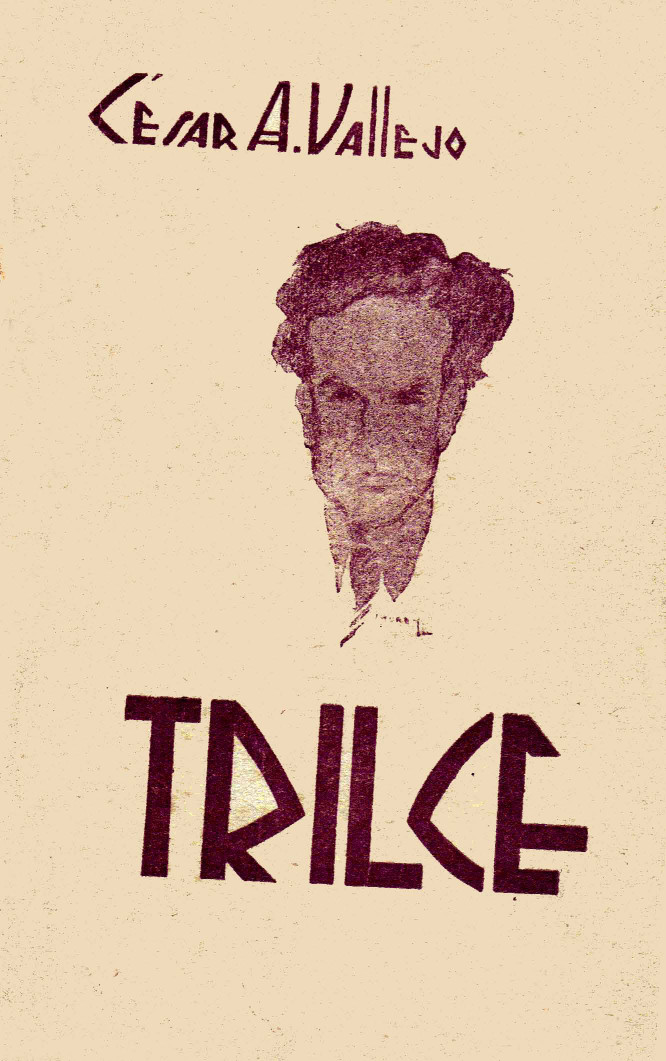
Trilce is the second and the most well-known book of poetry by the Peruvian author César Vallejo.
Pared of all ornamental language, Trilce introduces the wrenched syntax that allows Vallejo to get beyond the constraints of received linguistic conventions. Writing in A History of Peruvian Literature, James Higgins catalogues the elements of Vallejo’s diction: “Vallejo confounds the reader’s expectations by his daring exploitation of the line pause, which often leaves articles, conjunctions and even particles of words dangling at the end of a line, by his frequent resort to harsh sounds to break the rhythm, by employing alliterations so awkward as to be tongue-twisters. He distorts syntactic structures, changes the grammatical function of words, plays with spelling. His poetic vocabulary is frequently unfamiliar and ‘unliterary,’ he creates new words of his own, he often conflates two words into one, he tampers with cliches to give them new meaning, he plays on the multiple meaning of words and on the similarity of sound between words. He repeatedly makes use of oxymoron and paradox and, above all, catachresis, defamiliarising objects by attributing to them qualities not normally associated with them.”
D. P. Gallagher suggests in Modern Latin American Literature that Vallejo was “perhaps the first Latin American writer to have realized that it is precisely in the discovery of a language where literature must find itself in a continent where for centuries the written word was notorious more for what it concealed than for what it revealed, where ‘beautiful’ writing, sheer sonorous wordiness was a mere holding operation against the fact that you did not dare really say anything at all.” (from Vallejo’s biography by Poetry Foundation)
With a Foreword by Antenor Orrego
Publisher Talleres tipográficos de la Penitenciaría, Lima, 1922
136 pages
via Biblioteca BBVA
Commentary (Michelle Clayton, Poetry in Pieces: César Vallejo and Lyric Modernity, 2011, 329 pp)
Wikipedia (ES)
Wikipedia (EN)
PDF (Spanish), other editions: 1961, 1982, 1986, 1987
HTML (Spanish/English, trans. Clayton Eshleman, 2007)