

Jacques Rancière: Aisthesis: Scenes from the Aesthetic Regime of Art (2011/2013)
Filed under book | Tags: · aesthetics, art, art history, art theory, body, cinema, dance, film, life, literature, music, painting, pantomime, philosophy, photography, poetry, politics, representation, sculpture, theatre, theory
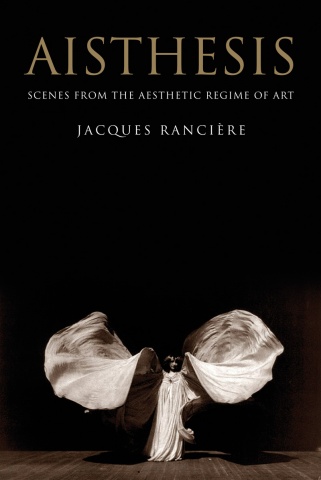
Rancière’s magnum opus on the aesthetic.
“Composed in a series of scenes, Aisthesis–Rancière’s definitive statement on the aesthetic–takes its reader from Dresden in 1764 to New York in 1941. Along the way, we view the Belvedere Torso with Winckelmann, accompany Hegel to the museum and Mallarmé to the Folies-Bergère, attend a lecture by Emerson, visit exhibitions in Paris and New York, factories in Berlin, and film sets in Moscow and Hollywood. Rancière uses these sites and events—some famous, others forgotten—to ask what becomes art and what comes of it. He shows how a regime of artistic perception and interpretation was constituted and transformed by erasing the specificities of the different arts, as well as the borders that separated them from ordinary experience. This incisive study provides a history of artistic modernity far removed from the conventional postures of modernism.”
First published as Aisthesis : Scènes du régime esthétique de l’art, Éditions Galilée, 2011
Translated by Zakir Paul
Publisher Verso Books, 2013
ISBN 1781680892, 9781781680896
304 pages
via falsedeity
Reviews: Hal Foster (London Review of Books), Joseph Tanke (Los Angeles Review of Books), Marc Farrant (The New Inquiry), Ali Alizadeh (Sydney Review of Books), Jean-Philippe Deranty (Parrhesia).
Roundtable discussion with Rancière at Columbia (video, 43 min)
Selected interviews and reviews (in French)
Simone Forti: Handbook in Motion (1974)
Filed under book | Tags: · choreography, dance, movement, performance
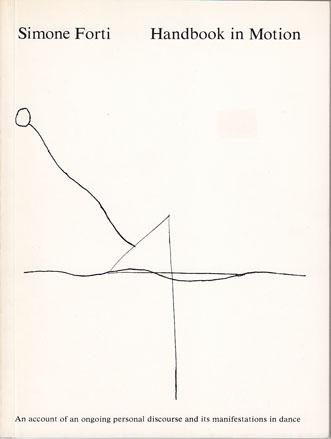
An account of an ongoing personal discourse and its manifestations in dance. Simone Forti is a dancer who has always forged her own path. She arrived in New York in the early 60’s from California. She brought with her a series of pieces that proved to be of serious influence on the development of “post modern” dance and sculpture in years to come. Her “dance-constructions” were based on a concern with bodies in action, the movement not being stylized or presented for its visual line but rather as a physical fact. The artist traces the development of her work intuitively rather than chronologically, including narratives about a time of participation in the drug culture that sheds light on the changes in her dancing. The book includes drawings, “dance reports” (short descriptions of events whose movement made a deep impression on the author’s memory), and documentary materials such as scores, descriptions, and photographic records of performances. Covers work from 1959 – 1973.
First published in 1974
Third edition, 1988
Publisher The Press of the Nova Scotia College of Art and Design, Halifax, Canada; with New York University Press, New York
Editor Kasper Koenig
ISBN 0937645052
152 pages
Siegfried Kracauer: The Mass Ornament: Weimar Essays (1963/1995)
Filed under book | Tags: · 1920s, 1930s, cinema, cultural criticism, cultural politics, dance, everyday, film theory, germany, literature, photography, weimar republic

“Siegfried Kracauer was one of the twentieth century’s most brilliant cultural critics, a daring and prolific scholar, and an incisive theorist of film. In this volume his finest writings on modern society make their long-awaited appearance in English.
This book is a celebration of the masses–their tastes, amusements, and everyday lives. Taking up themes of modernity, such as isolation and alienation, urban culture, and the relation between the group and the individual, Kracauer explores a kaleidoscope of topics: shopping arcades, the cinema, bestsellers and their readers, photography, dance, hotel lobbies, Kafka, the Bible, and boredom. For Kracauer, the most revelatory facets of modern life in the West lie on the surface, in the ephemeral and the marginal. Of special fascination to him is the United States, where he eventually settled after fleeing Germany and whose culture he sees as defined almost exclusively by “the ostentatious display of surface.”
With these essays, written in the 1920s and early 1930s and edited by the author in 1963, Kracauer was the first to demonstrate that studying the everyday world of the masses can bring great rewards. The Mass Ornament today remains a refreshing tribute to popular culture, and its impressively interdisciplinary essays continue to shed light not only on Kracauer’s later work but also on the ideas of the Frankfurt School, the genealogy of film theory and cultural studies, Weimar cultural politics, and, not least, the exigencies of intellectual exile.
In his introduction, Thomas Levin situates Kracauer in a turbulent age, illuminates the forces that influenced him–including his friendships with Walter Benjamin, Theodor Adorno, and other Weimar intellectuals–and provides the context necessary for understanding his ideas. Until now, Kracauer has been known primarily for his writings on the cinema. This volume brings us the full scope of his gifts as one of the most wide-ranging and penetrating interpreters of modern life.”
Originally published in German as Das Ornament der Masse: Essays, Suhrkamp Verlag, 1963
Translated, Edited, and with an Introduction by Thomas Y. Levin
Publisher Harvard University Press, 1995
ISBN 0674551621
416 pages