

Ivan Illich: Gender (1982)
Filed under book | Tags: · commons, economics, economy, gender, labour, marxism, medicine, men, production, rent, sex, sexuality, women, work
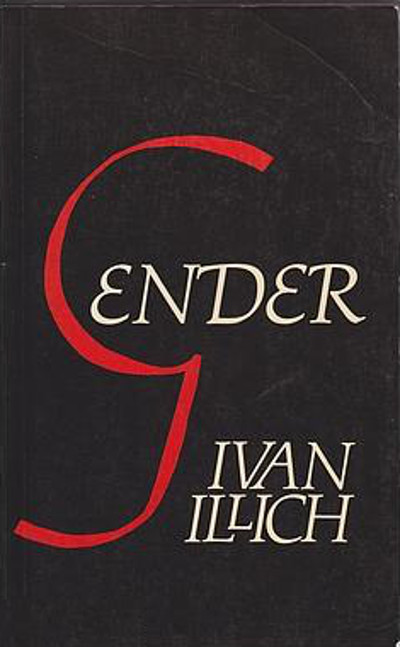
“The break with the past, which has been described by others as the transition to a capitalist mode of production, I describe here as the transition from the aegis of gender to the regime of sex.” Ivan Illich insists that we survey attitudes to male and female in both industrial society and its antecedents in order to recover a lost ‘art of living’. He argues that only a truly radical scrutiny of scarcity, with special attention in this study to the sexes and society, past and present, can prevent an intensification of this grim predicament.
Publisher Marion Boyars, London, 1982
ISBN 9780714520902
192 pages
Reviews: Arlie Russell Hochschild (New York Times, 1983), Ninna Nyberg-Sørensen (Acta Sociologica, 1987).
EPUB (updated on 2019-10-1)
PDF (30 MB, added on 2019-10-1)
Herculine Barbin, Being the Recently Discovered Memoirs of a Nineteenth-Century French Hermaphrodite (1978–) [FR, EN, ES]
Filed under fiction | Tags: · biography, gender, hermaphroditism, sexuality

“With an eye for the sensual bloom of young schoolgirls, and the torrid style of the romantic novels of her day, Herculine Barbin tells the story of her life as a hermaphrodite. Herculine was designated female at birth. A pious girl in a Catholic orphanage, a bewildered adolescent enchanted by the ripening bodies of her classmates, a passionate lover of another schoolmistress, she is suddenly reclassified as a man. Alone and desolate, he commits suicide at the age of thirty in a miserable attic in Paris.
Here, in an erotic diary, is one lost voice from our sexual past. Provocative, articulate, eerily prescient as she imagines her corpse under the probing instruments of scientists, Herculine brings a disturbing perspective to our own notions of sexuality. Michel Foucault, who discovered these memoirs in the archives of the French Department of Public Hygiene, presents them with the graphic medical descriptions of Herculine’s body before and after her death. In a striking contrast, a painfully confused young person and the doctors who examine her try to sort out the nature of masculine and feminine at the dawn of the age of modern sexuality.”
“Herculine Barbin can be savored like a libertine novel. The ingenousness of Herculine, the passionate yet equivocal tenderness which thrusts her into the arms, even into the beds, of her companions, gives these pages a charm strangely erotic…Michel Foucault has a genius for bringing to light texts and reviving destinies outside the ordinary.” (Le Monde, July 1978)
Originally published as Herculine Barbir, dite Alexina B., Gallimard, 1978
English edition
Edited and Introduced by Michel Foucault
Translated by Richard McDougall
First published by Pantheon Books, 1980
Publisher Vintage Books, 2010
ISBN 9780394738628
199 pages
via homoluden
Review (Andrea Rossi, Foucault Studies, 2013)
Review (G. S. Rousseau, Medical History, 1981)
Review (Kirkus Reviews)
Commentary (Sarug Dagir Ribeiro, Belo Horizonte, 2010, in Spanish)
Wikipedia (EN)
Adélaïde Herculine Barbin: Mes souvenirs (French, 1978/2002, on Scribd.com)
Herculine Barbin, Being the Recently Discovered Memoirs of a Nineteenth-Century French Hermaphrodite (English, 1980/2010) (updated to OCR’d version, via bbjanz).
Herculine Barbin, Llamada Alexina B. (Spanish, sel. Antonio Serrano, 2a ed., 1985/2007)
J.N. Adams: The Latin Sexual Vocabulary (1982)
Filed under book | Tags: · body, history of literature, language, latin, linguistics, literature, philology, sex, sexuality
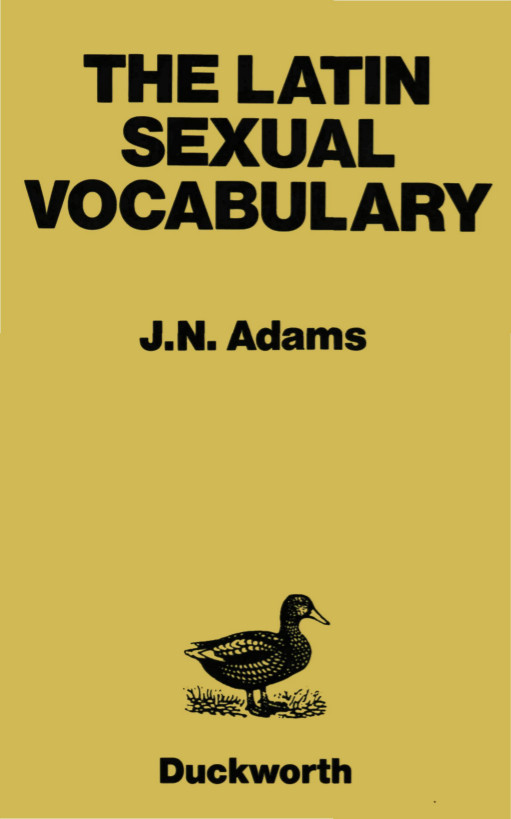
Like other languages, Latin had a group of words which speakers regarded as basic obscenities, as well as a rich stock of sexual euphemisms and metaphors. At the lower end of the social and stylistic scale evidence for Latin sexual terminology comes from numerous graffiti. On the other hand certain literary genres had a marked sexual content.
The Latin sexual vocabulary has never been systematically investigated, despite its linguistic and literary interest. This book collects for the first time the evidence provided by both non-literary and literary sources from the early Republic down to about the fourth century A.D.
Separate chapters are given to each of the sexual parts of the body, and to the terminology used to describe sexual acts. General topics treated include lexical differences between various literary genres, the influence of Greek on Latin, diachronic changes within the vocabulary, and the weakening of sexual words into general terms of abuse.
This is a fundamental book in every sense.
Publisher Duckworth, London, 1982
ISBN 071561648X
272 pages
via Gabriela García Palapa
Review (Peter Parsons, London Review of Books, 1983)
Review (D.R. Shackleton Bailey, Classical Philology, 1985)
PDF (72 MB)
Comment (0)