

Yvonne Rainer: Feelings Are Facts: A Life (2006)
Filed under book | Tags: · biography, choreography, dance, film, memoir
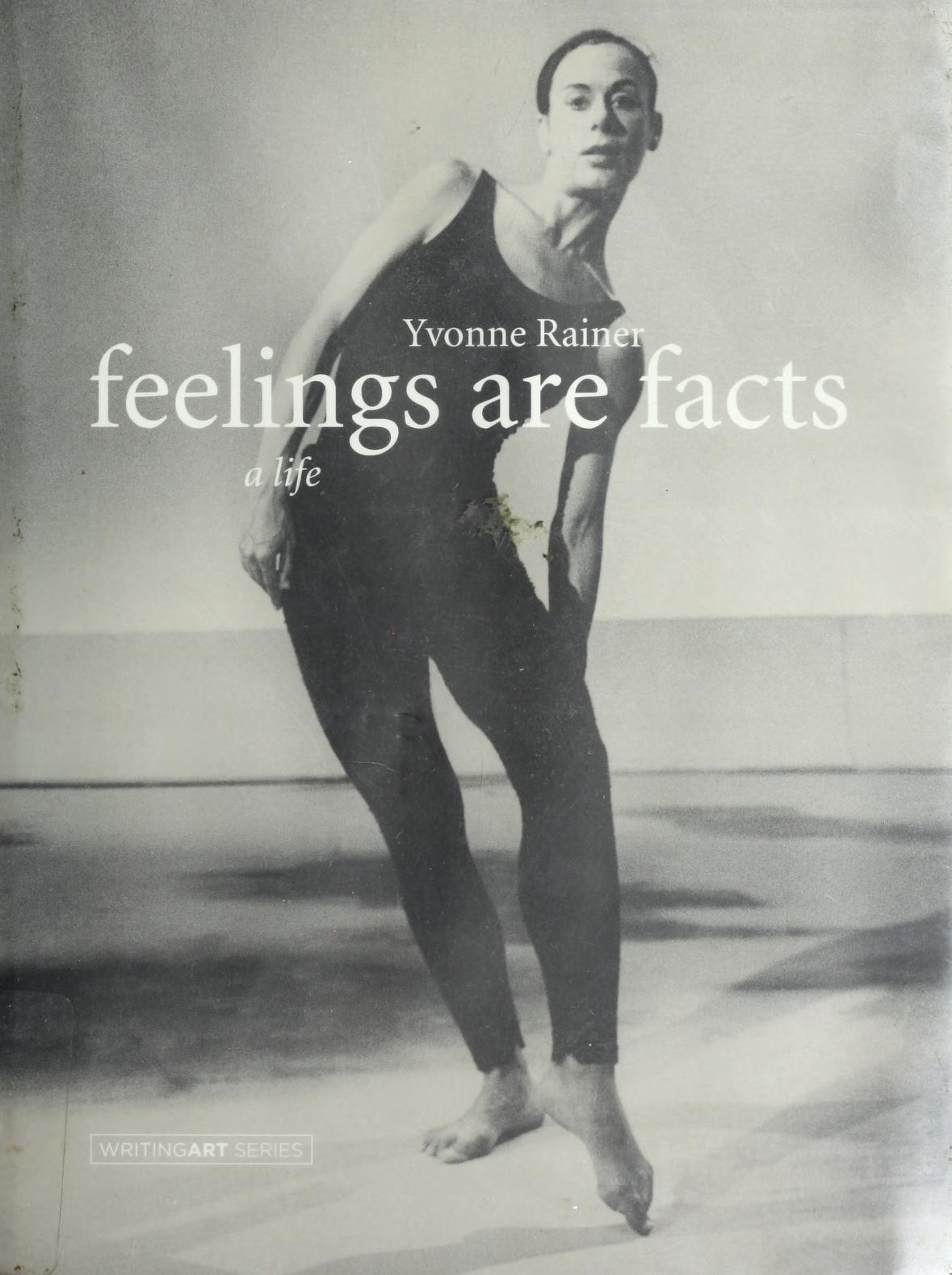
“In this memoir, dancer, choreographer, and filmmaker Yvonne Rainer traces her personal and artistic coming of age. Feelings Are Facts (the title comes from a dictum by Rainer’s one-time psychotherapist) uses diary entries, letters, program notes, excerpts from film scripts, snapshots, and film-frame enlargements to present a vivid portrait of an extraordinary artist and woman in postwar America.
Rainer tells of a California childhood in which she was farmed out by her parents to foster families and orphanages, of sexual and intellectual initiations in San Francisco and Berkeley, and of artistic discoveries and accomplishments in the New York City dance world. Rainer studied with Martha Graham and Merce Cunningham in the late 1950s and early 1960s, cofounded the Judson Dance Theater in 1962, hobnobbed with New York artists including Robert Rauschenberg, Robert Morris (her lover and partner for several years), and Yoko Ono, and became involved with feminist and antiwar causes in the 1970s and 1980s. Rainer writes about how she constructed her dances—including The Mind Is a Muscle and its famous section, Trio A, as well as the recent After Many a Summer Dies the Swan—and about turning from dance to film and back to dance. And she writes about meeting her longtime partner Martha Gever and discovering the pleasures of domestic life.”
Publisher MIT Press, 2006
Writing Art series
ISBN 9780262182515, 0262182513
xvi+473 pages
Reviews: John Rockwell (NYT, 2006), Ian White (Afterall, 2007), Daniel Ross (Screening the Past, 2007), Deborah Jowitt (Dance Research, 2008).
PDF (62 MB, no OCR)
Comment (0)Ute Holl: Cinema, Trance and Cybernetics (2002–)
Filed under book | Tags: · anthropology, avant-garde, cinema, cybernetics, film, film history, psychology, theory

“Ute Holl explores cinema as a cultural technique of trance, unconsciously transforming everyday spatio-temporal perception. The archaeology of experimental and anthropological cinema leads into psycho-physiological laboratories of the 19th century. Through personal and systematic catenations, avant-garde filmmaking is closely linked to the emerging aesthetics of feedback in cybernetic models of the mind developed at the same time. Holl analyses three major fields of experimental and anthropological filmmaking: the Soviet avant-garde with Dziga Vertov and his background in Russian psycho-reflexology and theory of trance; Jean Rouch and his theory of cine-trance and the feed-back; and the New American Cinema with Maya Deren and Gregory Bateson conceptualising the organisation of time, space, movement and feedback trance in anthropological filmmaking.”
First published as Kino, Trance und Kybernetik, Brinkmann & Bose, Berlin, 2002.
Translated by Daniel Hendrickson
Publisher Amsterdam University Press, Amsterdam, 2017
Recursions series
Creative Commons BY-NC 4.0 License
ISBN 9789089646682, 908964668X
326 pages
Eric Hynes: Neither/Nor: Chimeric Cinema, New York City, 1967-1968 (2013)
Filed under booklet | Tags: · documentary film, film, film criticism
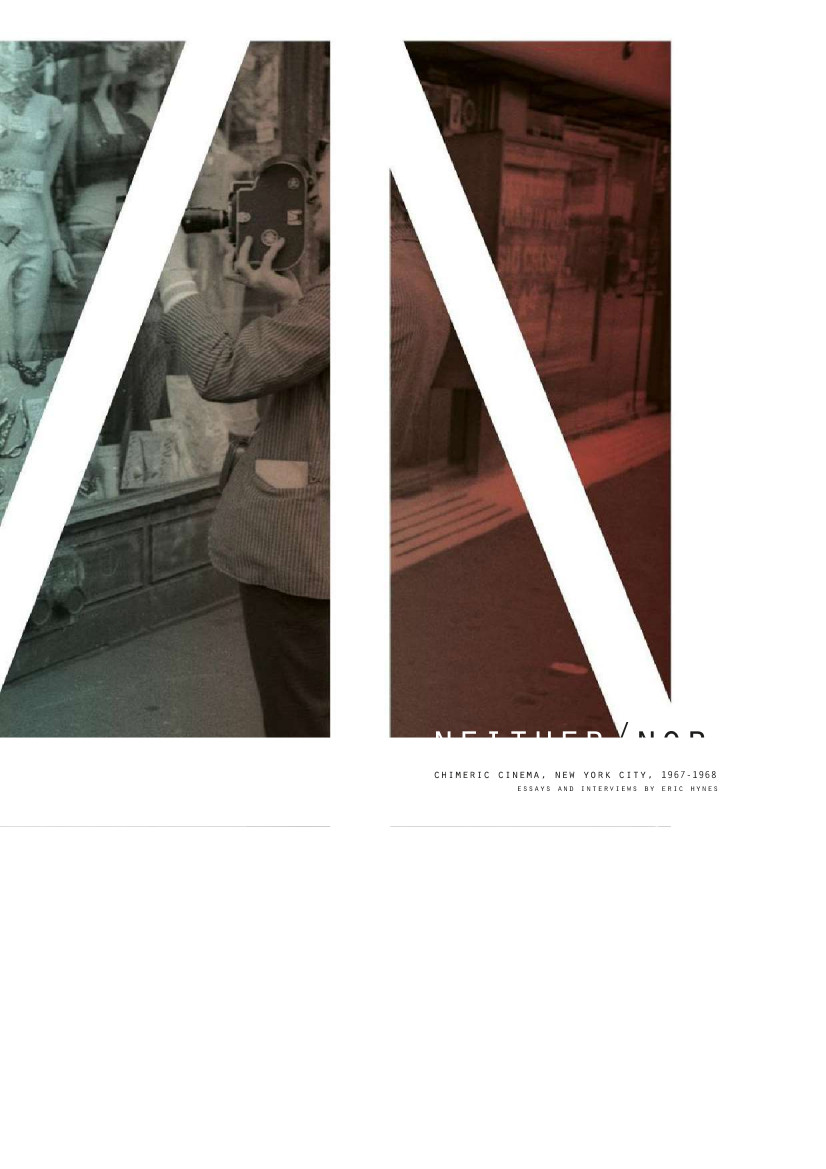
“Chimeras have existed since the advent of film, a form that has always simultaneously offered to record and represent, to capture and simulate life. But as filmmaker Jim McBride says, “Something was in the air” in the mid-to-late 1960s, particularly in New York City, where the likes of McBride, William Greaves, D.A. Pennebaker, as well as transients Peter Whitehead and Jean-Luc Godard, were making gloriously uncategorizable works of cinematic art. It was a moment when everything and everyone seemed to be riding, or even embracing, the edge of things, when films and politics and morality suddenly seemed undefined, up for grabs, subject to reinvention. With the Civil Rights era giving way to Black Power, Kennedy idealism ceding to Johnson’s military morass, Beat Dadaism transforming into hippie agitation, and mod Godard morphing into Mao Godard, it was as if utopia and dystopia were both within reach—if not one and the same.” (from the Introduction)
Publisher True False & Ragtag Cinema, 2013
Open access
31 pages