

Cathy Porter: Alexandra Kollontai: A Biography (1980)
Filed under book | Tags: · biography, communism, feminism, marxism, politics, revolution, russia, sexuality, socialism, soviet union, women
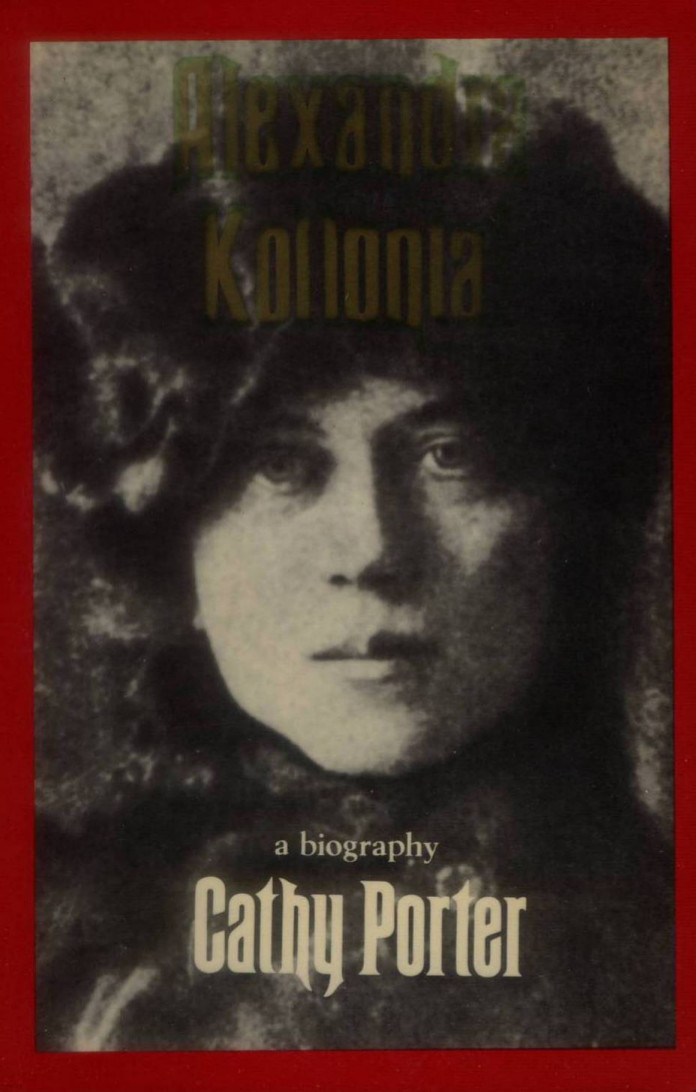
Alexandra Kollontai is “one of the most fascinating and least understood figures of the Bolshevik revolution. A feminist and a socialist, Kollontai defended a vision of emancipation premised on equality, comradeship, and personal autonomy, where society would take responsibility for domestic labour while enabling individuals freely to express their sexuality.” (source)
She was a key leader of the Russian Socialist movement, the only woman in the early Soviet government, and one of the most famous women in Russian history. She worked tirelessly all her life, as a speaker, writer, and organizer for women’s emancipation. This compelling biography recounts her life for an emerging generation of fighters for women’s liberation.
Publisher Virago, 1980
ISBN 0860680134
537 pages
Review (Tamara Deutscher, Marxism Today, 1980)
Review (Sarah Creagh, Socialist Review)
Commentary (Christine Sypnowich, Labour/Le Travail, 1993)
Commentary (Nick Evans, The Oxford Left Review, 2012)
PDF (no OCR)
Comment (0)Georges Bataille: Erotism: Death and Sensuality (1957–) [FR, ES, EN, IT, PT]
Filed under book | Tags: · death, ecstasy, eroticism, language, psychology, religion, sex, sexuality
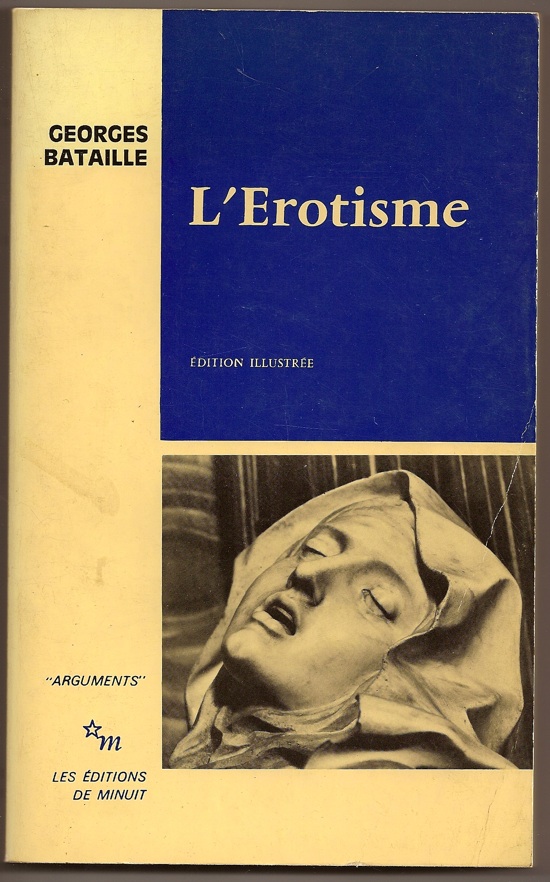
Taboo and sacrifice, transgression and language, death and sensuality—Georges Bataille pursues these themes with an original, often startling perspective. He challenges any single discourse on the erotic. The scope of his inquiry ranges from Emily Bronte to Sade, from St. Therese to Claude Levi-Strauss and Dr. Kinsey; and the subjects he covers include prostitution, mythical ecstasy, cruelty, and organized war. Investigating desire prior to and extending beyond the realm of sexuality, he argues that eroticism is “a psychological quest not alien to death.”
First published in French as L’Érotisme, Éditions de Minuit, 1957.
This edition published within Oeuvres complètes. Tome 10 (pp 1-270), together with Le procès de Gilles de Rais and Les larmes d’Éros.
Publisher Gallimard, 1987
734 pages
English edition
Translated by Mary Dalwood
The first edition in English was published as Death and Sensuality: a Study of Eroticism and the Taboo, Walker and Company, NY, 1962.
Publisher City Lights Books, San Francisco, 1986
ISBN 0872861902, 9780872861909
280 pages
Review (Mark Price, Philosophy Now)
L’Érotisme (French, 1957/1987). Alt link.
El erotismo (Spanish, transcript, trans. María Luisa Bastos, 1960)
Erotism: Death & Sensuality (English, trans. Mary Dalwood, 1962/1986)
L’erotismo (Italian, transcript, trans. Adriana dell’Orto, 1962)
O erotismo (Portuguese, trans. Antonio Carlos Viana, 1987)
Malek Alloula: The Colonial Harem (1981/1986)
Filed under book | Tags: · algeria, anthropology, colonialism, islam, moors, orientalism, photography, sexuality, visual colonialism, women

“Malek Alloula takes the everyday object of postcard and shows how it was a classic locus of Orientalism, which has long been a phantasm of the West: ‘There is no phantasm, though, without sex and in this Orientalism .. a central figure emerges, the very embodiment of the obsession: the harem’. In Arabic, harim means forbidden and thus also refers to the women’s quarters of many Islamic households, which are forbidden to strange men. Embroidering from four centuries of stories concerning the Imperial harem in Istanbul, however, the Western imagination had transformed every harem into a hotbed of sensuality and sexuality. France colonized Algeria in 1830, an operation documented at the time by the artist Eugène Delacroix and later depicted by countless Orientalist artists, led by figures like Horace Vernet and Eugène Fromentin. In the first decades of the twentieth century, the fine art genre of the odalisque, or Oriental nude, was displaced by a flood of popular postcards depicting the algérienne, the Algerian woman.
Alloula, himself Algerian, studied this mass of now-discarded visual material in his classic study The Colonial [Harem] in which he wants to ‘return this immense postcard to its sender’, the French colonizer. He shows how the veiled Algerian woman was a provocation to the European photographer as her light clothing produced a ‘whiteout’ in the bright sun, a technical failure of the photograph to register strong differences of light and dark. The women’s peephole gaze from behind the veil recalls the photographer’s own gaze from behind the cloth of a tripod camera of the period and in a sense ‘the photographer feels photographed .. he is dispossessed of his own gaze‘. The response is to remove the obstacle to the gaze–to obliterate it, in Terry Smith’s terms–by raising the veil: ‘he will unveil the veil and give figural expression to the forbidden’. Thus from the seemingly innocent postcards showing a woman slightly lifting her veil to the popular image of a half-naked Algerian woman, there is hardly a step. The colonial gaze must see and make an exhibition of these women, which is then rendered as the aesthetic. The erotic effect, such as it is, is beside the point in this operation of colonial visualism.” (from Nicolas Mirzoeff, Visual Culture Reader, 2002, pp 475-476)
Originally published as Le Harem Colonial: Images d’un sous-érotisme, Editions Slatkine, Geneve-Paris, 1981
Translated by Myrna Godzich and Wlad Godzich
Introduction by Barbara Harlow
Publisher University of Minnesota Press, 1986
Theory and History of Literature series, Volume 21
ISBN 0719019079, 9780719019074
160 pages
review (Gregory K. Betts, Canadian Review of Comparative Literature)
review (Carlos Shloss, The New York Times)
review (Arlette Gautier, Les Cahiers du CEIMA, in French)
commentary (Jean-Noël Ferrié & Gilles Boëtsch, Annuaire de l’Afrique du Nord)