

Gennifer Weisenfeld: Mavo: Japanese Artists and the Avant-Garde, 1905-1931 (2002)
Filed under book | Tags: · 1910s, 1920s, anarchism, architecture, art history, avant-garde, collage, communism, constructivism, dada, expressionism, futurism, graphic design, japan, marxism, socialism, theatre

“The radical Japanese art group Mavo roared into new arenas and new art forms during the 1920s, with work ranging from performance art to painting, book illustration, and architectural projects. Hurling rocks through glass roofs and displaying their rejected works, Mavo artists held peripatetic protest exhibitions against the Japanese art establishment. Ultimately, Mavo’s work became a major influence in Japanese commercial art and had a pronounced and lasting impact on Japanese visual and political culture. This abundantly illustrated volume, the first book-length study in English on Mavo, provides a critical evaluation of this often outrageous and iconoclastic movement, tracing Mavo’s relationship to broader developments in modernism worldwide.
Gennifer Weisenfeld provides a fascinating look into Japanese popular culture by showing how Mavo artists sought to transform Japanese art in response to the rise of industrialism. They deliberately created images that conveyed the feelings of crisis, peril, and uncertainty that were beginning to characterize daily life. Their art often alluded to mechanical environments through the use of abstracted imagery such as interconnected tubular forms and shapes reminiscent of riveted steel-plate girders. Looking in depth at the art itself, the flamboyant personalities of the artists, and the cultural and political history of Japan in this interwar period, Weisenfeld traces the strategies used by these artists as they sought to reintegrate art into daily experience.
Weisenfeld thoroughly documents the links between Mavo artists and a wide range of other artistic and political movements with which they associated themselves, such as futurism, dada, expressionism, socialism, and communism. Capturing the restlessness and iconoclastic fervor of Mavo, Weisenfeld is the first to fully locate this modern Japanese artistic community within the broader historical and intellectual framework of international art of the early twentieth century.”
Publisher University of California Press, 2002
ISBN 0520223381, 9780520223387
368 pages
Reviews: Patricia Failing (caa.reviews), Alexandra Munroe (J Japanese Studies), J. Keith Vincent (J Asian Studies).
PDF (95 MB, no OCR, updated on 2017-7-17)
multiple formats (Internet Archive, added on 2017-7-17)
See also Weisenfeld’s essay Mavo’s Conscious Constructivism: Art, Individualism, and Daily Life in Interwar Japan (1996, 10 pp) and
Hagiwara Kyōjirō’s Death Sentence (1925).
Iliazd: Lidantiu faram (1923) [Russian]
Filed under artist publishing, play | Tags: · dada, futurism, poetry, typography, visual poetry, zaum

Lidantiu faram [Le-Dantyu as a Beacon] is a play typed in zaum language by the Georgian-French artist-typographer Iliazd (Ilya Zdanevich). It remains an unsurpassed example of visually fascinating typographical contrivances and was to exert a decisive influence on the typographical component of international dadaist poetry.
“The book is preceded by a table of symbols which indicate how the sounds they stand for, such as a click of the tongue, are to be pronounced. The stressed symbol is given a capital letter, often large and bold, in the middle of the word, while unstressed vowels are written as pronounced, not necessarily as normally spelt.
The plot, in a parodic inversion of Gogol’s short story ‘The Portrait’, investigates the nature of reality in its relation to art. It begins with the Spirit [Zaperedukhyai] muttering a soliloquy over the body of a dead woman. The Spirit’s words do not contain vowels, an omission suggesting firmness. The villain of the piece, the realist painter [peredvizhnik] who is presented as a lisping phoney, paints a lifelike portrait of the dead woman. Then comes an obscure avant-garde artist, Mikhail Ledentu, who represents genuine liberated art and he paints an unlike portrait of the same lady. Both portraits come alive during the play, with Unlike killing Lifelike. The Spirit also dies but the forces of life are resurrected. The play ends with an ensemble superimposed on each other: the harmonious trio of the living is echoed by the dissonant octet of the dead. The forces of death include a Greek chorus of five ugly realism-loving women, usually singing in quintet. They are defined as truperdy (this combines death and decay with scatology) and their individual names are mostly rare Russian folk words with sexual anatomical meanings. The quintets show strong individualisation of each part: one of them speaks in vowels only; another hissing and lisping; another in abrupt and primitive tones adding clicks of her tongue to her words; the other two speak in a coarse and unpleasant idiom.
Le-Dantyu as a Beacon is an astonishing tour-de-force. Every page number, for instance, is created in a different and inventive manner (and there are sixty-one of them), and the variety of typeforms used must surely have entailed ransacking the typecases of several printers.” (from Alan Bartram’s Futurist Typography and the Liberated Text, 2005, altered)
Lidantiu faram (Лидантю фарам; Ledentu le Phare: poème dramatique en zaoum)
Preface by Georges Ribemont-Dessaignes, in French (attached at the end)
Cover by N. Granowsky
Typography by Ilya Zdanevich
Publisher Éditions du 41º, Paris, 1923
61 pages + 8-page prospectus
Commentary: Lewis Blackwell (20th-century Type, 2004: 35), Alan Bartram (Futurist Typography, 2005: 50-69).
PDF (15 MB, via Iowa Digital Library)
PDF (107 MB, added on 2020-12-5, via Kunsthaus Zurich)
Will Bradley, Charles Esche (eds.): Art and Social Change: A Critical Reader (2007)
Filed under book | Tags: · aesthetics, art, art history, art theory, avant-garde, bauhaus, constructivism, dada, politics, revolution, situationists, social movements, subversion, zapatistas
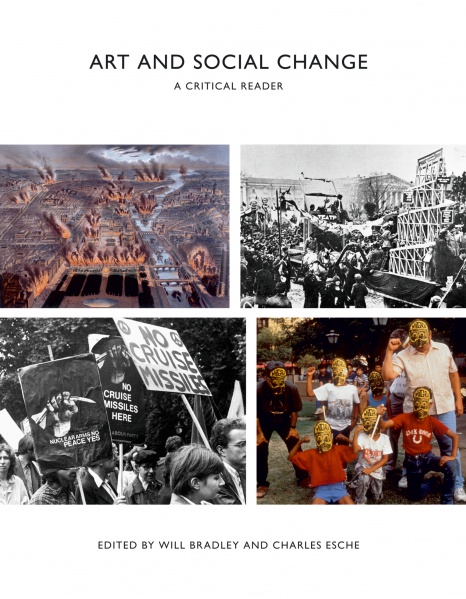
“The desire to change the world has often led artists to align themselves with wider social movements and to break with established institutions of art. This reader gathers together an international selection of artists’ proposals, manifestos, theoretical texts and public declarations that focus on the question of political engagement and the possibility of social change. The approaches represented are many and diverse, from Gustave Courbet’s involvement in the Paris Commune and the socialist art theory of William Morris to the hybrid activist practice associated with the twenty-first century ‘movement of movements’; from the political commitments of the Modernist avant-gardes to the rejections of Modernism in favour of protest, critique, utopian social experiment or revolutionary propaganda. Six specially commissioned essays – by Geeta Kapur, Lucy Lippard, John Milner, Gerald Raunig, Marina Vishmidt and Tirdad Zolghadr – further explore both the historical context and the contemporary situation.”
Publisher Tate Publishing, in association with Afterall, London, 2007
ISBN 9781854376268
479 pages
Commentary: Marco Deseriis and Brian Holmes (Mute).
Comments (3)