

Neil Postman: Amusing Ourselves to Death: Public Discourse in the Age of Show Business (1985)
Filed under book | Tags: · culture, entertainment, mass media, media ecology, show business, social criticism, sociology, television
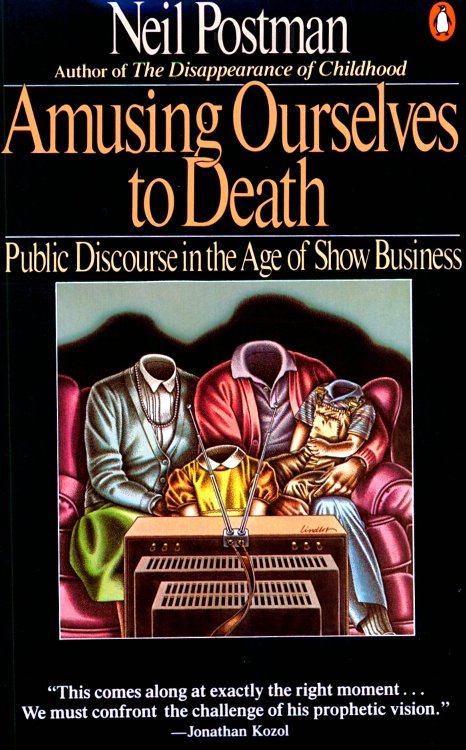
The book originated with Postman’s delivering a talk to the Frankfurt Book Fair in 1984. He was participating in a panel on Orwell’s 1984 and the contemporary world. In the introduction to his book Postman said that reality was reflected more by Aldous Huxley’s Brave New World where the public was oppressed by pleasure than Orwell’s 1984 where they were oppressed by pain.
Television has conditioned us to tolerate visually entertaining material measured out in spoonfuls of time, to the detriment of rational public discourse and reasoned public affairs. Neil Postman alerts us to the real and present dangers of this state of affairs, and offers compelling suggestions as to how to withstand the media onslaught. Before we hand over politics, education, religion, and journalism to the show business demands of the television age, we must recognize the ways in which the media shape our lives and the ways we can, in turn, shape them to serve out highest goals.
Publisher Penguin Books, 1985
ISBN 0140094385, 9780140094381
Length 184 pages
More info (wikipedia)
More info (publisher)
More info (google books)
Marshall McLuhan: Understanding Media: The Extensions of Man (1964–) [EN, SC, CZ, DE, CR]
Filed under book | Tags: · advertising, film, global village, history of technology, mass media, media technology, media theory, money, new media, phonograph, photography, print, radio, technology, telegraphy, telephone, television

“When first published, Marshall McLuhan’s Understanding Media made history with its radical view of the effects of electronic communications upon man and life in the twentieth century. In Terrence Gordon’s own words, “McLuhan is in full flight already in the introduction, challenging us to plunge with him into what he calls ‘the creative process of knowing.'” Much to the chagrin of his contemporary critics McLuhan’s preference was for a prose style that explored rather than explained. Probes, or aphorisms, were an indispensable tool with which he sought to prompt and prod the reader into an “understanding of how media operates” and to provoke reflection.
In the 1960s McLuhan’s theories aroused both wrath and admiration. It is intriguing to speculate what he might have to say 40 years later on subjects to which he devoted whole chapters such as Television, The Telephone, Weapons, Housing and Money. Today few would dispute that mass media have indeed decentralized modern living and turned the world into a global village.”
First published in 1964
With a new introduction by Lewis H. Lapham
Publisher The MIT Press, 1994
ISBN: 0262631598, 9780262631594
392 pages
Understanding Media: The Extensions of Man (English, 1964/1994, updated on 2019-2-27)
Poznavanje opštila: čovekovih produžetaka (Serbo-Croatian, trans. Slobodan Đorđević, 1971, added on 2015-12-21)
Jak rozumět médiím: Extenze člověka (Czech, trans. Miloš Calda, 1991, added on 2014-3-13)
Die magischen Kanäle: Understanding Media (German, trans. Meinrad Amann, 1992, added on 2013-11-22)
Razumijevanje medija (Croatian, trans. David Prpa, 2008, added on 2013-11-22)
Roger Silverstone: Television And Everyday Life (1994)
Filed under book | Tags: · life, mass media, media culture, television

Television and Everyday Life explores the enigma of television, and how it has insinuated its way so profoundly and intimately into our daily lives. The book unravels television’s emotional, cognitive, spatial, temporal and political significance.
Drawing from a broad range of literature–from psychoanalysis to sociology, from geography to cultural studies–Roger Silverstone constructs a theory which places television in a central position within the various realities and discourses which construct everyday life. The medium emerges from these arguments as a fascinating, complex phenomenon of contradictions, yet the book explodes many of the myths surrounding what has been called “The Love Machine”.
Television and Everyday Life presents a radical new approach to the medium, one that both challenges closely-held wisdoms, and offers a compellingly original view of where telvision sits in everyday life.
Publisher Routledge, 1994
ISBN 0415016479, 9780415016476
Length 204 pages
Keywords and phrases
soap opera, ontological security, television, moral economy, Silverstone, mass media, suburbanisation, situation comedy, Frankfurt School, post-modern, phenomenology, commodification, Marilyn Strathern, polysemy, Radway, sit-coms, David Morley, Daniel Miller, object relations theory, privatisation
More info (publisher)
More info (google books)