

communication +1, 3(1): Afterlives of Systems (2014)
Filed under journal | Tags: · biology, communication, computing, cybernetics, ecology, environment, media ecology, music theory, systems theory, technology
“Under the impression of today’s global crisis and the rise of ecological thinking, confronted with smart, ubiquitous technosystems and the impression of interconnectedness, there appears a new urge to excavate the remnants of the past. The articles of this issue suggest that in order to understand present technologies, we need to account the systems thinking that fostered their emergence, and that we cannot gain insight into the afterlives of systems without exploring their technologies.
The nine contributions ask how these debates and affective states survive and live on in today’s discussions of media ecologies, environmentalism, object-oriented philosophies, computer simulations, performative art, and communication technologies. In this sense, they take the renaissance of systems thinking in the late 20th and early 21st Century as an effect of various system crisis and explore new media technologies as stabilizing ‘cures’ against the dystopian future scenarios that emerged after World War II. The articles of this issue suggest that in order to understand present technologies, we need to account the systems thinking that fostered their emergence, and that we cannot gain insight into the afterlives of systems without exploring their technologies.”
With contributions by Etienne Benson, Rafico Ruiz, Katja Rothe, Niklas Schrape, Christoph Neubert and Serjoscha Wiemer, Sebastian Vehlken, Bruce Clarke, Jan Mueggenburg, and You Nakai.
Edited by Christina Vagt and Florian Sprenger
Publisher University of Massachusetts Amherst, September 2014
Creative Commons Attribution-Share Alike 3.0 License
c231 pages
PDF articles
single PDF (4 MB)
James J. Gibson: The Ecological Approach to Visual Perception (1979–) [EN, RU]
Filed under book | Tags: · ambience, ecology, environment, image, information, light, media, movement, object, perception, perspective, psychology, surface, vision
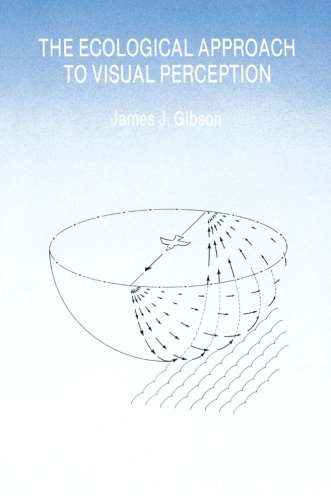
“James J. Gibson (1904–1979) is one of the most important psychologists of the 20th century, best known for his work on visual perception. He received his Ph.D. from Princeton University and his first major work was The Perception of the Visual World (1950) in which he rejected behaviorism for a view based on his own experimental work. In his later works, including The Ecological Approach to Visual Perception (1979), Gibson became more philosophical and criticized cognitivism in the same way he had attacked behaviorism before, arguing strongly in favor of direct perception and direct realism, as opposed to cognitivist indirect realism. He termed his new approach ‘ecological psychology’.”
“He moved from thinking about what patterns could act as stimuli to rethinking the concept of the stimulus itself, ultimately rejecting “stimulus” in favor of his version of “information.” In a 1960 paper that is a classic in its own right, Gibson carefully surveyed the patch work of meanings of the term “stimulus” that could be found in the literature. He concluded that the optical (or acoustic, or haptic etc.) patterning that would best correspond to actual perceiving in the world no longer seemed like a “stimulus” at all in any proper sense. Instead, he proposed a common-sense usage of the term “information” (as opposed to the technical usage of Shannon) which was fairly well developed by that time. By information, Gibson meant structured energy that was information about environmental sources, in contrast to information as structure in an information theoretical sense which implies a sender and a receiver. Gibson’s information is specific to its environmental sources though not a replica or a copy. It certainly is not a stimulus in the sense of energy that triggers a response. Gibson’s information does not come to the animal. The animal goes to it, actively obtaining the information. Part 2 of this volume develops this concept of information and is at the heart of Gibson’s theory.” (from the Introduction)
“Gibson’s legacy is increasingly influential on many contemporary movements in psychology, particularly those considered to be post-cognitivist.”
Publisher Houghton Mifflin, Boston, 1979
This edition, Psychology Press, 2014
ISBN 9781315740218
315 pages
Reviews and commentaries: E. Bruce Goldstein (Leonardo, 1981), Frederick A. Jules (1984), A. P. Costall (Journal of the Experimental Analysis of Behavior, 1984), Maurizio Ferraris (1999, IT), William M. Mace (Ethics & the Environment, 2005).
Wikipedia, FR
Publisher
WorldCat
The Ecological Approach to Visual Perception (English, 1979/2014, 4 MB)
Ekologicheskiy podchod k zritelnomu vospriyatiyu (Russian, trans. T.M. Sokolskoy, 1988, 11 MB)
For more on Gibson see Monoskop wiki.
Comment (1)J. R. McNeill, Corinna R. Unger (eds.): Environmental Histories of the Cold War (2010)
Filed under book | Tags: · climate, cold war, ecology, environment, geopolitics, history, military, nuclear weapons, politics, war, war studies

“This book explores the links between the Cold War and the global environment, ranging from the environmental impacts of nuclear weapons to the political repercussions of environmentalism. Environmental change accelerated sharply during the Cold War years, and so did environmentalism as both a popular movement and a scientific preoccupation. Most Cold War history however entirely overlooks these developments, which were not only simultaneous but also linked together in ways both straightforward and surprising. The contributors to this book present these connected issues as a global phenomenon, with chapters concerning China, the USSR, Europe, North America, Oceania, and elsewhere. The role of experts as agents and advocates of using the environment as a weapon in the Cold War or, contrastingly, of preventing environmental damage resulting from Cold War politics is also given broad attention.”
Publisher Cambridge University Press, 2010
ISBN 0521762448, 9780521762441
362 pages
Reviews: Chaney (H-Net, 2011), Tucker (Michigan War Studies Review, 2012), Kinkela (Cold War History, 2013).
Conference report by Thomas Robertson (GFI Bulletin, 2007)
PDF (5 MB, updated on 2019-10-11)
Comment (0)