

RoseLee Goldberg: Performance: Live Art 1909 to the Present (1979–) [English, Spanish]
Filed under book | Tags: · art, art history, bauhaus, dada, futurism, happening, live art, painting, performance, performance art, spectacle, surrealism
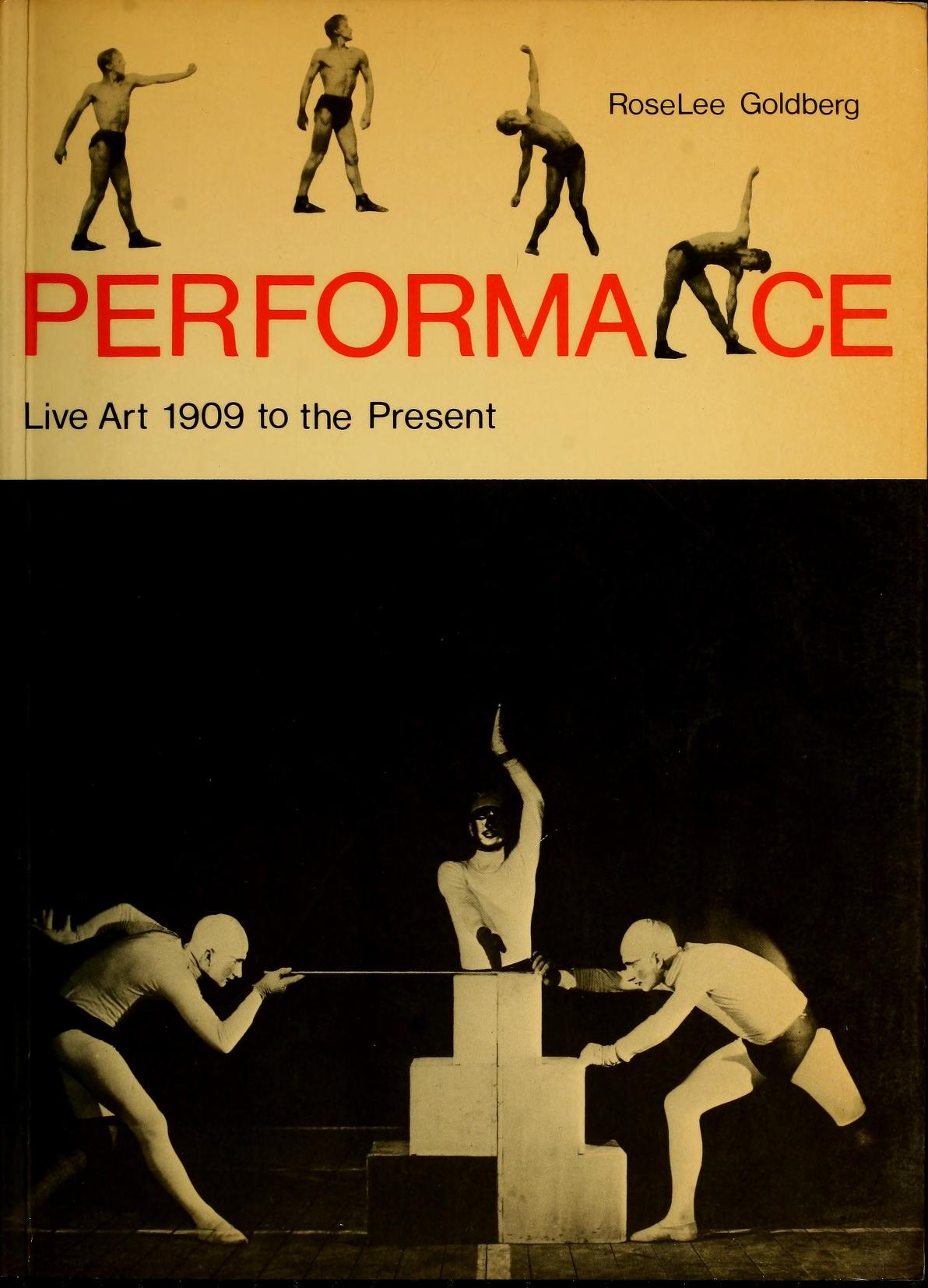
A provocative history of live art traces the precedents of contemporary multi-media events to Bauhaus experimentalism and surveys the Futurists’ manifesto-like events, the Dadaists’ cabarets, and later “happenings” and “spectacles.”
Publisher Harry N. Abrams, New York, 1979
ISBN 0810914565, 9780810914568
128 pages
Performance: Live Art 1909 to the Present (English, 1979, 44 MB, updated on 2018-10-28)
Performance art: desde el futurismo hasta el presente (Spanish, 1996, 67 MB, updated on 2017-7-10)
Amelia Jones: Irrational Modernism: A Neurasthenic History of New York Dada (2004)
Filed under book | Tags: · 1910s, 1920s, art, art history, avant-garde, dada, irrational

In Irrational Modernism, Amelia Jones gives us a history of New York Dada, reinterpreted in relation to the life and works of Baroness Elsa von Freytag-Loringhoven. Jones enlarges our conception of New York Dada beyond the male avant-garde heroics of Marcel Duchamp, Man Ray, and Francis Picabia to include the rebellious body of the Baroness. If they practiced Dada, she lived it, with her unorthodox personal life, wild assemblage objects, radical poetry and prose, and the flamboyant self-displays by which she became her own work of art. Through this reinterpretation, Jones not only provides a revisionist history of an art movement but also suggests a new method of art history.
Jones argues that the accepted idea of New York Dada as epitomized by Duchamp’s readymades and their implicit cultural critique does not take into consideration the contradictions within the movement—its misogyny, for example—or the social turmoil of the period caused by industrialization, urbanization, and the upheaval of World War I and its aftermath, which coincided with the Baroness’s time in New York (1913-1923). Baroness Elsa, whose appearances in Jones’s narrative of New York Dada mirror her volcanic intrusions into the artistic circles of the time, can be seen to embody a new way to understand the history of avant-gardism—one that embraces the irrational and marginal rather than promoting the canonical.
Acknowledging her identification with the Baroness (as a “fellow neurasthenic”), and interrupting her own objective passages of art historical argument with what she describes in her introduction as “bursts of irrationality,” Jones explores the interestedness of all art history, and proposes a new “immersive” understanding of history (reflecting the historian’s own history) that parallels the irrational immersive trajectory of avant-gardism as practiced by Baroness Elsa.
Publisher MIT Press, 2004
ISBN 0262101025, 9780262101028
344 pages
PDF (updated on 2012-11-19)
Comment (1)Matthew Biro: The Dada Cyborg: Visions of the New Human in Weimar Berlin (2009)
Filed under book | Tags: · 1920s, 1930s, avant-garde, berlin, cyborg, dada, germany, weimar republic

Finding the cyborg in early twentieth-century German art
In an era when technology, biology, and culture are becoming ever more closely connected, The Dada Cyborg explains how the cyborg as we know it today actually developed between 1918 and 1933 when German artists gave visual form to their utopian hopes and fantasies in a fearful response to World War I.
In what could be termed a prehistory of the posthuman, Matthew Biro shows the ways in which new forms of human existence were imagined in Germany between the two world wars through depictions of cyborgs. Examining the work of Hannah Höch, Raoul Hausmann, George Grosz, John Heartfield, Otto Dix, and Rudolf Schlichter, he reveals an innovative interpretation of the cyborg as a representative of hybrid identity, as well as a locus of new modes of awareness created by the impact of technology on human perception. Tracing the prevalence of cyborgs in German avant-garde art, Biro demonstrates how vision, hearing, touch, and embodiment were beginning to be reconceived during the Weimar Republic.
Biro’s unique and interdisciplinary analysis offers a substantially new account of the Berlin Dada movement, one that integrates the group’s poetic, theoretical, and performative practices with its famous visual strategies of photomontage, assemblage, and mixed-media painting to reveal radical images of a “new human.”
Publisher University of Minnesota Press, 2009
ISBN 0816636206, 9780816636204
318 pages
PDF (updated on 2012-7-25)
Comment (0)