

Leonardo Music Journal, 23: Sound Art (2013)
Filed under journal | Tags: · art criticism, art history, environment, field recording, installation art, music, music history, music theory, sound, sound art, sound design

The volume contains essays on environmental sound (both pastoral and urban), the spatial distribution of sound, technical innovations, as well as historical and critical contributions.
Contributions by Llorenç Barber, Rafael Liñan, Peter Batchelor, Marc Berghaus, Jane Grant, John Matthias, Mike Blow, Florian Grond, Adriana Olmos, Jeremy R. Cooperstock, Yolande Harris, Jessica Thompson, Edwin van der Heide, Emma Whittaker, Jos Mulder, Colin Wambsgans, Florian Hollerweger, David Monacchi, Rob van Rijswijk, Jeroen Strijbos, Yuan-Yi Fan, David Minnen, Jess Rowland, Jay Needham, Eric Leonardson, Ricardo Arias, Gascia Ouzounian, Simon Polson, Daniele Balit, Ethan Rose, Dugal McKinnon, Chuck Johnson and Daniel Wilson.
Edited by Nicolas Collins
Publisher MIT Press, 2013
ISSN 0961-1215
106 pages
via deadchildstar
PDF (removed on 2013-12-17 upon request of the publisher)
Comments (3)Tetsurō Watsuji: A Climate: A Philosophical Study (1935/1961)
Filed under book | Tags: · buddhism, climate, culture, ecology, environment, nature, philosophy, self, space
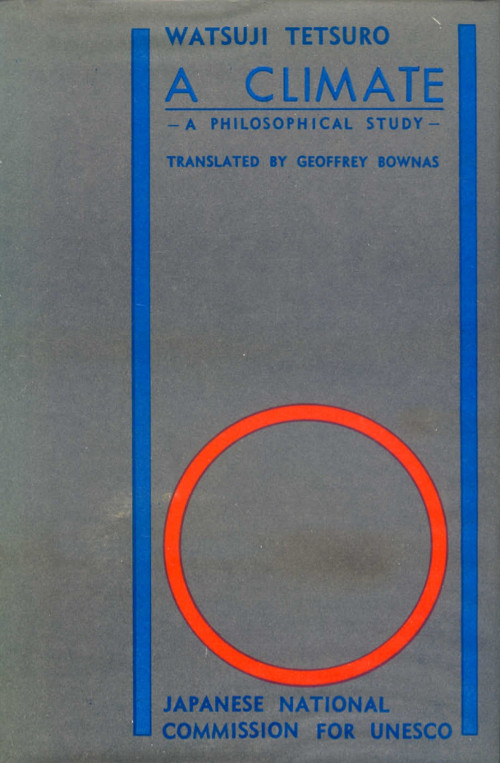
“In 1927 the Japanese philosopher and cultural and intellectual historian Tetsurō Watsuji went to Germany and returned the next year much influenced by the philosophy of Martin Heidegger. Watsuji could not agree with Heidegger’s theories about human existence, so he wrote a book named Fūdo, published in English as A Climate: A Philosophical Study (reprinted as Climate and Culture: A Philosophical Study). Watsuji explained Fūdo as ‘the natural environment of a given land’. Watsuji thought that Heidegger placed too much influence on the individual and overlooked the importance of social and geographical factors that affect the individual.
Heidegger’s emphasis on the individual was an outcome of centuries of European thought. Descartes said, ‘cogito, ergo sum’, (I think, therefore I am). Watsuji, however, saw the human being as a product of a ‘climate’ including not only natural surroundings but also the social environment of family, society and history. For example, Watsuji explains that ‘cold’ is not a specific temperature, but also the sensation of ‘cold’ which we actually experience in our daily lives. In other words, is the feeling of ‘cold’ a subjective, conscious feeling? Or does the feeling of ‘cold’ come from the independent existence of ‘cold’? Watsuji says that neither is a satisfactory answer because both explanations make a distinction between subject and object, or human and nature. A human being recognizes coldness before any division is made between ‘subjective’ and ‘objective’. For Watsuji, the relationship between a human and his environment, called aidagara, already exists before any other concepts are understood. This idea is similar to the “pure experience” of Nishida Kitaro.
Watsuji’s philosophical uniqueness is the explanation of human existence, aidagara, in terms of social and geographical phenomena. French scholar Augustin Berque was influenced by Watsuji’s way of thought and understood that Watsuji does not regard nature and nature-human as dual existences. Berque suggests the term trajet to include the subject simultaneously with object, nature with artificiality. In French the term trajet usually means distance of travel, or route. Berque sought to change the fixed meaning of subject and object, nature and culture, individual and society, to include the possibility of inter-changeable relationships.” (from New World Encyclopedia)
The book was reprinted under the title Climate and Culture: A Philosophical Study by Greenwood Press, 1961.
Originally published as Fūdo (風土 人間学的考察), 1935
Translated by Geoffrey Bownas
Publisher Printing Bureau, Japanese Government, 1961
235 pages
via golittlebook
Watsuji at Stanford Encyclopedia of Philosophy
Comment (0)Intergovernmental Panel on Climate Change: Fifth Assessment Report: The Physical Science Basis (2013)
Filed under report | Tags: · climate crisis, environment, global warming, science

The first of three parts of the Fifth Assessment Report (AR5) focuses on the scientific evidence behind climate change and the human role in it. The Intergovernmental Panel on Climate Change (IPCC) has been meeting in Stockholm this week to discuss the final wording of the summary of Working Group One (WG1), which assesses the physical science, such as concentrations of greenhouse gases in the atmosphere, temperature rises and climate models. It has been written the world’s top climate scientists – 209 lead authors and 50 editors from 39 countries. This summary report will be followed by Working Group I’s full in-depth report on Monday, 30 September.
Set up in 1988, the IPCC is a United Nations body that evaluates the state of climate science. It produces major assessments every five-seven years. The last report, published in Paris in 2007, said that scientists were 90% certain that humans were responsible for global warming. The panel was awarded the Nobel peace prize in the same year, shared jointly with former US vice–president, Al Gore.
Working Group II’s report on Impacts, Adaptation and Vulnerability is scheduled to be released in mid March 2014, followed by Working Group III’s Mitigation of Climate Change in early April 2014. AR5 Synthesis Report (SYR) will be released in October 2014.
AR5 Media Portal
UN_ClimateTalks at Twitter
IPCC at Twitter
IPCC Fifth Assessment Report at Wikipedia
Live coverage by The Guardian (27 September)
Global warming likely to breach 2C threshold, climate scientists conclude (summary by Fiona Harvey for The Guardian)
FAQs answered by Adam Vaughan (The Guardian)
Report summary (28 pp, 2 MB, updated on 2015-2-6)
Full report (1535 pp, 375 MB, updated on 2015-2-6)
Press release (27 September 2013)
Other formats and translations (added on 2015-2-6)