
Ben-Ami Scharfstein: Art Without Borders. A Philosophical Exploration of Art and Humanity (2009)
Filed under book | Tags: · aesthetics, anthropology, art, philosophy, philosophy of art

People all over the world make art and take pleasure in it, and they have done so for millennia. But acknowledging that art is a universal part of human experience leads us to some big questions: Why does it exist? Why do we enjoy it? And how do the world’s different art traditions relate to art and to each other?
Art Without Borders is an extraordinary exploration of those questions, a profound and personal meditation on the human hunger for art and a dazzling synthesis of the whole range of inquiry into its significance. Esteemed thinker Ben-Ami Scharfstein’s encyclopedic erudition is here brought to bear on the full breadth of the world of art. He draws on neuroscience and psychology to understand the way we both perceive and conceive of art, including its resistance to verbal exposition. Through examples of work by Indian, Chinese, European, African, and Australian artists, Art Without Borders probes the distinction between accepting a tradition and defying it through innovation, which leads to a consideration of the notion of artistic genius. Continuing in this comparative vein, Scharfstein examines the mutual influence of European and non-European artists. Then, through a comprehensive evaluation of the world’s major art cultures, he shows how all of these individual traditions are gradually, but haltingly, conjoining into a single current of universal art. Finally, he concludes by looking at the ways empathy and intuition can allow members of one culture to appreciate the art of another.
Lucid, learned, and incomparably rich in thought and detail, Art Without Borders is a monumental accomplishment, on par with the artistic achievements Scharfstein writes about so lovingly in its pages.
Publisher University of Chicago Press, 2009
ISBN 0226736091, 9780226736099
Length 543 pages
Peter Weibel (ed.): Beyond Art: A Third Culture. A Comparative Study in Cultures, Art and Science in 20th Century Austria and Hungary (2005)
Filed under book | Tags: · art, art and science, art history, austria, computer art, conceptual art, cybernetics, history of science, hungary, mathematics, media art, philosophy, psychoanalysis, technology
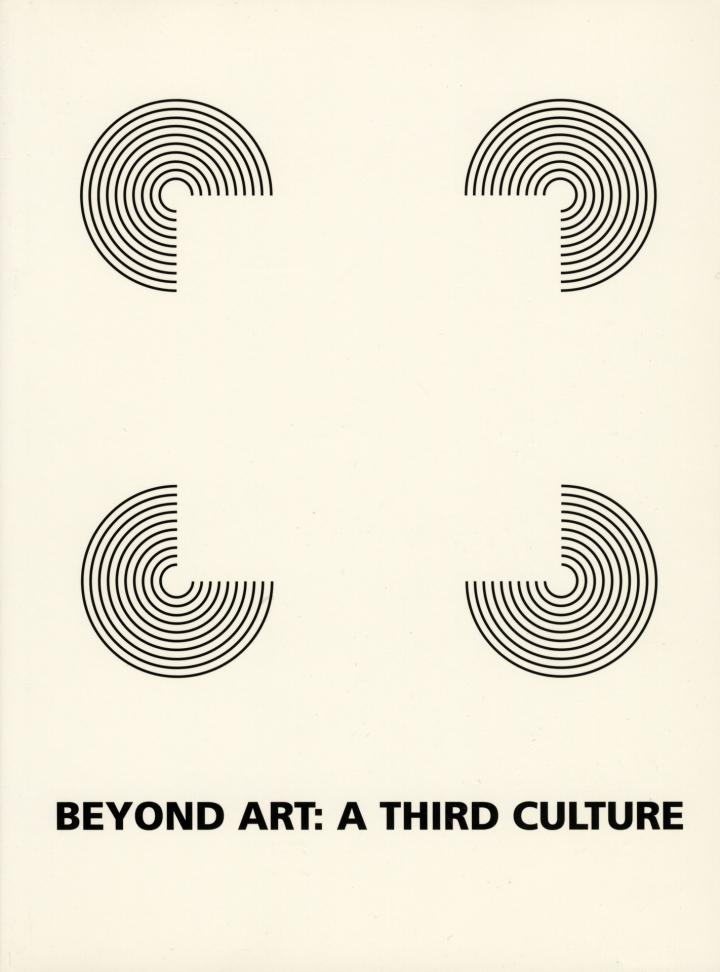
“Austria and Hungary in the 20th century were nations that made enormous achievements in the formal sciences and arts: abstraction, logic, mathematics, physics, positivism, psychoanalysis, cybernetics, constructivism, economics, art, media art, and concept art. Art and science are usually divided into two different cultures, and nations, too, are seen as having separate ones. This book delivers a new model of consilience and convergence of art and science by closely studying in a material historical way by using a multitude of original papers and contributions, photographs, documents, bibliographies, biographies, and survey essays, the mutual influence of art and science in Austria and Hungary. In fields ranging from Gestalt psychology to Quantum physics, from constructivism to theories of vision, from holography to cyberspace, we discover a multitude of ideas, books, movements and personalities that have deeply influenced the world. Richly illustrated, the book is a nearly invaluable sourcebook, in which a new method, resembling more a CD-ROM narration than a dictionary, has been used to map an unknown horizon of knowledge. Those involved in the history of science or art and in the field of cultural theory, will find an incomparable frame of reference and information. They will discover not only genius, talents and themes they have not been aware of, but also a new model of culture, a third culture. The book is graphically and structurally user-friendly with a synopsis for each chapter, models, diagrams, images, corolaries and index etc.”
Publisher Springer, Vienna, 2005
ISBN 3211245626, 9783211245620
616 pages
PDF (40 MB, updated on 2019-10-30)
Comments (2)Jacques Rancière: Aesthetics and Its Discontents (2009)
Filed under book | Tags: · aesthetics, art, ethics, philosophy, politics

Only yesterday aesthetics stood accused of concealing cultural games of social distinction. Now it is considered a parasitic discourse from which artistic practices must be freed. But aesthetics is not a discourse. It is an historical regime of the identification of art. This regime is paradoxical, because it founds the autonomy of art only at the price of suppressing the boundaries separating its practices and its objects from those of everyday life and of making free aesthetic play into the promise of a new revolution. Aesthetics is not a politics by accident but in essence. But this politics operates in the unresolved tension between two opposed forms of politics: the first consists in transforming art into forms of collective life, the second in preserving from all forms of militant or commercial compromise the autonomy that makes it a promise of emancipation. This constitutive tension sheds light on the paradoxes and transformations of critical art. It also makes it possible to understand why today’s calls to free art from aesthetics are misguided and lead to a smothering of both aesthetics and politics in ethics.
Translated by Steven Corcoran
Publisher Polity, 2009
ISBN 074564631X, 9780745646312
176 pages
PDF (no OCR; some pages missing; updated on 2012-7-14)
Comment (0)