3/4 magazine, 27-28: Media Art History: Remake (2012) [English/Slovak]
Filed under magazine | Tags: · 1990s, 2000s, appropriation, art, art history, computer art, experimental film, film history, media art, media culture, remake, remix, sound art, streaming

Special bilingual issue of 3/4 magazine dedicated to media art history. Serves as a catalogue of a travelling exhibition Remake. It also brings, for the first time, selection of interviews done by Dušan Barok with personalities and media art and culture history-makers Diana McCarty, Michal Murin, Călin Man, Rasa Smite and Raitis Smits. Interviews are complemented by a passage from monograph about Steina and Woody Vasulka, entitled Dialogue with Daemons of Tools by art historian Lenka Dolanová, views on art scenes in Ukraine and Iceland and appendix showing the process of development of works for Remake exhibition.
Editor: Barbora Šedivá
Editor-in-chief: Slávo Krekovič
Contributing editors: Dušan Barok, Katarína Gatialová, Oliver Rehák, Mária Rišková, Catherine Lenoble
Publisher Atrakt Art, Bratislava, Slovakia
ISSN 1335-5309
134 pages
Sher Doruff, Nancy Mauro-Flude (eds.): Connected: LiveArt (2005)
Filed under catalogue | Tags: · art, collaboration, installation art, media art, network art, networks, radio art, sound art, streaming, telepresence
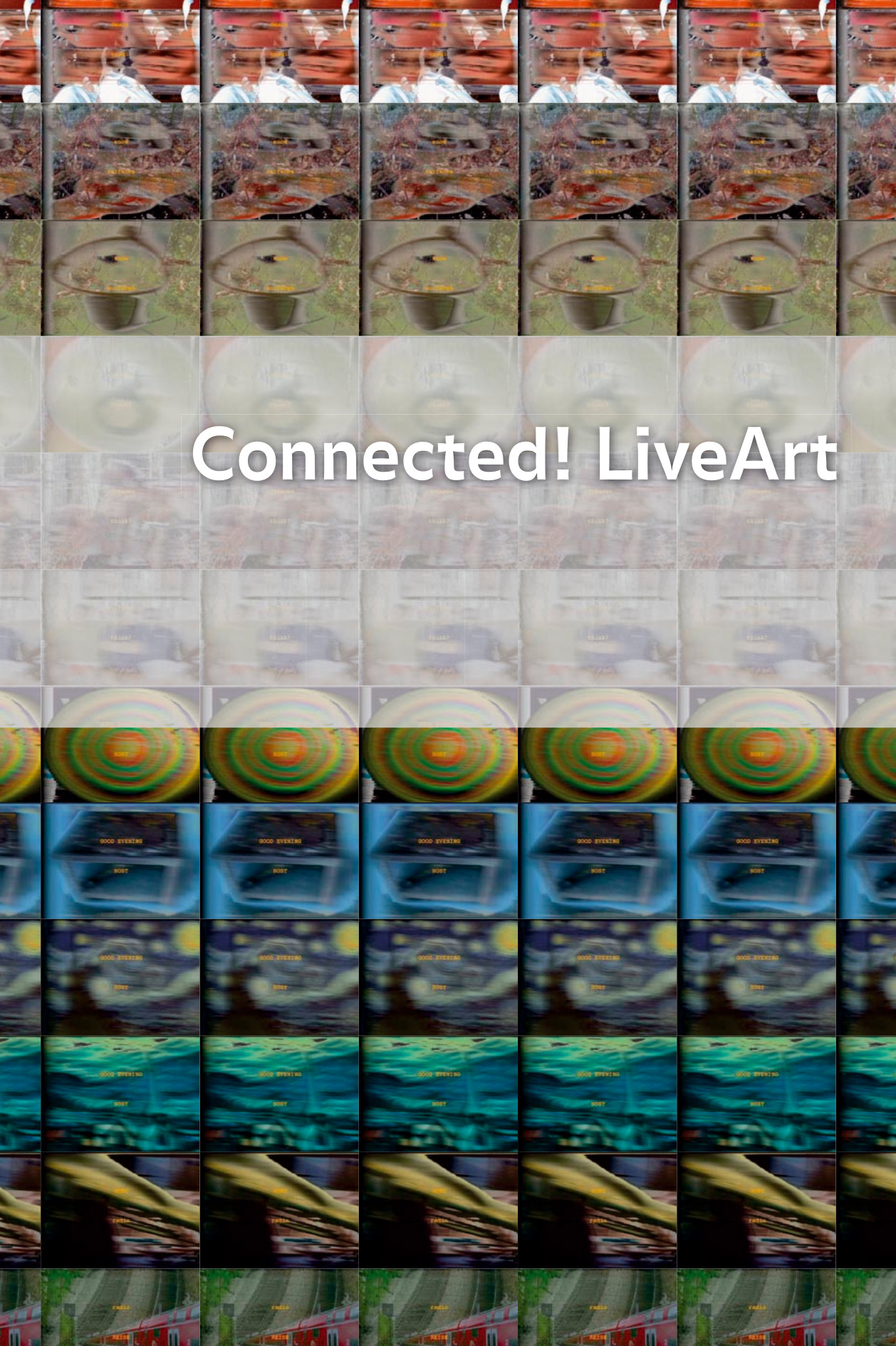
“The Connected! Programme spanned a two year period from January 2003 to January 2005. It officially concluded with a celebratory Birthday party for Art in the Theatrum Anatomicum of Waag Society, the local ‘home’-base of many Connected! projects. Although most of the people present at that event agreed with Federico Bonelli’s assessment “that art could have committed suicide in 1984″ – the research and the show goes on.
The Connected! Programme had four nested components: Projects, Artists-in-Residence, Sentient Creatures Lecture Series and Anatomic. This book documents many of the activities in these domains; the lectures, the events, the workshops, the performances, the installations, the discourse. Yet, it’s interesting to note that pulling together material for this publication was a bit like trying to capture the wind. Much of the work produced in this two-year period emphasized the real-time process of the making. Documentation of that often fragile, unstable and always already ephemeral process is sketchy at best and marginal to the actualization of the event itself. For many of these artists, documentation is a secondary concern, an afterthought. For others, documenting is an integral process indistinguishable from the event itself.
There are myriad photos in this catalogue of artists behind their laptops. Myriad photos that say little about the levels and layers of codified communication emitted from those unseen screens. These casual, unpretentious shots are images of social networks in progress – the translocal – a feedback loop of the local effecting the global affecting the local affecting the global. Not only does the artwork produced, or better transduced, scramble representational meaning but so too does the process of making. Performance practice that addresses the indeterminate dance-on-the-edge-of-chaos in compositional processes is a felt thing, an experience that doesn’t always translate well in laptop snapshots.”
Co-writers: Federico Bonelli, Beth Coleman, Josephine Dorado, Lucas Evers, Wander Eikelboom, Howard Goldkrand, Jan-Kees van Kampen, Arjen Keesmaat, Jeff Mann, Mark Meadows, Hellen Sky, Michelle Teran, Ananya Vajpeyi
Publisher Waag Society, Amsterdam, September 2005
Creative Commons BY-SA 2.0 Netherlands License
160 pages
PDF (updated on 2012-9-3)
Comment (0)LCD (Lowest Common Denominator), 18-27 (1997-2001)
Filed under magazine | Tags: · art, community radio, music, music history, radio, sound art, sound recording
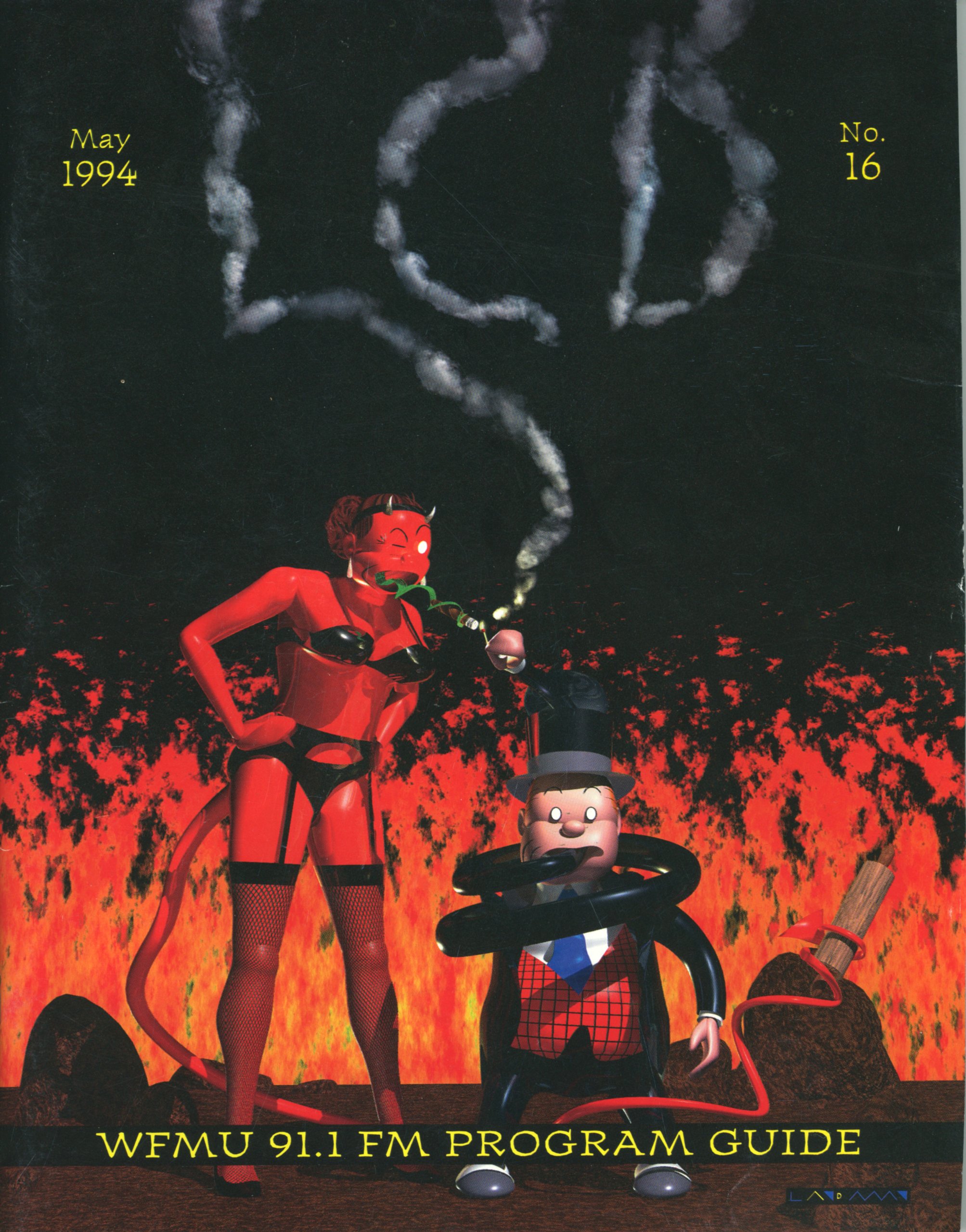
“Named the best radio station in America by Rolling Stone magazine four years running, WFMU is considered the alternative radio station. The New York-area noncommercial, free-form station features programming ranging from pure rock and roll to flat-out uncategorizable strangeness such as cooking instructions, off-kilter kids’ music, and spoken-word mash-ups. LCD (Lowest Common Denominator), the station’s program guide–begun in 1986 as a visual counterpart to WFMU’s oddball programming–was a wicked cocktail of satire, cultural news, alternative history, and provocative artwork that quickly gained noteriety and earned its own devoted cult following.”
Comment (0)