

Norbert Wiener: The Human Use of Human Beings: Cybernetics and Society (1950–) [EN, FR, BR-PT, RU, ES, SC, IT, GR]
Filed under book | Tags: · computing, cybernetics, entropy, machine, society, theory of communication
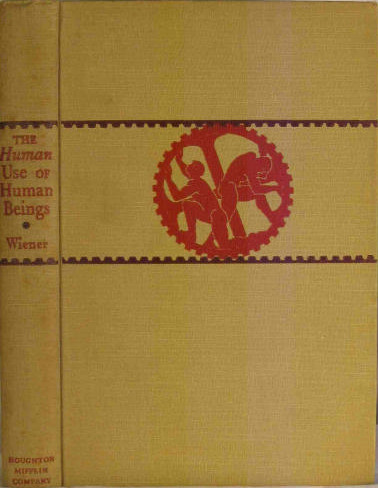
“Founder of the science of cybernetics—the study of the relationship between computers and the human nervous system—Wiener was widely misunderstood as one who advocated the automation of human life. As this book reveals, his vision was much more complex and interesting. He hoped that machines would release people from relentless and repetitive drudgery in order to achieve more creative pursuits. At the same time he realized the danger of dehumanizing and displacement. His book examines the implications of cybernetics for education, law, language, science, technology, as he anticipates the enormous impact—in effect, a third industrial revolution—that the computer has had on our lives.”
Publisher Houghton Mifflin, Boston, 1950
241 pages
New edition
With an Introduction by Steve J. Heims
Published by Free Association Books, London, 1989
ISBN 1853430757
xxx+199 pages
Wikipedia (EN)
The Human Use of Human Beings: Cybernetics and Society (English, 1950, added on 2021-4-8)
The Human Use of Human Beings: Cybernetics and Society (English, 1950/1989, updated on 2021-4-8)
Cybernétique et société: l’usage humain des êtres humains (French, 1952/2014, EPUB, added on 2021-4-8)
Cibernética e sociedade: o uso humano de seres humanos (BR-Portuguese, trans. José Paulo Paes, 2nd ed., 1954/1968, added on 2013-12-12)
Kibernetika i obshchestvo (Russian, trans. E.G. Panfilov, 1958, DJVU, added on 2021-4-8)
Cybernética y sociedad (Spanish, trans. José Novo Cerro, 1958, added on 2021-4-8)
Kibernetika i društvo: ljudska upotreba ljudskih bića (Serbo-Croatian, trans. Ljubomir Radanović, 1964, added on 2021-4-8)
Introduzione alla cibernetica: l’uso umano degli esseri umani (Italian, trans. Dario Persiani, 1966, added on 2021-4-8)
Kyvernētikē kai koinōnia: ē anthrōpinē chrēsimopoiēsē tōn anthrōpinōn ontōn (Greek, trans. Giannē Iōannidē, 1970, DJVU, added on 2021-4-8)
Andrew Pickering: The Cybernetic Brain: Sketches of Another Future (2010)
Filed under book | Tags: · brain, cybernetics, history of computing, history of technology, machine, ontology, philosophy, psychiatry, psychology, schizophrenia

“Cybernetics is often thought of as a grim military or industrial science of control. But as Andrew Pickering reveals in this beguiling book, a much more lively and experimental strain of cybernetics can be traced from the 1940s to the present.
The Cybernetic Brain explores a largely forgotten group of British thinkers, including Grey Walter, Ross Ashby, Gregory Bateson, R. D. Laing, Stafford Beer, and Gordon Pask, and their singular work in a dazzling array of fields. Psychiatry, engineering, management, politics, music, architecture, education, tantric yoga, the Beats, and the sixties counterculture all come into play as Pickering follows the history of cybernetics’ impact on the world, from contemporary robotics and complexity theory to the Chilean economy under Salvador Allende. What underpins this fascinating history, Pickering contends, is a shared but unconventional vision of the world as ultimately unknowable, a place where genuine novelty is always emerging. And thus, Pickering avers, the history of cybernetics provides us with an imaginative model of open-ended experimentation in stark opposition to the modern urge to achieve domination over nature and each other.”
Publisher University of Chicago Press, 2010
ISBN 0226667898, 9780226667898
526 pages
Reviews: M. Beatrice Fazi (Computational Culture, 2011), Jon Goodbun (Radical Philosophy, 2011).
PDF (updated on 2020-4-17)
Comment (1)Tiqqun journal, 1-2 (1999-2001) [French/transl.]
Filed under journal | Tags: · anarchism, capitalism, critique, cybernetic capitalism, cybernetics, information society, lettrism, networks, philosophy, politics, situationists, technology


Tiqqun was a French journal that published two issues in 1999 and 2001. The authors wrote as an editorial collective of seven people in the first edition and went uncredited in the second edition.
“Tiqqun’s poetic style and radical political engagement are akin to the Situationists and the Lettrists. Tiqqun is relatively accepted in the radical, philosophical milieu, the Situationist and post-Situationist groups, in the ultra-left, the squat and autonomist movements, as well as among some anarchists. Tiqqun is strongly influenced by the work of the italian philosopher Giorgio Agamben.” (Wikipedia)
Reading The Cybernetic Hypothesis (article by Joss Winn, July 2010)
Tiqqun at Bloom0101.org (from IA)
Tiqqun.info
Issue 1 (French, more formats at IA)
Issue 2 (French, more formats at IA)
Trans. of selected texts from issues 1 and 2 (English)
Trans. of selected texts from issues 1 and 2 (English, German, Italian, Spanish, Greek, Portuguese)