

Slava Gerovitch: From Newspeak to Cyberspeak: A History of Soviet Cybernetics (2004)
Filed under book | Tags: · computing, cybernetics, history of computing, history of science, history of technology, soviet union, technology

“In this book, Slava Gerovitch argues that Soviet cybernetics was not just an intellectual trend but a social movement for radical reform in science and society as a whole. Followers of cybernetics viewed computer simulation as a universal method of problem solving and the language of cybernetics as a language of objectivity and truth. With this new objectivity, they challenged the existing order of things in economics and politics as well as in science.
The history of Soviet cybernetics followed a curious arc. In the 1950s it was labeled a reactionary pseudoscience and a weapon of imperialist ideology. With the arrival of Khrushchev’s political “thaw,” however, it was seen as an innocent victim of political oppression, and it evolved into a movement for radical reform of the Stalinist system of science. In the early 1960s it was hailed as “science in the service of communism,” but by the end of the decade it had turned into a shallow fashionable trend. Using extensive new archival materials, Gerovitch argues that these fluctuating attitudes reflected profound changes in scientific language and research methodology across disciplines, in power relations within the scientific community, and in the political role of scientists and engineers in Soviet society. His detailed analysis of scientific discourse shows how the Newspeak of the late Stalinist period and the Cyberspeak that challenged it eventually blended into “CyberNewspeak.””
Published by MIT Press, 2004
ISBN 0262572257, 9780262572255
383 pages
Key terms:
newspeak, Norbert Wiener, dialectical materialism, Soviet Union, machine translation, Moscow University, John von Neumann, structural linguistics, Stalin, Stalinist, information theory, Roman Jakobson, servomechanisms, Andrei Markov, Cold War, Andrei Kolmogorov, Liapunov, entropy, Pavlovian, BESM
PDF (updated on 2017-10-25)
Comment (1)Christoph Klütsch: Computergrafik: Ästhetische Experimente zwischen zwei Kulturen. Die Anfänge der Computerkunst in den 1960er Jahren (2007) [German]
Filed under book | Tags: · aesthetics, art, computer art, computer graphics, cybernetics, information aesthetics
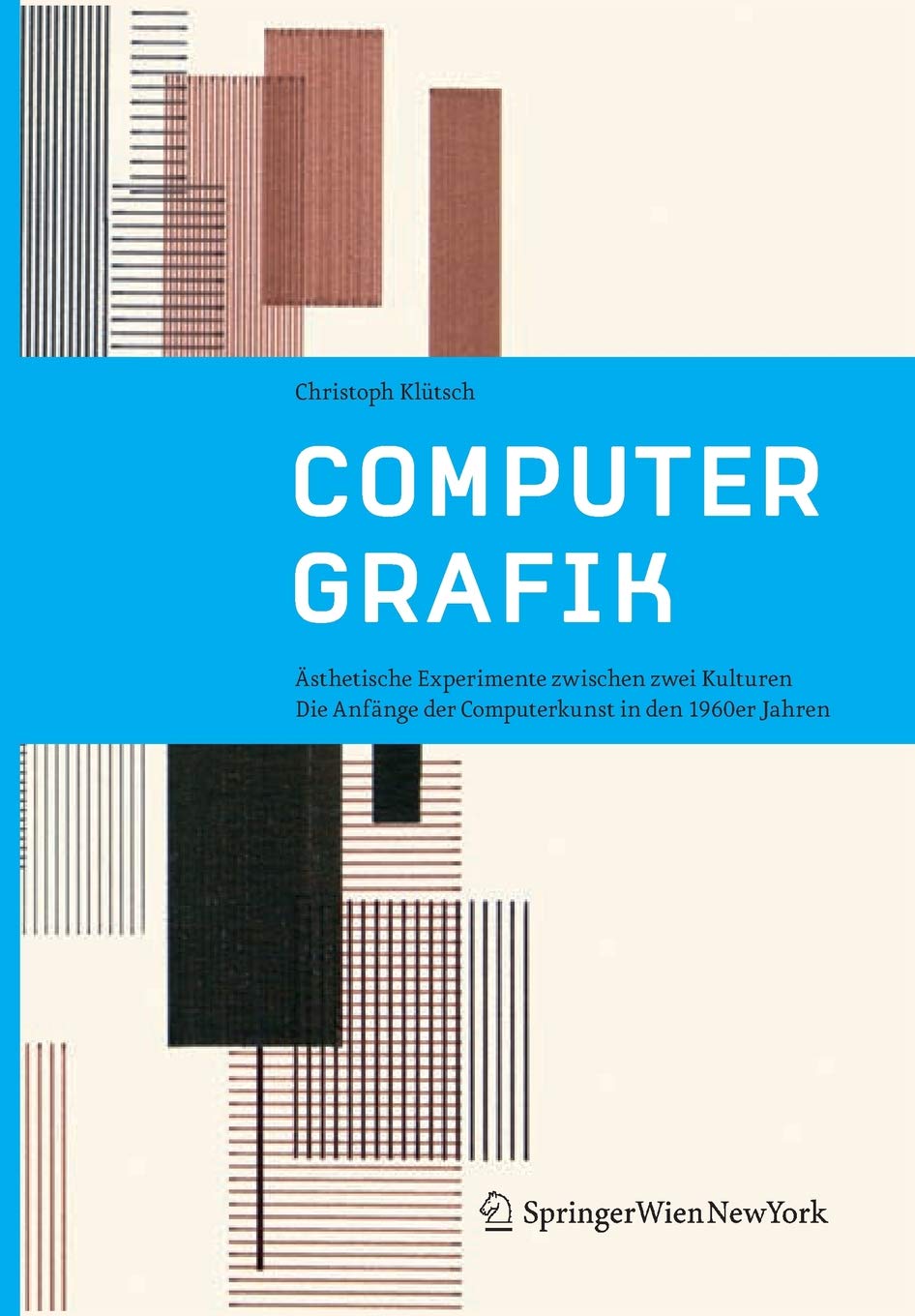
“Computergrafik ist ein innovativer Beitrag zur ungeschriebenen Geschichte der Computergrafik der 60er Jahre. Vor dem Hintergrund C. P. Snows “zwei Kulturen” Diskussion entwickelte sich in der Stuttgarter Schule um Max Bense eine neue Form generativer bzw. algorithmischer Kunst, die die Anfänge der digitalen Computergrafik markieren. Zentrale theoretische und künstlerische Konzepte werden anhand der Werke von Frieder Nake, Georg Nees, A. Michael Noll und Manfred Mohr diskutiert. Pionierleistungen, theoretische Diskussionen und die Bezüge zu zeitgenössischen Kunstbewegungen sind systematisch aufgearbeitet und ermöglichen die Einordnung einer ästhetischen Debatte, wie sie bisher weder im Kontext einer neuen Informationsästhetik noch in der Kunstgeschichte oder in medienwissenschaftlichen Untersuchungen geleistet worden ist. Interviews mit Pionieren der Computergrafik in Deutschland und den USA, die Aufarbeitung schwer zugänglichen Quellenmaterials und eine umfangreiche Bibliographie runden das Werk ab.”
Publisher Springer, 2007
ISBN 3211394095, 9783211394090
288 pages
Key terms: Computerkunst, Frieder Nake, Max Bense, Manfred Mohr, Computergrafik, Informationsästhetik, Bell Labs, Zagreb, Serendipity, Op-Art, C. P. Snow, Informationstheorie, Konkrete Kunst, Semiotik, Kybernetik, Helmar Frank, Computerkünstler, Bridget Riley, Turing test
Review: Mihai Nadin (Image, 2007).
PDF (updated on 2020-11-20)
Academia.edu (from author, added on 2020-11-20)
Richard Barbrook: Imaginary Futures: From Thinking Machines to the Global Village (2007)
Filed under book | Tags: · artificial intelligence, computing, control society, cybernetics, gift economy, history of computing, history of technology, information society, internet, politics

“Cooperative creativity and participatory democracy should be extended from the virtual world into all areas of life. This time, the new stage of growth must be a new civilisation.
Richard Barbrook traces the early days of the Internet, beginning from a pivotal point at the 1964 World’s Fair, in what critics are saying is the most well-researched and original account of cybertechnology among contemporary works. He demonstrates how business and ideological leaders put forth a carefully orchestrated vision of an imaginary future, where robots would do the washing up, go to the office and think for us. With America at the forefront of these promises, Barbrook shows how ideological forces joined to develop new information technologies during the Cold War era and how what they created historically has shaped the modern Internet, with intended political consequences.
Crucially, he argues that had the past been different, our technological and political present would not be what it is today. Barbrook’s conclusions about the modern state of the Internet, puts forward a call for action in how the world’s most important tool of revolutionary politics should be approached.”
Key terms: Fordism, W.W. Rostow, Marxism, cybernetic, Bell commission, artificial intelligence, gift economy, Stalinist, Maoist, Cold War game, Trotskyist, information society, laissez-faire liberalism, soft power, Hard power, American empire, Tet Offensive, Unisphere, grand narrative, Cold War Left
Publisher Pluto, 2007
ISBN 0745326609, 9780745326603
334 pages
Book website
Video introduction
Publisher
PDF, PDF (13 MB, updated on 2012-7-15)
Comments (3)