

IDEA Arts + Society (2003–) [Romanian/English]
Filed under magazine | Tags: · activism, art, art criticism, art theory, autonomy, capitalism, contemporary art, cultural criticism, eastern europe, institutional critique, performance art, politics, romania, society, southeastern europe, theory, video art

Idea 36-37, 2010
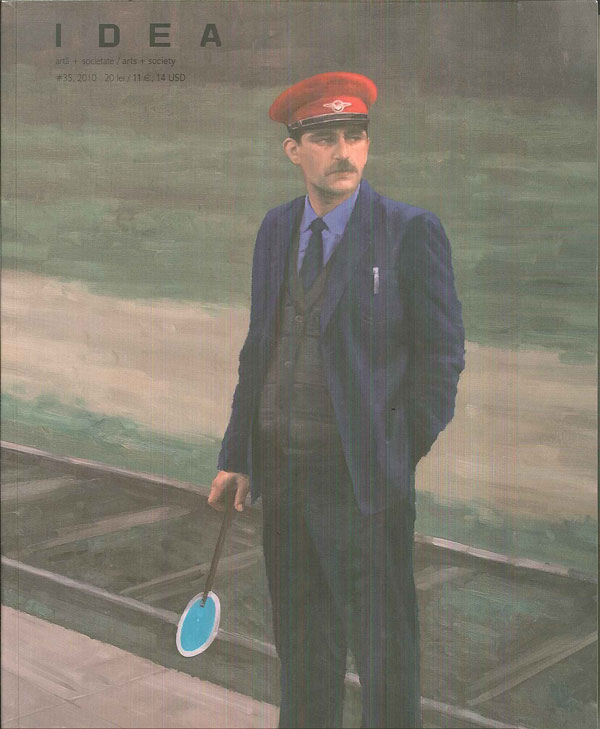
Idea 35, 2010
“IDEA art+society is a multiannual publication produced by IDEA, Cluj. It is published under its current form since 2003.
Allegiance to the exigency of genuine theory – a theory which is, first of all, its own practice – this is the program of IDEA arts+society magazine. This means: the practice of the concerned eye, which can be rigorous solely through the unconditional solidarity with the concrete. It is a practice of thinking which is alien to any aestheticism, hostile to any institutionalized transcendence, immune to the biased fiction of ideological neutrality, and remote from the pernicious language of our contemporary culture of ‘experts.’ In brief, it is the practice of critical and defiant reflection, dramatically lacking in the intellectual-civic debates of present-day Romania.
The graphical and logical operator ‘+’ functions as the material figura of all these dimensions, to which we can add artistic education and the public influence of art. The various ways of deciphering this sign suggest the manifold articulations between the artistic and the social realm. That is, the political.”
IDEA artă + societate / IDEA arts + society
Editors: Bogdan Ghiu, Ciprian Mureșan, Timotei Nădășan (editor-in-chief), Alexandru Polgár, Adrian T. Sîrbu, Ovidiu Țichindeleanu, Raluca Voinea
ISSN 1583–8293
Derek Wall: Babylon and Beyond. The Economics of Anti-Capitalist, Anti-Globalist and Radical Green Movements (2005)
Filed under book | Tags: · activism, anarchism, anti-capitalism, autonomy, capitalism, ecology, economics, economy, marxism, social movements, socialism

Babylon and Beyond provides the first clear and accessible guide to the economics of anti-capitalism. Anti-capitalism is a diverse movement: critics accuse it of knowing what it is against, but not knowing what it is for. Anti-capitalists want radical change, but what shape should that change take? The truth is that different sections of the movement advocate distinct—sometimes complementary, sometimes contradictory—programmes for change. This book concentrates on perhaps the most divisive issue of all in the anti-capitalist struggle: how to transform the economy. There are greens who think we must hold back economic growth and Marxists who believe the economy must move forward along capitalist lines before there can be revolutionary change; there are those who remain faithful to notions of collective or state ownership of all aspects of the economy, and those who think various kinds of reform or regulation of capitalist practice is more appropriate. Babylon and Beyond is a modern guidebook to the complicated terrain of alternatives to global capitalism. Derek Wall explains and summarises the rich variety of theories available within the anti-capitalist movement. Chapters cover Marxism, Autonomism, Anarchism, Ecosocialism, Capitalist reformers (like George Soros and Joseph Stiglitz), Green localists (like Colin Hines), and others. Unique in its coverage, clear and accessible, the book is ideal for activists, and anyone who is trying to find a useful way forward. This book is published in association with the Green Economics Institute.
Publisher Pluto Press, 2005
ISBN 074532391X, 9780745323916
232 pages
PDF (updated on 2014-8-28)
Comment (0)Radical Education Collective (eds.): New Public Spaces: Dissensual Political and Artistic Practices in the Post-Yugoslav Context (2009)
Filed under book | Tags: · activism, art, capitalism, democracy, education, ex-yugoslavia, kosovo, politics, protest, public space, public sphere, resistance, slovenia

New public spaces: dissensual political and aesthetical practices in the post-Yugoslav context is a reader edited by a Radical Education Collective from Ljubljana (Gal Kirn, Gasper Kralj and Bojana Piskur). It drew its inspiration from encounters and conversations with activists, artists, critical thinkers, curators, militant researchers and writers from Belgrade, Helsinki, Istanbul, Ljubljana, London, Pristina and Prizren in April and May 2008 at the social centre ROG and the AKC Metelkova mesto in Ljubljana. Those encounters challenged not only the distinction between ‘serious’ discussions and ‘informal’ debates – that instantly reproduce linear time and hierarchical space – but also our mutual ability to listen, talk and share experiences (instead of consume information). Contributions were subsequently elaborated into the reader, which consists of two parts. In the first part, engaged collectives reflect on the organisation of different political issues: from anti-capitalist and student struggles, to immigrant workers and the re-appropriation of public spaces in the region. The second part focuses on specific art collectives from Kosovo and Ljubljana, which are occupied with the question of space: why was space so important when rethinking the relation between art and politics, and also what can one do with the space? Here, a set of political practices enabled art collective to undermine the presupposed liberal border between public and private. The reader concludes with a presentation of some art projects that intervened and articulated spatial and visual transformations in the post-Yugoslav context.
Authors and contributors: Barbara Beznec, Sezgin Boynik, Ibrahim Ćurić, Cornelia Durka, Janna Graham, Minna Henriksson, Gal Kirn, Gašper Kralj, Andreja Kulunčić, Andrej Kurnik, Polona Mozetič, Said Mujić, Osman Pezić, Bojana Piškur, Marjetica Potrč, Tjaša Pureber, Radical Education Collective, TEMP, Darij Zadnikar, Antonios Vradis
Edited and compiled by: Gal Kirn, Gašper Kralj, Bojana Piškur
Published by Jan van Eyck Academie, Maastricht (NL), Modern Galerija, Ljubljana / Museum of Modern Art, July 2009
ISBN 978–90–72076–87–8
PDF (updated on 2025-1-24)
PDFs