
Maya Deren: An Anagram of Ideas on Art, Form and Film (1946)
Filed under pamphlet | Tags: · art, experimental film, film, film theory
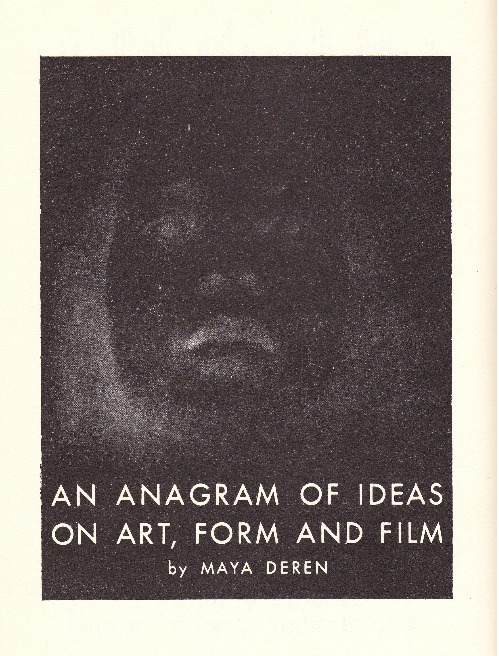
“Maya Deren’s four 16 mm. films have already won considerable acclaim. Convinced that there was poetry in the camera, she defied all commercial production conventions and started to make films with only ordinary amateur equipment. Her first, MESHES OF THE AFTERNOON (1943), was made with her husband Alexander Hammid, whose films–FORGOTTEN VILLAGE, CRISIS, HYMN OF THE NATIONS (Toscannini) and others–reveal also that devotion to the poetry of vision which formed the common ground of their collaboration. When other work claimed his time, Maya Deren went on by herself–conceiving, producing, directing, acting, (being unable to afford actors) photographing (when she was not in the scene) and cutting. Through all the trials of such shoe-string production, which included carrying equipment for miles to the location, she had only assistance of another woman, Hella Heyman, as camerawoman. Yet three more films were made: AT LAND, A STUDY IN CHOREOGRAPHY FOR CAMERA (with Talley Beatty) and RITUAL IN TRANSFIGURED TIME, thus proving that fine films could be made “for the price of the lipstick in a single Hollywood production.” Her heroic persistence has just been rewarded by a John Simon Guggenheim Memorial Foundation Fellowship. Moreover, the reputation of the films has spread so that performance at the Provincetown Playhouse were completely sold out and they have also been shown in colleges and museums throughout the country.
In this pamphlet Maya Deren’s approach to film reflects not the limited scope of a professional craftsman, but a broad cultural background–a profound interest not only in esthetics generally and in psychological insight, but in physics and the sciences as well. Russian-born, daughter of a psychiatrist, Maya Deren attended Syracuse University, when she first became interested in film, and received her B.A. from New York University and her M.A. from Smith College, both degrees in literature.” (Publisher’s Note)
Publisher Alicat Book Shop Press, Yonkers, New York, 1946
Issue 9 of “Outcast” series of chapbooks
52 pages
via meghedii
Experimental film at Monoskop wiki
Google books
PDF (no OCR; updated on 2012-7-14)
Comment (0)Edward S. Small: Direct Theory: Experimental Film/Video as Major Genre (1994)
Filed under book | Tags: · aesthetics, avant-garde, cinema, computer film, expanded cinema, experimental film, film, film theory, phenomenology, structural film, video, video art

“Undulating water patterns; designs etched directly into exposed film; computer- generated, pulsating, multihued light tapestries—the visual images that often constitute experimental film and video provide the basis for Edward S. Small’s argument for a new theory defining this often overlooked and misunderstood genre. In a radical revision of film theory incorporating a semiotic system, Small contends that experimental film/video constitutes a mode of theory that bypasses written or spoken words to directly connect Ferdinand de Saussure’s “signifier” and “signified,” the image and the viewer. This new theory leads Small to develop a case for the establishment of experimental film/video as a major genre.
Small contends that the aesthetic of experimental film/video would best be understood as a coordinate major genre separate from genres such as fictive narrative and documentary. He employs eight experimental technical/structural characteristics to demonstrate this thesis: the autonomy of the artist or a-collaborative construction; economic independence; brevity; an affinity for animation and special effects that embraces video technology and computer graphics; use of the phenomenology of mental imagery, including dreams, reveries, and hallucinations; an avoidance of verbal language as either dialogue or narration; an exploration of nonnarrative structure; and a pronounced reflexivity—drawing the audience’s attention to the art of the film through images rather than through the mediation of words.
Along with a theoretical approach, Small provides an overview of the historical development of experimental film as a genre. He covers seven decades beginning in France and Germany in the 1920s with European avant-garde and underground films and ends with a discussion of experimental videos of the 1990s. He highlights certain films and provides a sampling of frames from them to demonstrate the heightened reflexivity when images rather than words are the transmitters: for example, Ralph Steiner’s 1929 H2O, a twelve-minute, wordless, realistic study of water patterns, and Bruce Conner’s 1958 A Movie, which unites his themes of war-weapons-death and sexuality not by narrative digesis but by intellectual montage juxtapositions. Small also examines experimental video productions such as Stephen Beck’s 1977 Video Weavings, which has a simple musical score and abstract images recalling American Indian rugs and tapestries.
Small adds classic and contemporary film theory discussions to this historical survey to further develop his direct-theory argument and his presentation of experimental film/video as a separate major genre. He stresses that the function of experimental film/video is “neither to entertain nor persuade but rather to examine the quite omnipresent yet little understood pictos [semiotic symbols] that mark and measure our postmodern milieu.”
Publisher SIU Press, 1994
ISBN 0809319209, 9780809319206
122 pages
EPUB (updated on 2012-7-9)
Comments (2)Shoot Shoot Shoot: The First Decade of the London Film-Makers’ Co-operative and British Avant-Garde Film 1966-1976 (2002)
Filed under brochure | Tags: · 1960s, 1970s, expanded cinema, experimental film, film, film history, united kingdom
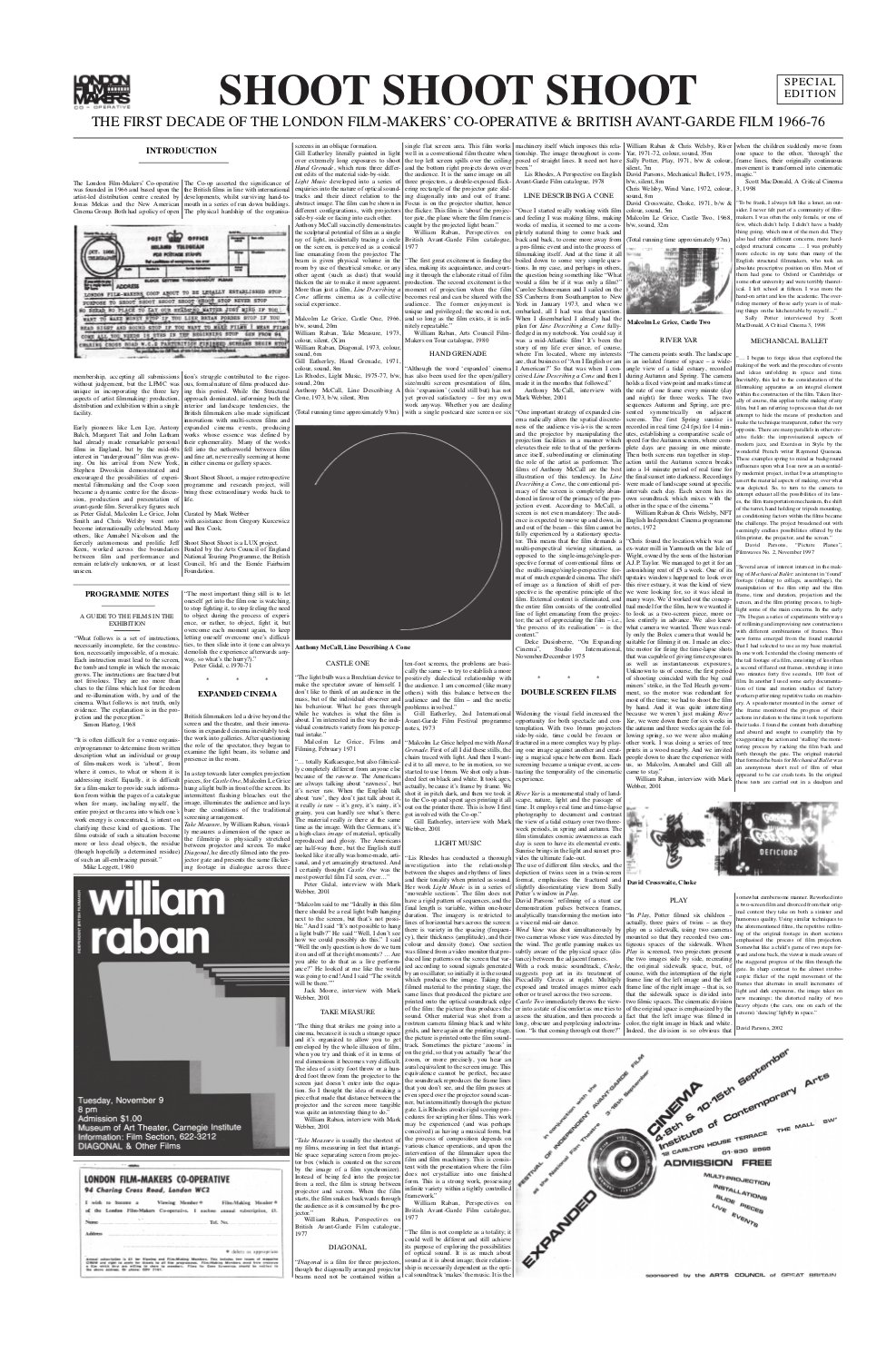
Broadsheet for the film exhibition curated by Mark Webber and organised by LUX London. Includes film descriptions, chronology of events and developments 1966-76, and the article by A.L. Rees.
“The London Film-Makers’ Co-operative was founded in 1966 and based upon the artist-led distribution centre created by Jonas Mekas and the New American Cinema Group. Both had a policy of open membership, accepting all submissions without judgement, but the LFMC was unique in incorporating the three key aspects of artist filmmaking: production, distribution and exhibition within a single facility.
Early pioneers like Len Lye, Antony Balch, Margaret Tait and John Latham had already made remarkable personal films in England, but by the mid-60s interest in “underground” film was growing. On his arrival from New York, Stephen Dwoskin demonstrated and encouraged the possibilities of experimental filmmaking and the Coop soon became a dynamic centre for the discussion, production and presentation of avant-garde film. Several key figures such as Peter Gidal, Malcolm Le Grice, John Smith and Chris Welsby went onto become internationally celebrated. Many others, like Annabel Nicolson and the fiercely autonomous and prolific Jeff Keen, worked across the boundaries between film and performance and remain relatively unknown, or at least unseen.
The Co-op asserted the significance of the British films in line with international developments, whilst surviving hand-to-mouth in a series of run down buildings. The physical hardship of the organisation’s struggle contributed to the rigorous, formal nature of films produced during this period. While the Structural approach dominated, informing both the interior and landscape tendencies, the British filmmakers also made significant innovations with multi-screen films and expanded cinema events, producing works whose essence was defined by their ephemerality. Many of the works fell into the netherworld between film and fine art, never really seeming at home in either cinema or gallery spaces.
Shoot Shoot Shoot, a major retrospective programme and research project, will bring these extraordinary works back to life.
Curated by Mark Webber with assistance from Gregory Kurcewicz and Ben Cook.
Shoot Shoot Shoot is a LUX project.” (from Introduction)
Publisher Lux, London, May 2002
8 pages
project
more (touring programme, Lux Online)
overview of the touring programme (George Clark, Senses of Cinema)
DVD anthology (published in 2006)
PDF (85 MB, added on 2014-12-22), Scribd
Comment (0)