

Sean Cubitt: Finite Media: Environmental Implications of Digital Technologies (2016)
Filed under book | Tags: · aesthetics, ecology, energy, environment, matter, media, politics, technology
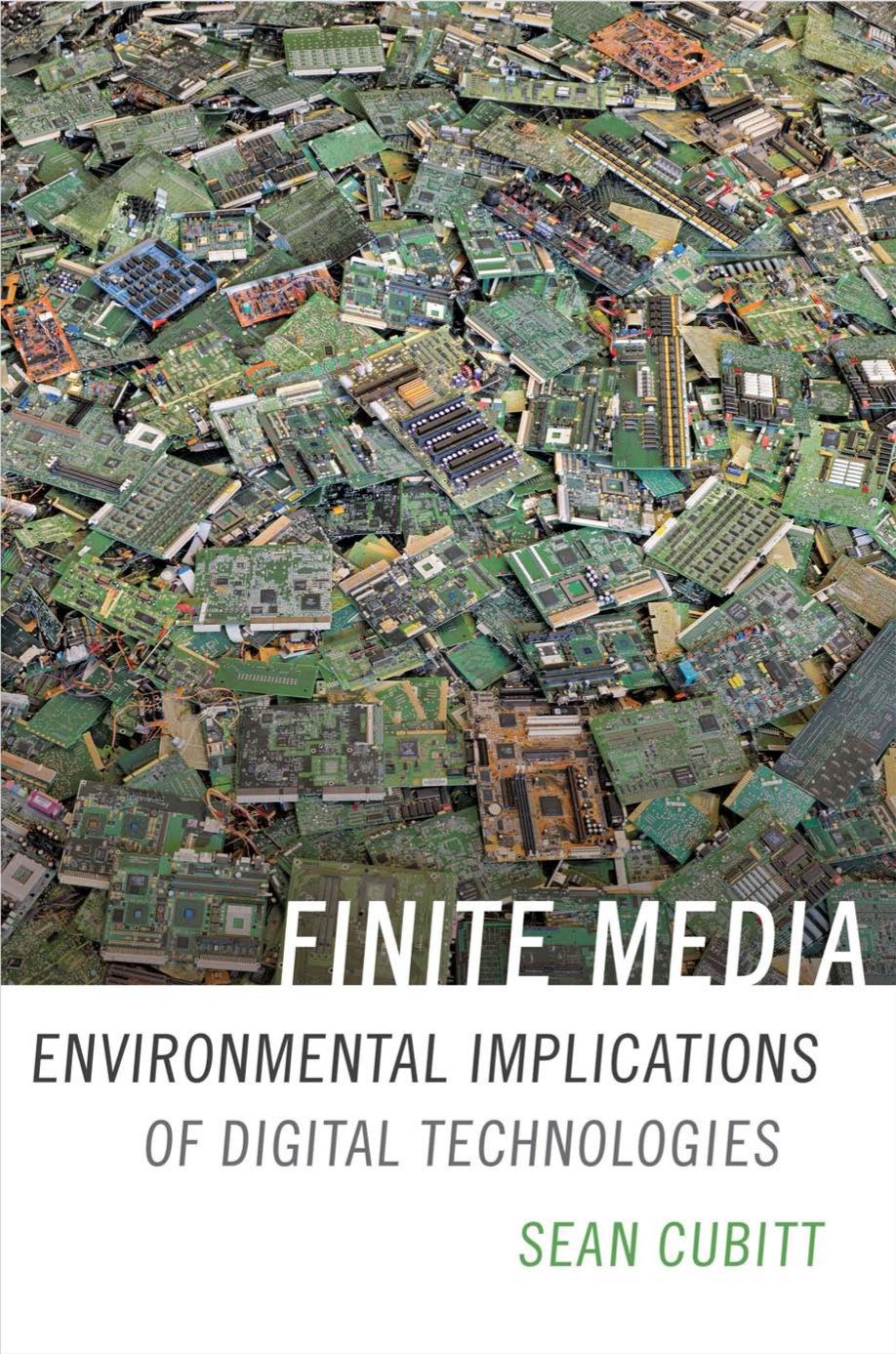
“While digital media give us the ability to communicate with and know the world, their use comes at the expense of an immense ecological footprint and environmental degradation. In Finite Media Sean Cubitt offers a large-scale rethinking of theories of mediation by examining the environmental and human toll exacted by mining and the manufacture, use, and disposal of millions of phones, computers, and other devices. The way out is through an eco-political media aesthetics, in which people use media to shift their relationship to the environment and where public goods and spaces are available to all. Cubitt demonstrates this through case studies ranging from the 1906 film The Story of the Kelly Gang to an image of Saturn taken during NASA’s Cassini-Huygens mission, suggesting that affective responses to images may generate a populist environmental politics that demands better ways of living and being. Only by reorienting our use of media, Cubitt contends, can we overcome the failures of political elites and the ravages of capital.”
Publisher Duke University Press, 2016
Cultural Politics Books series
ISBN 9780822362920. 0822362929
256 pages
via wX
PDF (updated on 2021-1-29)
Comment (0)Donna J. Haraway: Staying with the Trouble: Making Kin in the Chthulucene (2016)
Filed under book | Tags: · anthropocene, biology, capitalism, capitalocene, chthulucene, environment, feminism, human, human ecology, multispecies, nature
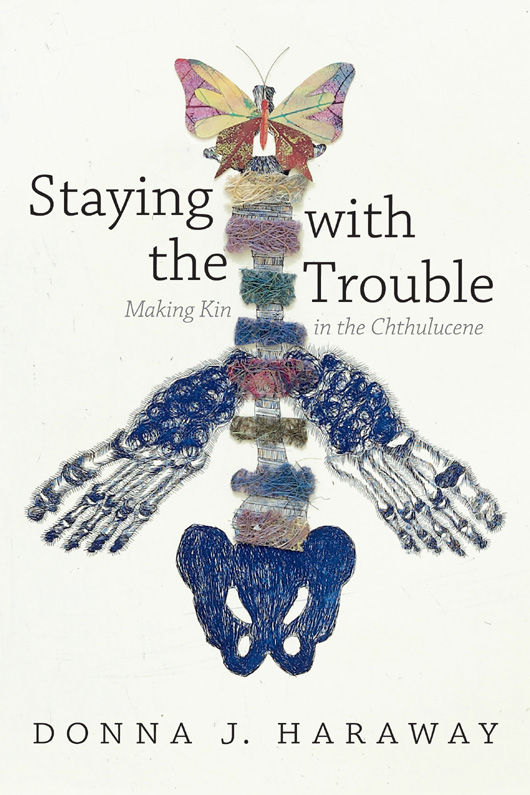
“In the midst of spiraling ecological devastation, multispecies feminist theorist Donna J. Haraway offers provocative new ways to reconfigure our relations to the earth and all its inhabitants. She eschews referring to our current epoch as the Anthropocene, preferring to conceptualize it as what she calls the Chthulucene, as it more aptly and fully describes our epoch as one in which the human and nonhuman are inextricably linked in tentacular practices. The Chthulucene, Haraway explains, requires sym-poiesis, or making-with, rather than auto-poiesis, or self-making. Learning to stay with the trouble of living and dying together on a damaged earth will prove more conducive to the kind of thinking that would provide the means to building more livable futures. Theoretically and methodologically driven by the signifier SF—string figures, science fact, science fiction, speculative feminism, speculative fabulation, so far—Staying with the Trouble further cements Haraway’s reputation as one of the most daring and original thinkers of our time.”
Publisher Duke University Press, 2016
Experimental Futures series
ISBN 9780822373780, 0822373785
xv+296 pages
Talk (video, 25 min, 2014)
Interview with author: Lauren O’Neill-Butler (Artforum, 2016).
Reviews: Archie Davies (Antipode, 2016), Matt Thompson (Savage Minds, 2016), Ingrid M. Hoofd (Feminist Review, 2017), Devin Proctor (Anthropological Quarterly, 2017), Danya Glabau (J Cultural Economy, 2017), Oliver Basciano (ArtReview, 2017), Ben Denham (Sydney Review of Books, 2017), Juan Guevara (Space and Culture, 2018), Gyrus (Dreamflash, 2018), Luis Campos (Quarterly Review of Biology, 2018), Kaisa Kortekallio (European Journal of Women’s Studies, 2019), Irene Wolfstone (Imaginations, 2019), Thierry Hoquet (Critique, 2019, FR), Doortje Hörst (Junctions, 2019).
HTML (removed on 2017-5-17 upon request from publisher)
Comment (0)Environmental Humanities, 8(1): Multispecies Studies (2016)
Filed under journal | Tags: · animal, biology, botany, environment, ethnography, multispecies

“The emerging field of multispecies studies, grounded in passionate immersion in the lives of fungi, microorganisms, animals, plants, and others, is opening up novel ways of engaging with worlds around us. This issue brings together some of the leading scholars in this field to explore what is at stake—epistemologically, politically, ethically—for different forms of life caught up in diverse relationships of knowing and living together. The collection takes us into the worlds of sheep and shepherds; of stones, worms, salmon, and forest-devouring beetles; of viruses and their elephants; of seals, crows, and lava flows in Hawaii; and finally of frogs-as-pregnancy-tests and possible agents of pathogenic fungal spread. Each of the contributors explores what difference curious and careful attention to others might make in our efforts to inhabit and coconstitute flourishing worlds in these difficult times.”
Edited by Thom van Dooren, Ursula Münster, Eben Kirksey, Deborah Bird Rose, Matthew Chrulew, and Anna Lowenhaupt Tsing
Publisher Duke University Press, May 2016
Creative Commons license CC BY-NC-ND 3.0
ISSN 2201‐1919
148 pages
HT marcelo
HTML, PDFs (updated on 2018-4-26)
single PDF (2 MB)