

Ola Uhrqvist: Seeing and Knowing the Earth as a System: An Effective History of Global Environmental Change Research as Scientific and Political Practice (2014)
Filed under book, thesis | Tags: · anthropocene, climate crisis, earth, earth system, environment, governance, knowledge, knowledge production
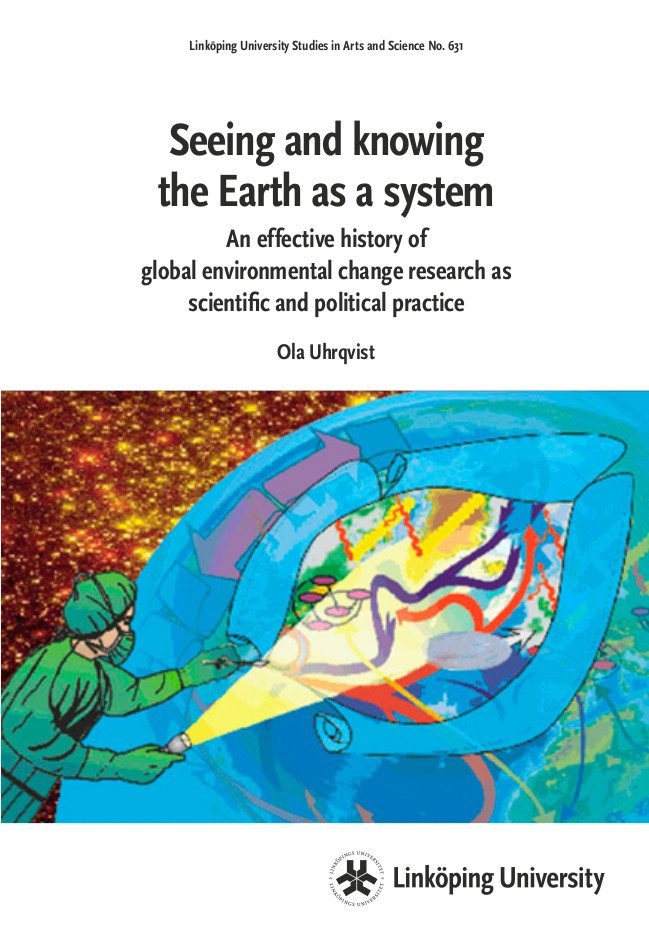
“Previous research connecting scientific knowledge production with governing of the global environment usually start in international climate change negotiations and related assessments. From that vantage point Earth system science and models are studied as an expansion of Global Circulation Models. By tracing of the history of the present Earth system outlook this thesis offers a reflection about how scientific knowledge produce and connects problems with descriptions of desired order of things and strategies to get there. Knowledge becomes a productive power by shaping fields of possible action in relation to the global environment.
The interpreted empirical material consists of scientific discussions from the International global environmental change programmes and particularly the International Geosphere-Biosphere Programme (IGBP) and the International Human Dimensions Programme on global environmental change (IHDP). The studied period spans from the start of the planning of the IGBP in 1983 to the presentation of the new research programme Future Earth in 2013. The thesis is organised around the effects of the IGBP’s strategy to use predictive Earth system models as a tool to bring a broad range of scientific disciplines together.
The results demonstrate the historicity of the present Earth system outlook by showing how ecosystems and human dimensions were attributed new and more important roles as drivers of global change. The thesis also argue for the need to approach the ‘Earth system’ as a result of a productive tension between top-down perspectives found in global modelling and bottom-up empirical research engaging with process interactions down to local scales.”
Publisher Linköping University Electronic Press, Linköping, 2014
Open access
ISBN 9789175192369
91 pages
PDF, PDF (updated on 2018-6-11)
Comment (0)The Anthropocene Review, 2(2): When and How Did the Anthropocene Begin? (2015)
Filed under journal | Tags: · anthropocene, climate crisis, earth, environment, geology, human, science

“In March of this year, Nature published a stimulating article by Simon Lewis and Mark Maslin entitled Defining the Anthropocene (Lewis and Maslin, 2015). In it, they proposed criteria for determining the formal onset of the Anthropocene Epoch and from these, derived new starting dates. They proposed two alternatives, ad 1610 and ad 1964. The former date lies some two centuries before the date proposed by Crutzen and Stoermer (2000) in their paper introducing and providing both a definition and a starting point for the Anthropocene. The latter date is over a decade later than an alternative and increasingly discussed onset date arising from Steffen et al.’s paper (2007) identifying a ‘Great Acceleration’ in detectable human impact on the Earth System beginning in the mid 20th century. These new proposals have provoked a great deal of interest and debate.
In this issue of The Anthropocene Review, we have tried to provide a timely account of this debate. The first four papers comprise contrasted ‘comments’ on the Nature article, followed by ‘replies’ from its authors. The issues raised are far from forming a sterile debate on starting dates. They are full of, and indeed go well beyond, the engaging scientific basis upon which the contrasted points of view rest.” (from the Editorial)
Editor: Mike Oldfield
Publisher Sage, August 2015
ISSN 20530196
91 pages
PDF (2 MB)
Comment (0)Robert Rosen: Essays on Life Itself (1999)
Filed under book | Tags: · algorithm, anticipation, biology, causality, complex systems, complexity, environment, life, machine, mathematics, mind, philosophy of science, physics, science, semantics, systems theory, technology, theory

“In this collection of twenty-two essays, Rosen takes to task the central objective of the natural sciences, calling into question the attempt to create objectivity in a subjective world. The book opens with an exploration of the interaction between biology and physics, unpacking Schrödinger´s famous text What Is Life? and revealing the shortcomings of the notion that artificial intelligence can truly replicate life.
He also refutes the thesis that mathematical models of reality can be reflected entirely in algorithms, that is, are of a purely syntactical character. He argues that it is the noncomputable, nonformalizable nature of biology that makes organisms complex, and that these systems are generic, whereas those systems described by reductionistic reasoning are simple and rare.
An intriguing enigma links all of the essays: ‘How can science explain the unpredictable?'”
Publisher Columbia University Press, 1999
Complexity in Ecological Systems series
ISBN 023110510X, 9780231105101
x+360 pages
Reviews: Bruce J. West (Quarterly Review of Biology, 2001), Donald C. Mikulecky (c1999).
PDF (removed on 2019-10-30 upon request from Judith Rosen)
Comment (0)