

Alfred H. Barr, Jr.: Cubism and Abstract Art: Painting, Sculpture, Constructions, Photography, Architecture, Industrial Art, Theatre, Films, Posters, Typography (1936)
Filed under book, catalogue | Tags: · abstract art, abstraction, architecture, art, art history, avant-garde, constructivism, cubism, dada, design, expressionism, fauvism, film, futurism, impressionism, painting, photography, sculpture, suprematism, surrealism, theatre, typography
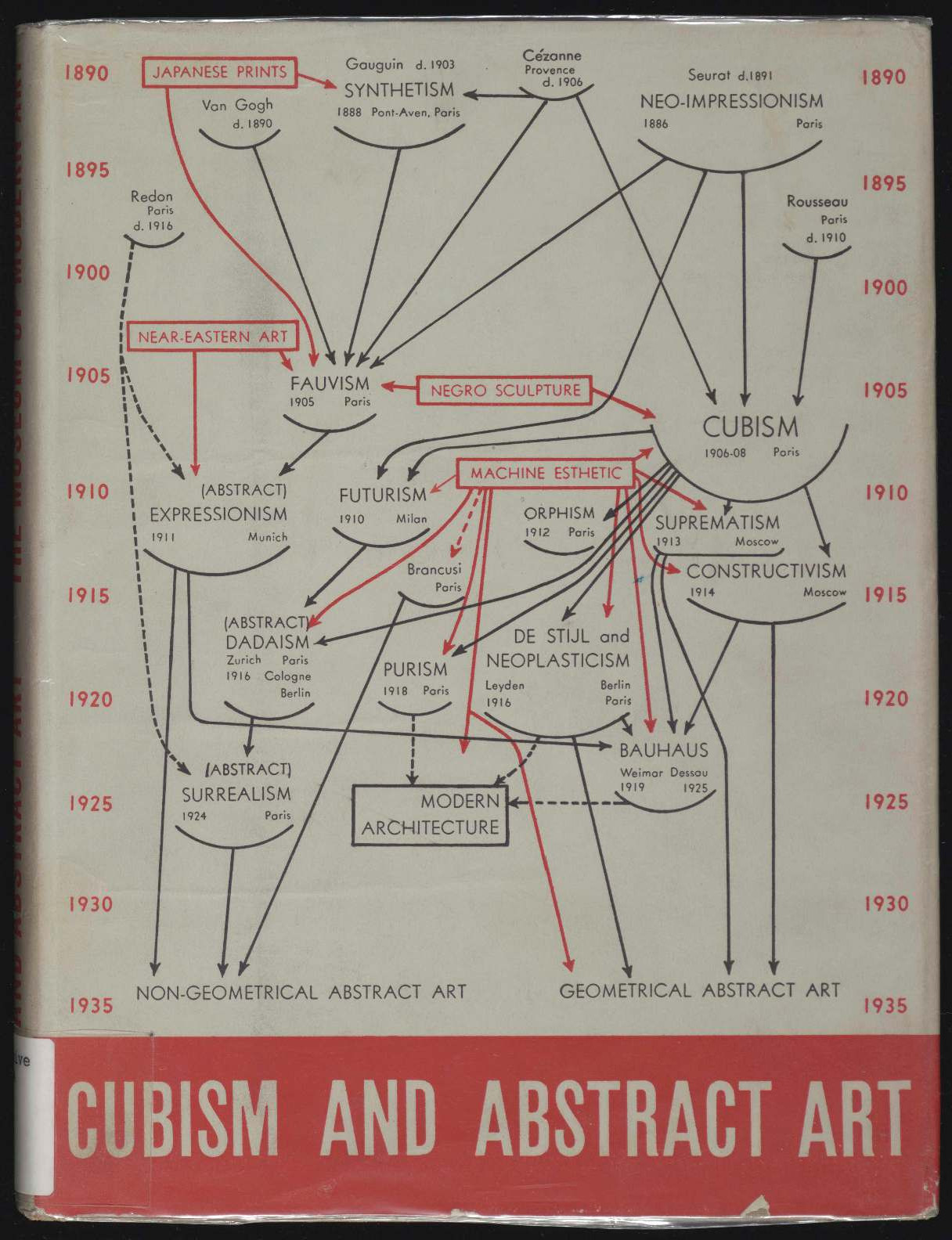
The catalogue of the first MoMA’s retrospective of modernism, held 2 March-19 April 1936, laid the theoretical foundation of the museum. Its jacket contains a notorious chart of modernist art history, the Diagram of Stylistic Evolution from 1890 until 1935.
“The catalogue remains an important historical document (as does that for Fantastic Art, Dada, Surrealism). It set abstraction within a formalist framework that—ignoring the intellectual byways of French symbolism, German idealism, and Russian Marxism of the previous thirty years—was shaped by the scientific climate that had started a century before. … The exhibition together with the widespread dissemination of its influential catalogue, established Cubism as the central issue of early modernism, abstraction as the goal.” (Sybil Gordon Kantor, 2003)
The exhibition later traveled to another 7 cities: San Francisco, Cincinnati, Minneapolis, Cleveland, Baltimore, Providence, and Grand Rapids.
Publisher Museum of Modern Art, New York, 1936
249 pages
via MoMA
Commentary: Meyer Schapiro (Marxist Quarterly, 1937), Susan Noyes Platt (Art Journal, 1988), Astrit Schmidt Burkhardt (Word & Image, 2000).
Publisher (incl. master checklist and press releases)
WorldCat
PDF (47 MB)
Comment (1)Journal of Aesthetics & Culture, 4: From Sign to Signal (2012)
Filed under book | Tags: · aesthetics, art theory, electronic art, film, interface, media, media art, media technology, new media, semiotics, sign, signal processing, technology, theory
“Since the 1990s there has been intensified focus on the concepts of performativity, the relational, and affect in the humanities. Scholars from different fields have in a variety of ways embraced these notions in their accounts of contemporary culture, and as such they also form the backdrop of this thematic collection of articles entitled From Sign to Signal. It seems, however, as if today’s media situation–the globally evident usage of media technologies–requires a new theoretical approach in order to deal with the intersections of technology and aesthetics, since in these cases the sign often falls short. It has therefore been the ambition of this collection to invite scholars within the humanities to take part in a discussion on the implications of a gradual shift from a (linguistically framed) paradigm of the sign to a new paradigm connected with media augmented environments.
As the term for this new paradigm we have chosen the ‘signaletic material’, coined by Gilles Deleuze in his book Cinema 2: The Time-Image. Deleuze developed this notion in order to stress that film in his view of contemporary or modern cinema had altogether eliminated classical (literary) thoughts of plot and narration. Toward the end of Cinema 2 it becomes clear that the notion of the ‘signaletic material’ might be developed to cover all kinds of filmic and electronic material as well as the emerging new media technologies.” (from Foreword)
Edited by Bodil Marie Stavning Thomsen, John Sundholm and Ulla Angkjær Jørgensen
Publisher Co-Action Publishing, Järfälla, Sweden, 2012
Creative Commons CC-BY 4.0 License
eISSN 2000-4214
134 pages
HTML, PDFs (updated on 2017-10-27)
single PDF
Barton Byg: Landscapes of Resistance: The German Films of Danièle Huillet and Jean-Marie Straub (1995)
Filed under book | Tags: · avant-garde, cinema, film, film criticism, Frankfurt school, left, modernism, narrative, politics

“Fervently admired and frequently reviled, Jean-Marie Straub and Danièle Huillet—who have lived and worked together since the 1950s—may well be the most uncompromising, not to say intransigent, filmmakers in the history of the medium. Their radical and deeply political films placed them as forerunners of the New German Cinema movement in the 1960s and influential figures in the subsequent explosion of the European avant-garde. In Landscapes of Resistance, Barton Byg fills a significant gap in modern German and European cinema studies by tracing the career of the two filmmakers and exploring their connection to German modernism, in particular their relationship to the Frankfurt School.
Although they are not German themselves, Straub and Huillet have used German material as the basis for the majority of their films. They have transcribed prose by Böll and Kafka, operas by Schoenberg, and verse dramas by Hölderlin. Byg explores how their work engages German culture with a critical distance and affection and confronts the artificiality of divisions between high and low culture.”
Publisher University of California Press, 1995
Open access
ISBN 0520089081, 9780520089082
xiii+303 pages
Reviews: Ulrich Kriest (Medienwissenschaft 1997, DE), Margret Eifler (The German Quarterly 2000).
Comment (0)