

N. Katherine Hayles: How We Became Posthuman: Virtual Bodies in Cybernetics, Literature, and Informatics (1999)
Filed under book | Tags: · android, artificial intelligence, autopoiesis, body, cellular automata, computing, cybernetics, cyborg, epistemology, literature, posthuman, posthumanism, technology, virtual reality
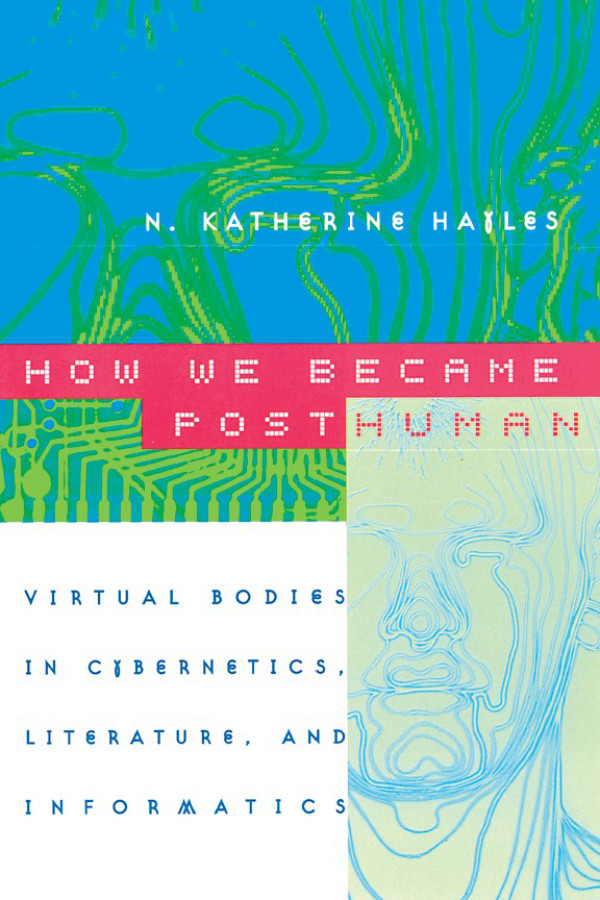
“In this age of DNA computers and artificial intelligence, information is becoming disembodied even as the “bodies” that once carried it vanish into virtuality. While some marvel at these changes, envisioning consciousness downloaded into a computer or humans “beamed” Star Trek-style, others view them with horror, seeing monsters brooding in the machines. In How We Became Posthuman, N. Katherine Hayles separates hype from fact, investigating the fate of embodiment in an information age.
Hayles relates three interwoven stories: how information lost its body, that is, how it came to be conceptualized as an entity separate from the material forms that carry it; the cultural and technological construction of the cyborg; and the dismantling of the liberal humanist “subject” in cybernetic discourse, along with the emergence of the “posthuman.”
Ranging widely across the history of technology, cultural studies, and literary criticism, Hayles shows what had to be erased, forgotten, and elided to conceive of information as a disembodied entity. Thus she moves from the post-World War II Macy Conferences on cybernetics to the 1952 novel Limbo by cybernetics aficionado Bernard Wolfe; from the concept of self-making to Philip K. Dick’s literary explorations of hallucination and reality; and from artificial life to postmodern novels exploring the implications of seeing humans as cybernetic systems.
Although becoming posthuman can be nightmarish, Hayles shows how it can also be liberating. From the birth of cybernetics to artificial life, How We Became Posthuman provides an indispensable account of how we arrived in our virtual age, and of where we might go from here.”
Publisher University of Chicago Press, 1999
ISBN 0226321460, 9780226321462
350 pages
PDF (updated on 2012-7-24)
Comment (0)Jussi Parikka: Insect Media: An Archaeology of Animals and Technology (2010)
Filed under book | Tags: · animal, biopolitics, biopower, biotechnology, cybernetics, deterritorialization, entomology, ethology, game theory, immanence, media archeology, media ecology, ontology, perception, philosophy, posthumanism, swarm intelligence, technology

“Since the early nineteenth century, when entomologists first popularized the unique biological and behavioral characteristics of insects, technological innovators and theorists have proposed insects as templates for a wide range of technologies. In Insect Media, Jussi Parikka analyzes how insect forms of social organization—swarms, hives, webs, and distributed intelligence—have been used to structure modern media technologies and the network society, providing a radical new perspective on the interconnection of biology and technology.
Through close engagement with the pioneering work of insect ethologists, including Jakob von Uexküll and Karl von Frisch, posthumanist philosophers, media theorists, and contemporary filmmakers and artists, Parikka develops an insect theory of media, one that conceptualizes modern media as more than the products of individual human actors, social interests, or technological determinants. They are, rather, profoundly nonhuman phenomena that both draw on and mimic the alien lifeworlds of insects.
Deftly moving from the life sciences to digital technology, from popular culture to avant-garde art and architecture, and from philosophy to cybernetics and game theory, Parikka provides innovative conceptual tools for exploring the phenomena of network society and culture. Challenging anthropocentric approaches to contemporary science and culture, Insect Media reveals the possibilities that insects and other nonhuman animals offer for rethinking media, the conflation of biology and technology, and our understanding of, and interaction with, contemporary digital culture.”
Publisher University of Minnesota Press, 2010
Posthumanities Series 11
ISBN 0816667403, 9780816667406
320 pages
Review: Jennifer Gabrys (Mute).
PDF (updated on 2012-7-15)
Comment (0)Gordon Pask: Conversation Theory. Application in Education and Epistemology (1976)
Filed under book | Tags: · communication, cybernetics, education, epistemology, knowledge, knowledge production, learning
“The argument in this book aims to apply a body of cohesive and interpretable ideas, developed over the last dozen years or so, to issues of significance in educational psychology and epistemology. The history and development of these ideas, which emerged from experiments on perceptual motor learning, group interaction and sequential choice (as well as more obviously relevant studies of learning, subject matter structuring and cognition), are described in two previous books (Pask 1961, 1975a). But the main themes are crystallised in a monograph (henceforward called ‘the previous monograph’), Pask 1975b, Conversation, Cognition and Learning, which is part of the present series. In fact, the previous monograph marks a point of departure, for the notions cling together well enough to count as an empirically supportable theory: Conversation Theory.
Ideally, perhaps, Conversation, Cognition and Learning should be read first. But there are some 600 odd pages of it, including some lengthy appendices, and provided the reader will take various statements on trust, it is quite possible to start with this book. Conversation, Cognition and Learning can be regarded, with equal legitimacy, as an essay in man/man and man/machine symbiosis or as an essay upon education, learning and the like. In contrast, the present book is an application study and is unambiguously oriented towards the areas of education, its psychology and epistemology. The Introduction provides the essential groundwork, and for those who have read Conversation, Cognition and Learning, it bridges the gap between the two volumes.” (Gordon Pask, from Preface)
Publisher Elsevier, Amsterdam-Oxford-New York, 1976
ISBN 044441424X, 9780444414243
402 pages
via pangaro.com
PDF (updated on 2012-7-16)
Comment (0)