

OPEN Cahier on Art and the Public Domain: Emergency Issue. The New Politics of Culture (2011) [Dutch]
Filed under magazine | Tags: · art, creative industries, culture, education, environment, ideology, knowledge, multiculturalism, netherlands, politics
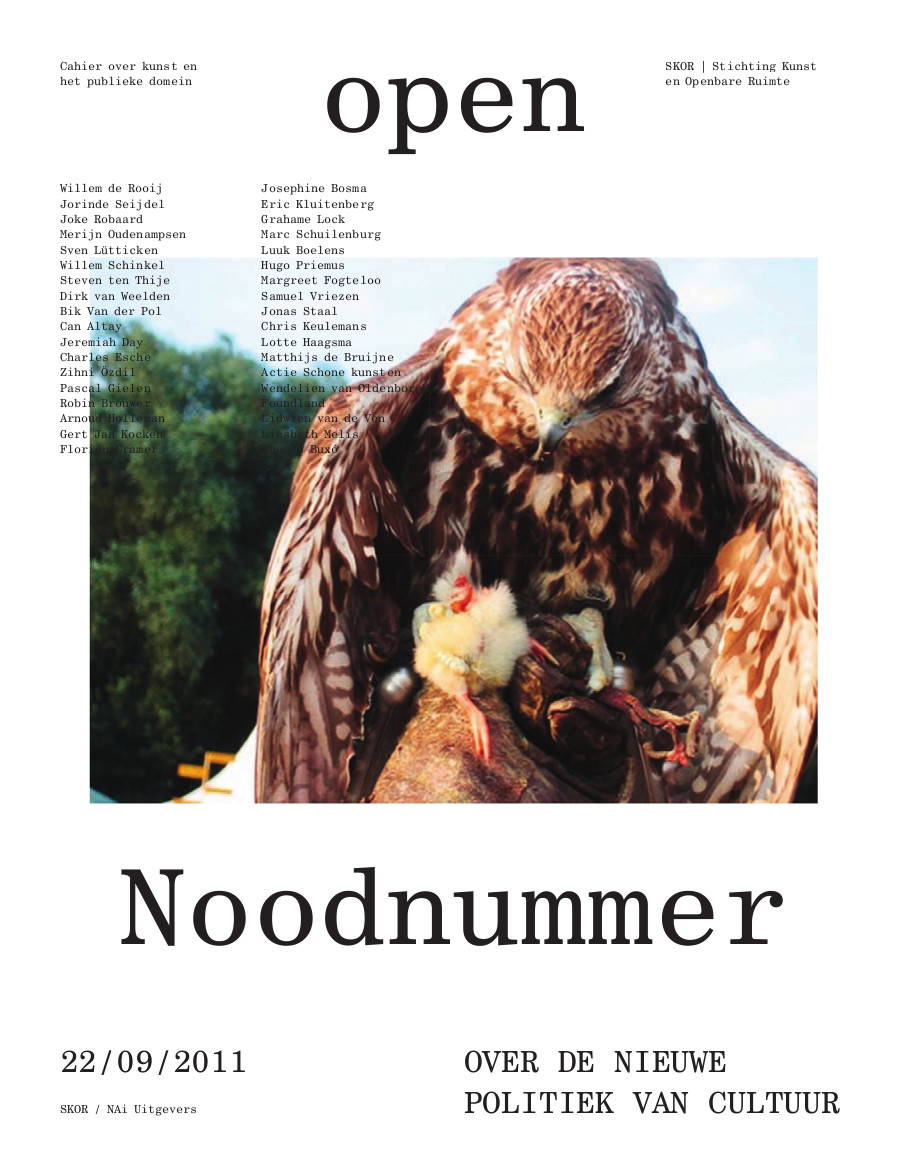
“The Dutch government’s new cultural plan and the cutbacks have intruded on our comfort zone and roughly awoken us from our reflective and theorising positions as critical observers.
This ’emergency issue’ of Open. Cahier on Art and the Public Domain is a special edition that accompanies De Groene Amsterdammer on September 23, 2011. It not only addresses the austerity measures, but also pays special attention to the overarching ideology and the right-populist government policy from which these arise.
Similarly, the publication does not merely defend the position of the arts, but is a record of public opposition to what many believe is a malicious policy that is adversely affecting or excluding growing numbers of groups (the sickly, immigrants, refugees, children, the elderly, artists, ‘ordinary’ people) and issues (relating to culture, knowledge, the environment, education, health care, multiculturalism).”
With contributions by Willem de Rooij, Jorinde Seijdel, Joke Robaard, Merijn Oudenampsen, Sven Lütticken, Willem Schinkel, Steven ten Thije, Dirk van Weelden, Bik Van der Pol, Can Altay, Jeremiah Day, Charles Esche, Zihni Özdil, Pascal Gielen, Robin Brouwer, Arnoud Holleman, Gert Jan Kocken, Florian Cramer, Josephine Bosma, Eric Kluitenberg, Grahame Lock, Marc Schuilenburg, Luuk Boelens, Hugo Priemus, Margreet Fogteloo, Samuel Vriezen, Jonas Staal, Chris Keulemans, Lotte Haagsma, Matthijs de Bruijne, Actie Schone kunsten, Wendelien van Oldenborgh, Foundland, Lidwien van de Ven, Liesbeth Melis, Thomas Buxó
Publisher: SKOR / NAi Uitgevers, September 2011
68 pages
PDF (updated on 2013-2-6)
Previous issues
Jane Bennett: Vibrant Matter: A Political Ecology of Things (2010)
Filed under book | Tags: · assemblage, ecology, environment, nature, philosophy, political ecology, politics, things, vital materialism

“In Vibrant Matter the political theorist Jane Bennett, renowned for her work on nature, ethics, and affect, shifts her focus from the human experience of things to things themselves. Bennett argues that political theory needs to do a better job of recognizing the active participation of nonhuman forces in events. Toward that end, she theorizes a “vital materiality” that runs through and across bodies, both human and nonhuman. Bennett explores how political analyses of public events might change were we to acknowledge that agency always emerges as the effect of ad hoc configurations of human and nonhuman forces. She suggests that recognizing that agency is distributed this way, and is not solely the province of humans, might spur the cultivation of a more responsible, ecologically sound politics: a politics less devoted to blaming and condemning individuals than to discerning the web of forces affecting situations and events.
Bennett examines the political and theoretical implications of vital materialism through extended discussions of commonplace things and physical phenomena including stem cells, fish oils, electricity, metal, and trash. She reflects on the vital power of material formations such as landfills, which generate lively streams of chemicals, and omega-3 fatty acids, which can transform brain chemistry and mood. Along the way, she engages with the concepts and claims of Spinoza, Nietzsche, Thoreau, Darwin, Adorno, and Deleuze, disclosing a long history of thinking about vibrant matter in Western philosophy, including attempts by Kant, Bergson, and the embryologist Hans Driesch to name the “vital force” inherent in material forms. Bennett concludes by sketching the contours of a “green materialist” ecophilosophy.”
Publisher Duke University Press, 2010
John Hope Franklin Center Book series
ISBN 0822346338, 9780822346333
200 pages
interview (Peter Gratton)
the book’s reading group: announcement, wrap-up, final overview
PDF, PDF (thanks to esco_bar; updated on 2012-7-25)
Comment (1)Gordon Pask: An Approach to Cybernetics (1961/1968)
Filed under book | Tags: · cybernetics, engineering, environment, machine, technology
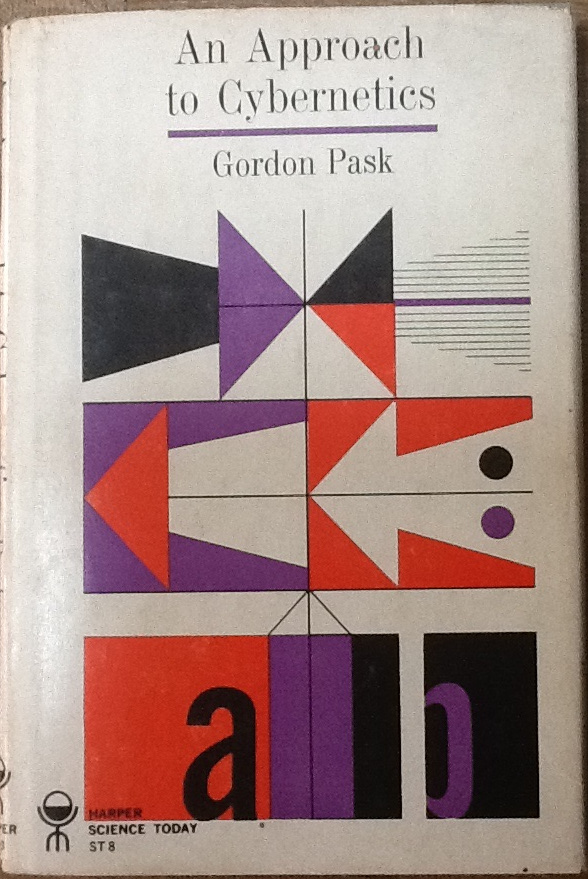
“This book is not for the engineer content with hardware, nor for the biologist uneasy outside his specialty; for it depicts that miscegenation of Art and Science which begets inanimate objects that behave like living systems. They regulate themselves and survive: They adapt and they compute: They invent. They co-operate and they compete. Naturally they evolve rapidly.
Pure mathematics, being mere tautology, and pure physics, being mere fact, could not have engendered them; for creatures to live, must sense the useful and the good; and engines to run must have energy available as work: and both, to endure, must regulate themselves. So it is to Thermodynamics and to its brother SUM(p) log p, called Information Theory, that we look for the distinctions between work and energy and between signal and noise.
For like cause we look to reflexology and its brother feedback, christened Multiple Closed Loop Servo Theory, for mechanical explanation of Entelechy in Homeostasis and in appetition. This is that governance, whether in living creatures and their societies or in our lively artifacts, that is now called Cybernetics.
But under that title Norbert Wiener necessarily subsumed the computation that, from afferent signals, forecasts successful conducts in a changing world.
To embody logic in proper hardware explains the laws of thought and consequently stems from psychology. For numbers the digital art is as old as the abacus, but i came alive only when Turing made the next operation of his machine hinge on the value of the operand, whence its ability to compute any computable number.
For Aristotelian logic, the followers of Ramon Llull, including Leibniz, have frequently made machines for three, and sometimes four classifications. The first of these to be lively computes contingent probabilities.
With this ability to make or select proper filters on its inputs, such a device explains the central problem of experimental epistemology. The riddles of stimulus equivalence or of local circuit action in the brain remain only as parochial problems.
This is that expanding world of beings, man-made or begotten, concerning which Ross Ashby asked, ‘How can such systems organize themselves?’ His answer is, in one sense, too general and its embodiment, too special to satisfy him, his friends or his followers.
This book describes their present toil to put his ideas to work so as to come to grips with his question.” (Warren S. McCulloch, Preface)
With a preface by Warren S. McCulloch
Publisher Hutchinson & Co, London, 1961
This edition March 1968
ISBN: 0090868102, 0090868110
128 pages
via pangaro.com
PDF (updated on 2012-7-16)
Comment (0)