
Carl Andre, Hollis Frampton: 12 Dialogues, 1962–1963 (1980)
Filed under book | Tags: · aesthetics, art, art criticism, avant-garde, film, literature, music, painting, photography, sculpture
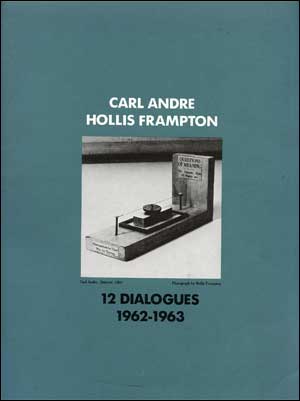
Twelve conversations between the minimalist sculptor Carl Andre and his close friend, photographer-filmmaker Hollis Frampton, about sculpture, photography, painting, music, literature, poetry and film. The two generated the dialogues over the course of a year, from October 1962 to September 1963 mostly on evenings and weekends in Andre’s one-room apartment in Brooklyn. A number of the dialogues begin with a discussion of recently shared art encounters, proceeding to examine a wide range of topics, including the development of avant-garde aesthetics, the significance of Duchamp, the legacy of the New York School, the relevance of photography, etc.
Edited and annotated by Benjamin H.D. Buchloh
Publisher The Press of the Nova Scotia College of Art and Design and New York University Press, 1980
ISBN 0919616178, 9780919616172
134 pages
via x
PDF (first 93 of 134 pages, 24 MB)
Comment (0)Michel Chion: Film, a Sound Art (2003/2009)
Filed under book | Tags: · aesthetics, audiovisual, cinema, film, film history, film sound, film theory, hearing, listening, music, noise, poetics, sound, sound studies, time, voice
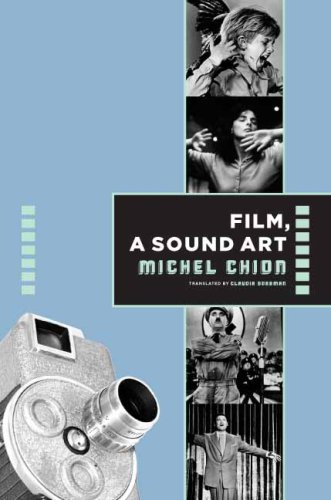
“French critic and composer Michel Chion argues that watching movies is more than just a visual exercise—it enacts a process of audio-viewing. The audiovisual makes use of a wealth of tropes, devices, techniques, and effects that convert multiple sensations into image and sound, therefore rendering, instead of reproducing, the world through cinema.
The first half of Film, A Sound Art considers developments in technology, aesthetic trends, and individual artistic style that recast the history of film as the evolution of a truly audiovisual language. The second half explores the intersection of auditory and visual realms. With restless inventiveness, Chion develops a rhetoric that describes the effects of audio-visual combinations, forcing us to rethink sound film. He claims, for example, that the silent era (which he terms “deaf cinema”) did not end with the advent of sound technology but continues to function underneath and within later films. Expanding our appreciation of cinematic experiences ranging from Dolby multitrack in action films and the eerie tricycle of Stanley Kubrick’s The Shining to the way actors from different nations use their voices and words, Film, A Sound Art showcases the vast knowledge and innovative thinking of a major theorist.”
First published as Art sonore, le cinema, 2003
Translated by Claudia Gorbman
Publisher Columbia University Press, 2009
ISBN 0231137761, 9780231137768
536 pages
via johnsonleow
Reviews: Knakkergaard (MedieKultur, 2010), Whittington (Music, Sound, and the Moving Image, 2010), Jaeckle (Quarterly Review of Film and Video, 2011).
PDF (Index missing, 58 MB, no OCR, updated on 2023-3-9)
Comment (1)J. R. Pierce: Portrait of the Machine as a Young Artist (1965)
Filed under essay | Tags: · art, computer art, computer music, computing, film, literature, machine, music
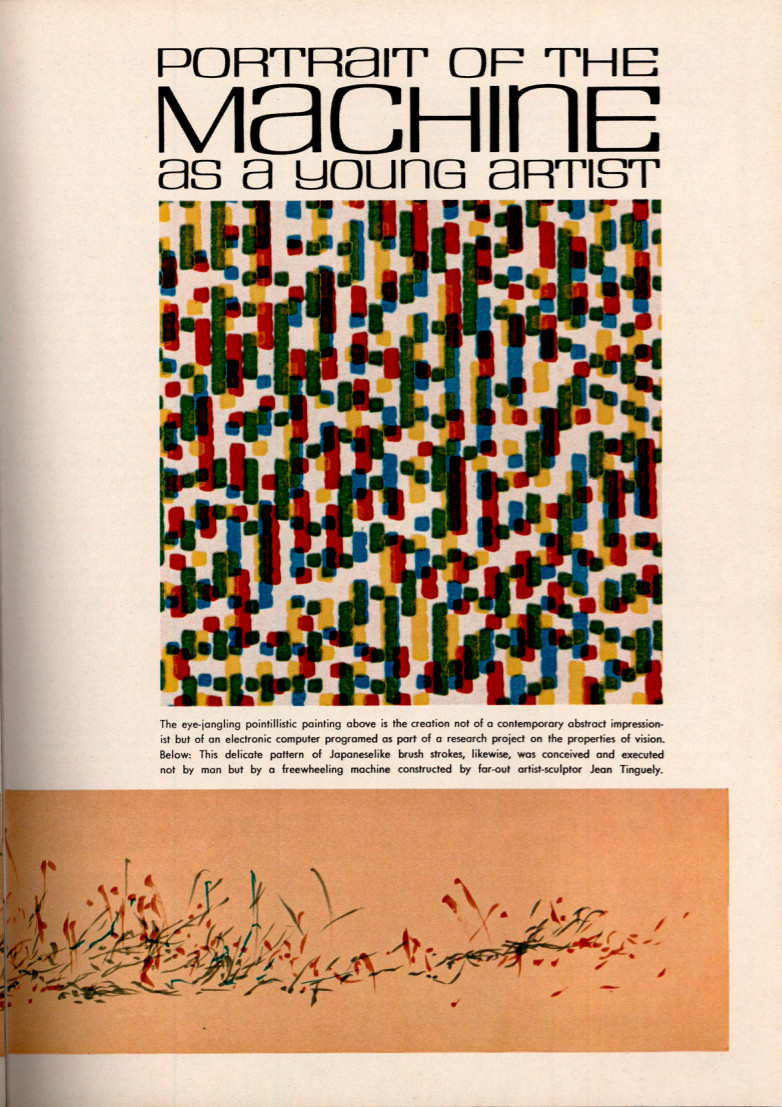
“Mechanistic muses are expanding their domain to encompass every facet of creative activity.”
In this article published in the June 1965 issue of Playboy, Bell Labs engineer, communications satellite pioneer and science fiction writer John R. Pierce introduces the work done in computer music, literature, film, and visual art, and issues an invitation to artists to explore and “school” the computer to yield new paths.
Published in Playboy 12(6), 1965, pp 124-5 & 150 & 182 & 184
via Forum on the Genealogy of MediaThinking (the website contains many scans of essays on media theory and archaeology)
PDF (14 MB)
See also:
Grace Glueck’s criticism of computer art, Portrait of the Artist as a Young Computer, New York Times, 1983.
More writings by Pierce.