

XLR8R magazine 130-131 (Nov/Dec 2009-Jan/Feb 2010)
Filed under magazine | Tags: · music, sound art, sound recording

Nov/Dec 2009
Issue 130: XLR8R’s Favorites of 2009
While we where pretty burnt on definitive best-of lists, we couldn’t resist crowning Bristol cover star Joker the 2009 king of bass music. On top of that, in this year-end issue we survey a host of our favorite artists of 2009, including Martyn, Hudson Mohawke, The Field, Holy Ghost!, Nite Jewel, Schlachthofbronx, DJ Koze and tons more. As well, we look at the year’s best technology and videogames, just in time for the holidays.

Jan/Feb 2010
Issue 131: Revolutions Per Minute: Matias Aguayo
As we head into 2010, the continuum of great music streaming from the tail end of last year just don’t stop. Latin playboy Matías Aguayo takes house in all sorts of new (vocal-driven) directions, while L-Vis 1990 and Bok Bok hold it down with their London club and label Night Slugs. Then over on this side of the pond, Washed Out, Pictureplane, Toro Y Moi, and Neon Indian take electronic music back to the garage, while Beach House blesses Sub Pop with a new seaside stunner. View online at Issuu.
Older issues (free download)
Comment (0)Curtis Roads: Microsound (2001)
Filed under book, sound recording | Tags: · computer music, electronic music, music, music history, music theory, sound, sound art, synthesis

“Below the level of the musical note lies the realm of microsound, of sound particles lasting less than one-tenth of a second. Recent technological advances allow us to probe and manipulate these pinpoints of sound, dissolving the traditional building blocks of music—notes and their intervals—into a more fluid and supple medium. The sensations of point, pulse (series of points), line (tone), and surface (texture) emerge as particle density increases. Sounds coalesce, evaporate, and mutate into other sounds.
Composers have used theories of microsound in computer music since the 1950s. Distinguished practitioners include Karlheinz Stockhausen and Iannis Xenakis. Today, with the increased interest in computer and electronic music, many young composers and software synthesis developers are exploring its advantages. Covering all aspects of composition with sound particles, Microsound offers composition theory, historical accounts, technical overviews, acoustical experiments, descriptions of musical works, and aesthetic reflections.”
Publisher MIT Press, 2001
ISBN 0262182157, 9780262182157
xii+409 pages
PDF (updated on 2012-8-3)
Accompanying CD (68 FLAC files, ZIP, added on 2013-9-11)
Allen S. Weiss (ed.): Experimental Sound & Radio (2000)
Filed under book | Tags: · listening, noise, public broadcasting, radio, radio art, sound art, sound recording, voice
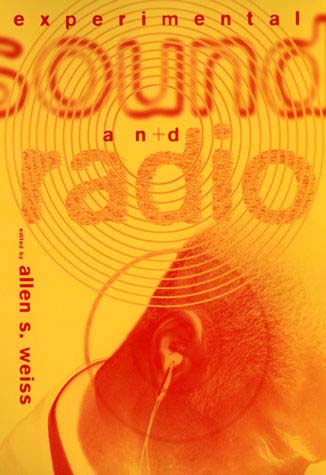
“Art making and criticism have focused mainly on the visual media. This book, which originally appeared as a special issue of TDR/The Drama Review, explores the myriad aesthetic, cultural, and experimental possibilities of radiophony and sound art. Taking the approach that there is no single entity that constitutes “radio,” but rather a multitude of radios, the essays explore various aspects of its apparatus, practice, forms, and utopias. The approaches include historical, political, popular cultural, archeological, semiotic, and feminist. Topics include the formal properties of radiophony, the disembodiment of the radiophonic voice, aesthetic implications of psychopathology, gender differences in broadcast musical voices and in narrative radio, erotic fantasy, and radio as an electronic memento mori.
The book includes a new piece by Allen Weiss on the origins of sound recording.”
Contributors: John Corbett, Tony Dove, René Farabet, Richard Foreman, Rev. Dwight Frizzell, Mary Louise Hill, G. X. Jupitter-Larsen, Douglas Kahn, Terri Kapsalis, Alexandra L. M. Keller, Lou Mallozzi, Jay Mandeville, Christof Migone, Joe Milutis, Kaye Mortley, Mark S. Roberts, Susan Stone, Allen S. Weiss, Gregory Whitehead, David Williams, Ellen Zweig.
Publisher MIT Press, 2000
ISBN 0262731304, 9780262731300
188 pages
PDF (updated on 2012-8-3)
Comment (0)