

Gerda Ridler (ed.): Trans_Mission: Vadim Kosmatchof: Organic Solar Sculptures (2007) [English/German]
Filed under book | Tags: · architecture, art, kinetic art, sculpture, solar energy, technology

Der aus Moskau stammende Bildhauer Vadim Kosmatschof lebt und arbeitet seit 1980 in Deutschland und Österreich. Das Museum Ritter präsentiert hier eine Auswahl seiner aktuellen Projekte für den öffentlichen Raum in Bildern und Texten. In Fortsetzung der konstruktivistischen Tradition entwickelt Vadim Kosmatschof das Konzept der biomechanischen Skulptur. Dabei bezieht er neueste Entdeckungen der Biologie, Biomimetik und physikalischen Chemie mit ein.
“Trans_Mission” vermittelt natürliche Energieströme und integriert sie in den städtebaulichen Kontext. Kosmatschof zeigt in seinem großmaßstäblichen Projektzyklus, zu welch innovativen Formen und Typen die Anwendung natürlicher Prozesse und Phänomene auch in der Kunst führen kann. Seine subtilen Konstruktionen treibt eine Energie an, die der Photosynthese ähnlich ist. Sie reagieren mit Gestaltveränderung, Bewegung und Lichteffekten auf ihre aktuelle Umgebung. Fachbeiträge renommierter internationaler Experten beleuchten die kunsttheoretischen und naturwissenschaftlichen Aspekte dieser innovativen Arbeit.
Editor Museum Ritter – Gerda Ridler
Publisher Springer, 2007
ISBN 321170972X, 9783211709726
Length 134 pages
Peter Weibel (ed.): Beyond Art: A Third Culture. A Comparative Study in Cultures, Art and Science in 20th Century Austria and Hungary (2005)
Filed under book | Tags: · art, art and science, art history, austria, computer art, conceptual art, cybernetics, history of science, hungary, mathematics, media art, philosophy, psychoanalysis, technology
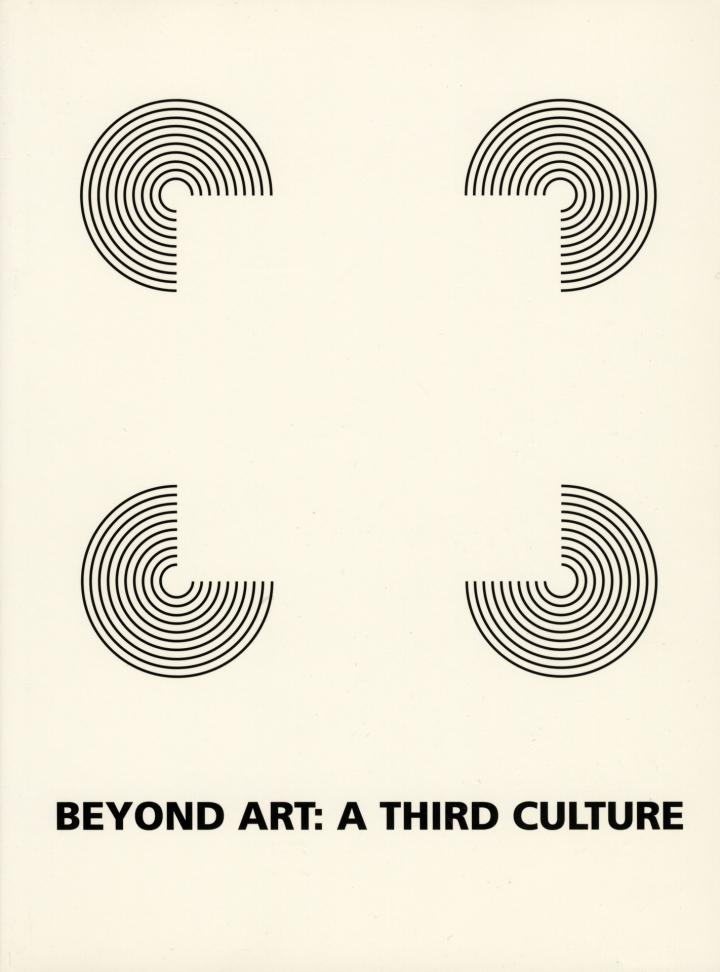
“Austria and Hungary in the 20th century were nations that made enormous achievements in the formal sciences and arts: abstraction, logic, mathematics, physics, positivism, psychoanalysis, cybernetics, constructivism, economics, art, media art, and concept art. Art and science are usually divided into two different cultures, and nations, too, are seen as having separate ones. This book delivers a new model of consilience and convergence of art and science by closely studying in a material historical way by using a multitude of original papers and contributions, photographs, documents, bibliographies, biographies, and survey essays, the mutual influence of art and science in Austria and Hungary. In fields ranging from Gestalt psychology to Quantum physics, from constructivism to theories of vision, from holography to cyberspace, we discover a multitude of ideas, books, movements and personalities that have deeply influenced the world. Richly illustrated, the book is a nearly invaluable sourcebook, in which a new method, resembling more a CD-ROM narration than a dictionary, has been used to map an unknown horizon of knowledge. Those involved in the history of science or art and in the field of cultural theory, will find an incomparable frame of reference and information. They will discover not only genius, talents and themes they have not been aware of, but also a new model of culture, a third culture. The book is graphically and structurally user-friendly with a synopsis for each chapter, models, diagrams, images, corolaries and index etc.”
Publisher Springer, Vienna, 2005
ISBN 3211245626, 9783211245620
616 pages
PDF (40 MB, updated on 2019-10-30)
Comments (2)R. L. Rutsky: High Technē: Art and Technology from the Machine Aesthetic to the Posthuman (1999)
Filed under book | Tags: · aesthetics, art, cyberpunk, history of technology, posthumanism, technology

In an age of high tech, our experience of technology has changed tremendously, yet the definition of technology has remained largely unquestioned. High Techne redresses this gap in thinking about technology, examining the shifting relations of technology, art, and culture from the beginnings of modernity to contemporary technocultures.
Drawing on the Greek root of technology (techne, generally translated as “art, skill, or craft”), R. L. Rutsky challenges both the modernist notion of technology as an instrument or tool and the conventional idea of a noninstrumental aesthetics. Today, technology and aesthetics have again begun to come together: even basketball shoes are said to exhibit a “high-tech style” and the most advanced technology is called “state of the art.” Rutsky charts the history and vicissitudes of this new high-tech techne up to our day — from Fritz Lang to Octavia Butler, Thomas Edison to Japanese Anime, constructivism to cyberspace.
Progressing from the major art movements ofmodernism to contemporary science fiction and cultural theory, Rutsky provides clear and compelling evidence of a shift in the cultural conceptions of technology and art and demonstrates the centrality of technology to modernism and postmodernism.
Publisher University of Minnesota Press, 1999
ISBN 0816633568, 9780816633562
196 pages
PDF (updated on 2012-11-4)
Comment (0)