
Karel Teige: O humoru, clownech a dadaistech, I-II (1928-30/2004) [Czech]
Filed under book | Tags: · aesthetics, art, art theory, avant-garde, circus, dada, film, humour, poetry, surrealism, theatre
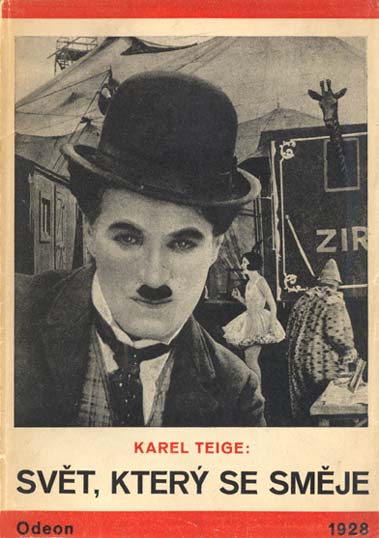
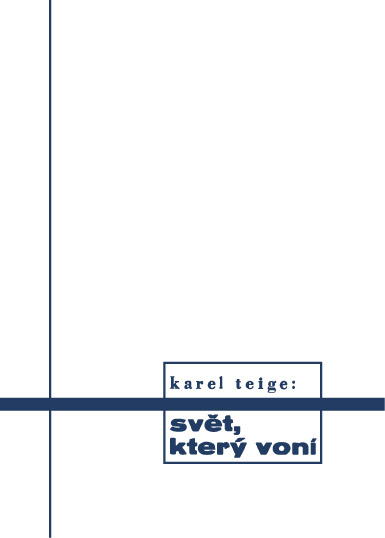
Dvousvazková kultovní práce vůdčího teoretika české avantgardy je unikátní studií o dadaismu.
První svazek obsahuje kapitoly “pojednávající o humoru, o světském a neliterárním dadaismu a o poezii cirkusu, music-hallu a lunaparku”. Druhý svazek “kreslí svět moderní básně, svět, který voní; podává genezi dadaismu přehledem vývoje od Baudelairea až k Tzarovi, charakteristiku hnutí dada i surrealistické revoluce a v závěru pokouší se formulovat teorii a estetiku nové poezie pro všecky smysly, podloženou fakty korespondence a analogie mezi jednotlivými obory ‘umění’..”, to, co “je jádrem nové estetické teorie, která se zve poetismem”. S doslovem Jiřího Brabce.
O humoru, clownech a dadaistech, I: Svět, který se směje
Originally published by Odeon, Prague, 1928, 112 pp
Publisher Akropolis, Prague, 2004
ISBN 8073040425
114 pages
O humoru, clownech a dadaistech, II: Svět, který voní
Originally published by Odeon, Prague, 1930, 240 pp
Publisher Akropolis, Prague, 2004
ISBN 8073040530, 9788073040536
244 pages
review (Vol. 1, Andrea Jochmanová, Literární noviny, in Czech)
review (Vol. 2, Jan Nejedlý, Čro Vltava, in Czech)
Florian Cramer: Exe.cut(up)able statements: Poetische Kalküle und Phantasmen des selbstausführenden Texts (2011) [German]
Filed under book | Tags: · aesthetics, algorithm, avant-garde, code, code poetry, experimental literature, history of literature, information aesthetics, kabbalah, literature, net art, poetry, software, text, theory

“From the antiquity to today, there has been poetry that literally performs computations, processing its own letters. Prototyped by magic and Pythagorean mathematical aesthetics, it encompasses such diverse forms as kabbalist and Lullist language combinatorics, word permutation poetry, ludistic poetry, computational text collage, aleatoric, stochastic and recursive texts, Oulipian constraints, computer-generative literature, poetry in programming languages, and codeworks. Just like visual and sound poetry poetize the graphetic and phonetic dimensions of words, these writings show that computation is a dimension of language. On top of that, their poetics is rife with speculative and contradictory programs: often one and the same text form is at once being instrumentalized for total art and anti-art, mysticism and technicism, order and chaos. This has resulted in a fantastic literature whose speculative imagination manifests itself in the arrangement of letters rather than the semantics of the text. The book includes close readings of a 17th century sonnet (Quirinus Kuhlmann’s “XLI. Libes-kuss”), a 20th century musical composition (Alvin Lucier’s “I am sitting in a room”) and a 21st century net.art codework (mez breeze’s “_Viro.Logic Condition][ing][ 1.1_”), and discusses limitations of existing literary and media theory for criticism of these works.
A shorter, less scholarly English-language mutant of this book has been electronically published in 2005 as Words Made Flesh: Code, Culture, Imagination.”
Publisher Wilhelm Fink Verlag, October 2011
343 pages
Note: the book has just become free for Open Access publishing and is offered here for download in its manuscript version, licensed under Creative Commons Attribution Unported 3.0.
Comment (0)Umberto Eco: The Open Work (1962–) [IT, PT, EN]
Filed under book | Tags: · aesthetics, art, literary criticism, literature, poetry, semiotics, theory

“Umberto Eco’s The Open Work remains significant for its concept of “openness”–the artist’s decision to leave arrangements of some constituents of a work to the public or to chance–and for its striking anticipation of two major themes of contemporary literary theory: the element of multiplicity and plurality in art, and the insistence on literary response as an interactive process between reader and text. The questions Eco raises, and the answers he suggests, are intertwined in the continuing debate on literature, art, and culture in general.
This new English edition includes an introduction by David Robey that explores Eco’s thought at the period of The Open Work, prior to his absorption in semiotics. The book now contains key essays on Eco’s mentor Luigi Pareyson, on television and mass culture, and on the politics of art.”
First published in Italian as Opera aperta, 1962.
English edition
Translated by Anna Cancogni
With an Introduction by David Robey
Publisher Harvard University Press, 1989
ISBN 0674639766, 9780674639768
285 pages
Opera aperta (Italian, 4th ed., 1962/1997, added on 2015-1-8)
Obra aberta (Portuguese, trans. Giovanni Cutolo, 8th ed., 1971/1991)
The Open Work (English, trans. Anna Cancogni, 1989)