

Walter Gropius (ed.): The Theater of the Bauhaus (1925–) [DE, EN]
Filed under book | Tags: · acrobatics, art history, avant-garde, bauhaus, circus, constructivism, dance, pantomime, theatre
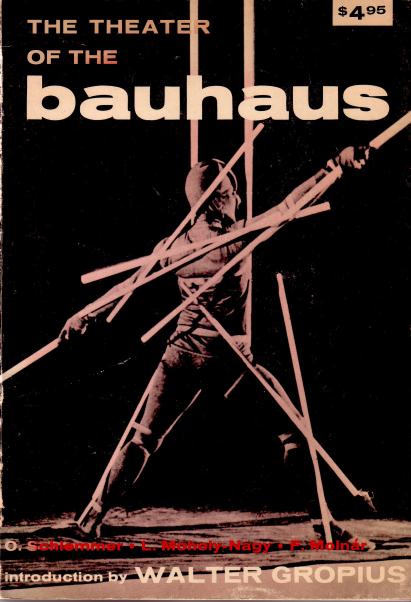
“The Bauhaus movement was one of this century’s most daring experiments in arts education, and its influence on architecture, design, and the visual arts is well known. Many of its most important ideas are revealed in Bauhaus writings about theatrical performance and performance spaces. Originally published in Germany in 1925 — at the height of the Bauhaus movement’s influence– The Theater of the Bauhaus collects writings from some of the movement’s most important figures and describes a theater stripped of history, moralism, scenery, and, for that matter, narrative itself. The Bauhaus group believed traditional theater to be little more than a vehicle for propaganda, with its “peep show stage” separating spectators from performers. They rejected as well the theater of ridicule and satire practiced by the Dadaists and Expressionists. In place of both traditional drama and the avant-garde that lampooned it, Oskar Schlemmer and his Bauhaus associates created an abstract theater of movement, color, light, form, and sound-language would be added later, once the stage had been purged of its “literary encumbrance.” They believed that humanity’s essential nature–freed from history, tradition, class, and nationality–would find expression in theatrical works that incorporated pantomime, masks, dance, and acrobatics.”
Contents: Walter Gropius: Introduction; Oskar Schlemmer: Man and Art Figure; Laszlo Moholy-Nagy: Theater, Circus, Variety; Farkas Molnar: U-Theater; Oskar Schlemmer: Theater (Bühne); Translator’s Note.
Publisher Albert Langen, Munich, 1925
Volume 4 of Bauhausbücher series
84 pages
via Bibliothèque Kandinsky
English edition
Translated by Arthur S. Wensinger
Publisher Wesleyan University Press, 1961
ISBN 0819560200
110 pages
Die Bühne im Bauhaus (German, 72 MB, via Bibliothèque Kandinsky, added on 2014-8-17, updated on 2022-4-13)
Die Bühne im Bauhaus (German, PDF, JPG, in Heidelberg U Library, added on 2019-7-7)
The Theater of the Bauhaus (English, trans. Arthur S. Wensinger, 1961, 6 MB, updated on 2016-10-15)
See also other titles in Bauhaus Books series.
Comments (6)Will Bradley, Charles Esche (eds.): Art and Social Change: A Critical Reader (2007)
Filed under book | Tags: · aesthetics, art, art history, art theory, avant-garde, bauhaus, constructivism, dada, politics, revolution, situationists, social movements, subversion, zapatistas

“The desire to change the world has often led artists to align themselves with wider social movements and to break with established institutions of art. This reader gathers together an international selection of artists’ proposals, manifestos, theoretical texts and public declarations that focus on the question of political engagement and the possibility of social change. The approaches represented are many and diverse, from Gustave Courbet’s involvement in the Paris Commune and the socialist art theory of William Morris to the hybrid activist practice associated with the twenty-first century ‘movement of movements’; from the political commitments of the Modernist avant-gardes to the rejections of Modernism in favour of protest, critique, utopian social experiment or revolutionary propaganda. Six specially commissioned essays – by Geeta Kapur, Lucy Lippard, John Milner, Gerald Raunig, Marina Vishmidt and Tirdad Zolghadr – further explore both the historical context and the contemporary situation.”
Publisher Tate Publishing, in association with Afterall, London, 2007
ISBN 9781854376268
479 pages
Commentary: Marco Deseriis and Brian Holmes (Mute).
Comments (3)Herbert Bayer, Walter Gropius, Ise Gropius (eds.): Bauhaus 1919–1928 (1938)
Filed under book, catalogue | Tags: · 1920s, architecture, art, art history, avant-garde, bauhaus, design, graphic design, industrial design, painting, photography, sculpture, typography
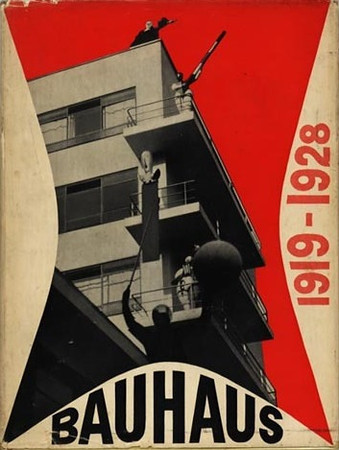
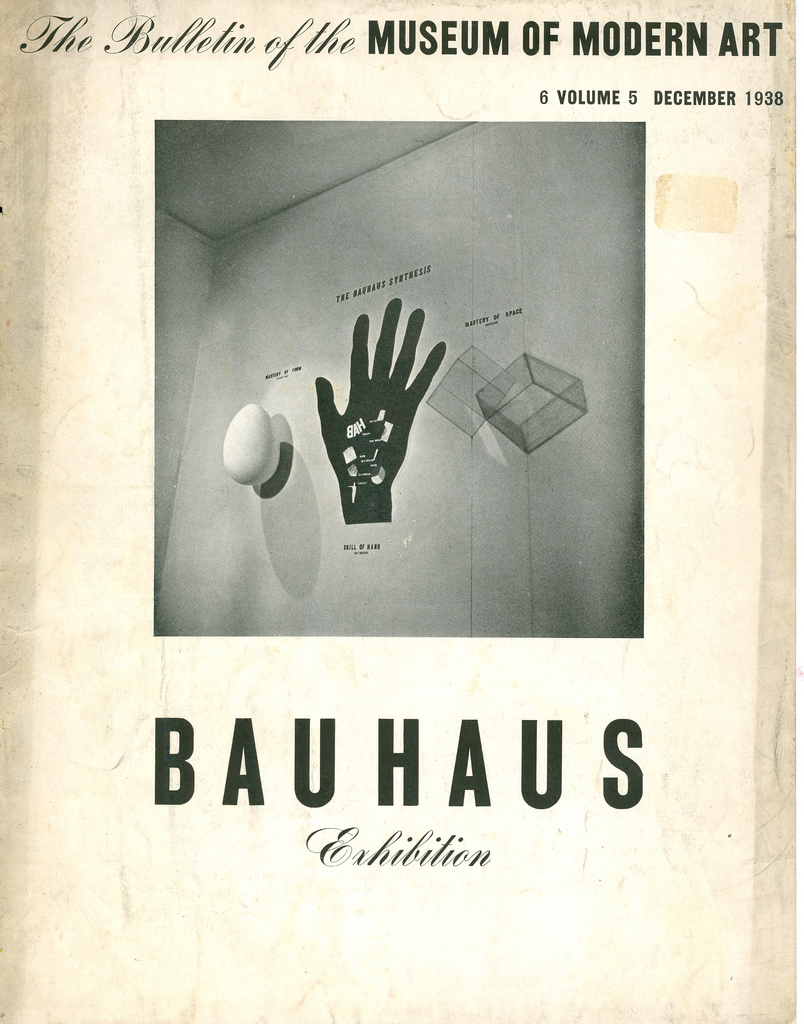
Bauhaus 1919-1928 remains one of the most valuable accounts of the Bauhaus school. The book was published in conjunction with the Museum Of Modern Art exhibition (December 7, 1938-January 30, 1939) and is a point-for-point record of actual programs and projects at the Bauhaus, prepared by Herbert Bayer under the general editorship of Walter Gropius and Ise Gropius and with the collaboration of a dozen other Bauhaus teachers — including Kandinsky, Klee, Feininger, Schlemmer, Itten, Moholy-Nagy, Albers, and Breuer. Rather than a retrospective history, it is a collection of photographs, articles, and notes prepared on the field of action. It may be considered as much a work of the Bauhaus as it is a work about it.
Includes work by all the Bauhaus faculty including Walter Gropius, Paul Klee, Wassily Kandinsky, Laszlo Moholy-Nagy, Marcel Breuer, Herbert Bayer, Josef Albers, Lyonel Feininger, Oskar Schlemmer, Hannes Meyer, Mies van der Rohe, Anni Albers, Otti Berger, Gunta Stolzl, Max Bill and many others.
The exhibition gave the first comprehensive review of the development of the institute under Gropius (no material from the later Bauhaus was shown). Preparation and technical arrangements were entrusted to Herbert Bayer, paving the way for his own emigration to America shortly afterwards. An accompanying Bulletin was a privilege, sent to members of MOMA. (Source)
Bauhaus 1919-1928
With a Preface by Alfred H. Barr, Jr.
Publisher Museum of Modern Art, New York, 1938
224 pages
via Joaquim Moreno, update via MoMA
The Bulletin of the Museum of Modern Art 6, Vol. 5 (Dec 1938): Bauhaus Exhibition
Publisher Museum of Modern Art, New York, 1938
8 pages
via David Levine
PDF (Book, 42 MB, updated on 2016-9-17)
PDF (Bulletin)