

Cultural Anthropology: Infrastructure (2012)
Filed under journal | Tags: · anthropology, city, infrastructure

“Infrastructures are the systems that enable circulation of goods, knowledge, meaning, people, and power. In Splintering Urbanism, Stephen Graham and Simon Marvin argue that we can see the role of public infrastructures and new technologies in facilitating the mobility of people, goods, and utilities when old forms decay. As Brian Larkin notes, the ongoing life of these structures and networks themselves create new social collectivities. With more and more scholars looking to infrastructure as an object of study, anthropologists are positioned to document and witness the role of infrastructures, both technological and human, in cultural life. […]
Cultural Anthropology has published many articles that present and analyze situations where people create and interact with networks that facilitate flows of value. Rather than considering infrastructure to be something with static effects, anthropological approaches to the study of infrastructure look for its construction and maintenance through everyday practices in particular ethnographic contexts. Here we have brought together six articles published in CA that have contributed to the emergent anthropology of infrastructure. […]
To enrich our understanding of the selected articles, authors Nikhil Anand, Julia Elyachar, Daniel Mains, Jonathan Bach, and Filip De Boeck have offered new commentary on their works. Additionally, AbdouMaliq Simone, a scholar whose study of “people as infrastructure” has led the way in this emergent area of inquiry, composed an essay reflecting on this collection.” (from the Introduction)
Edited by Jessica Lockrem and Adonia Lugo
Publisher Society for Cultural Anthropology, 2012
ISSN 1548-1360
View online (various formats, updated on 2019-7-8)
Comment (0)Continent. 5(2): The Technosphere, Now (2016)
Filed under journal | Tags: · agency, anthropocene, biopshere, body, complexity, earth, ecology, food, human, infrastructure, media, nature, production, systems theory, technology, technosphere, waste, water

“The “technosphere” is geologist Peter Haff’s term for the planetary-scale networks of transport, information, energy and media operating at a scale and functional efficacy that we can now compare with geological and climatic forces—the soils and rocks of the lithosphere, the waters of the hydrosphere or the winds of the atmosphere. Its emergence as a thematic is driven by the same witnessing of intertwining natural environments, vast socio-technical forces, and increasingly diverse technological species and spaces that has precipitated discussions of the Anthropocene.
[…] The Technosphere project at the HKW in Berlin (2015-18) began with an initial gathering in Autumn 2015. The first occasion for the ongoing collaboration between continent. and HKW was the latter’s hosting of The Technosphere, Now event in October, 2015 in Berlin. Editors from continent. came from various corners of the globe, invited to immerse themselves into and extrapolate from the talks, discussions, presentations and demonstrations held there. Interview-discussions held with the likewise international set of researchers, theorists, artists and scientists at this event precipitated an online special issue of continent. for April 2016, featuring articles titled by the names of our interviewees.”
Features interviews with Arno Rosemarin, Birgit Schneider, Bronislaw Szerszynski, Donald MacKenzie, Erich Hörl, Jennifer Gabrys, Lino Camprubí, Lucy A. Suchman, Mark Hansen, Masahiro Terada, Mushon Zer-Aviv, Oliver Sann, Peter K. Haff, S. Løchlann Jain, and Scott Gabriel Knowles.
Edited by Nina Jäger, Paul Boshears, Bernhard Garnicnig, Jamie Allen, Lital Khaikin, Katrin Klingan, Anna Sophie Luhn, Christoph Rosol, and Nick Hood
Publisher continent., Apr 2016
Creative Commons Attribution 3.0 License
ISSN 2159-9920
Short Circuit: A Counterlogistics Reader (2015)
Filed under book | Tags: · communism, cybernetics, infrastructure, logistics
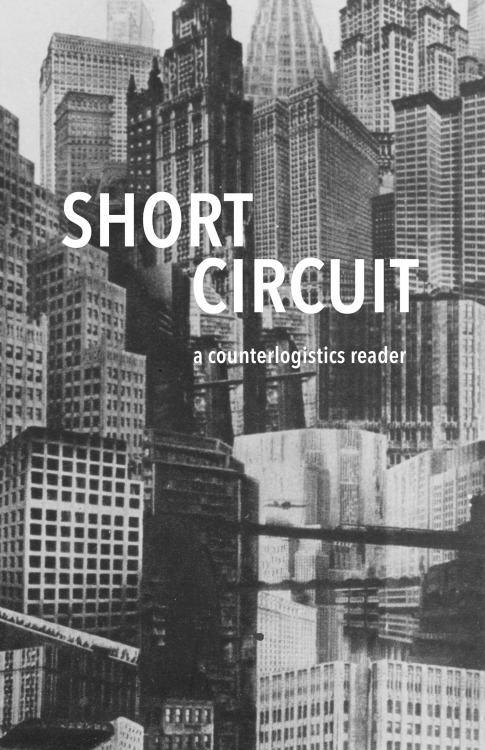
““Counter-logistics is not simply a matter of blocking all flows, of stopping movement, of locking things in place where they are. It is a matter of blocking those flows that constitute the material and metaphysical tissue of this world, while simultaneously enhancing our own ethical connections, movement, and friendship. Helping migrants to cross borders and remain undetected, helping information to cross through and within prison walls, destroying surveillance cameras, defending the basis of new worlds seized in opposition to the old—these are as important as blocking rail lines and disrupting commerce.”
This book is a collection of critical texts focused on logistics, counter-logistics, and cybernetics. It attempts to combine some disparate groups and tendencies that have all taken a recent turn towards evaluating infrastructure and logistics as a crucial element in the perpetuation of capital and control, and as vulnerable points worthy of study, evaluation, and attack.”
With texts by Anonymous, Jasper Bernes, Max L’Hameunasse, Tiqqun, Leon de Mattis, Out of the Woods, 1882 Woodbine, and Degenerate Communism.
Publisher No New Ideas, Aug 2015
xiii+245 pages
via pht
single PDF (4 MB)
PDF chapters