
Mélanie Hogan: Crashing the Archive: A Research-Creation Intervention into the SAW Video Mediatheque (2012)

29 June 2012, dusan

“Video Cache is a research creation intervention emerging from my doctoral research into defunct and crashed online archives, in the context of Canadian video art, which has a rich history of self-preservation and of documenting itself as an art movement. From major art galleries to personal collections; Canada has long privileged video as a tool for creative resistance, expression, and experimentation. Video Cache serves to track the SAW Video Mediatheque (based in Ottawa), from its launch to its crash and back online again, by updating its context and addressing in a practical way what it means to ‘activate’ the online archive. Much of my intervention occurred after the crash and during the two years the site was offline. It involved varied methodological entry points including in depth interviews with SAW Video staff and media archaeology to locate digital traces of the site. Key here is Video Cache’s success in simultaneously documenting the project and intervening to address archival loss: while it was the ‘cache’ that made the Mediatheque’s traces visible and re-visit-able, it was the ‘crash’ that signalled its ongoing archival value.” (from Abstract)

PhD thesis
Department of Communication Studies, Concordia University, Montréal, Québec, Canada
April 2012

more information

Direct download

Jürgen Wieckmann (ed.): Das Chaos-Computer-Buch: Hacking made in Germany (1988) [German]

29 June 2012, dusan

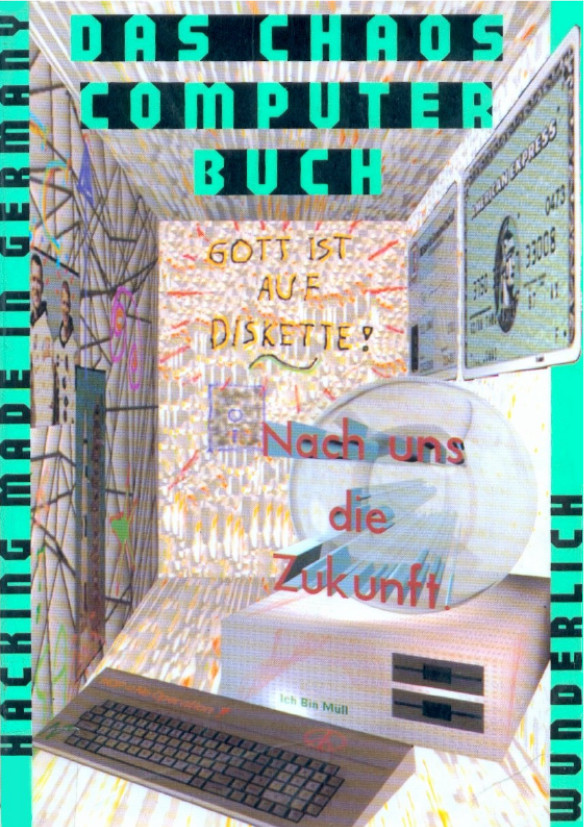
Wie wurde der NASA-Rechner geknackt? Wie funktionieren Computerviren und logische Bomben? Sind Hacker Schwarze Schafe im Wolfspelz? Jenseits des Medienrummels legt dieses Buch einen Blick hinter die Kulissen des Spektakulären frei. Alles über die Hackerszene, über Hackerpraxis, Technik, Auswirkungen und Anwendungen. Alles über den bereits legendären NASA-Hack. Über Lebensgefühl und Erlebnisse im Globalem Datennetz. Alles über Viren, Trojanische Pferde und logische Bomben.

Verlag Wunderlich, 1988
ISBN 3805204744, 9783805204743
237 Seiten

Download

Chaos Computer Club: Die Hackerbibel 1-2 (1985, 1988) [German]

27 June 2012, dusan

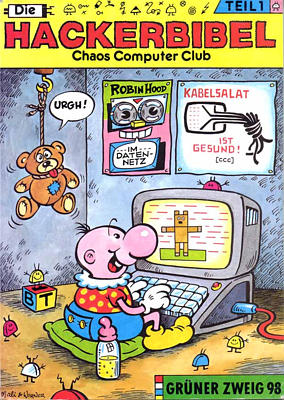
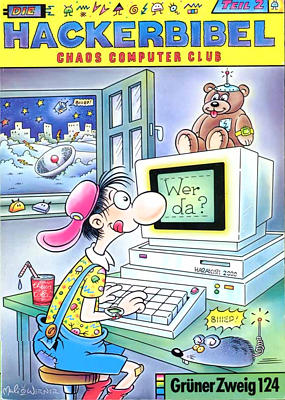
“Die Hackerbibel ist eine Publikation des Chaos Computer Clubs. Sie ist bisher in zwei Ausgaben in den Jahren 1985 und 1988 erschienen. Beide Ausgaben wurden von Wau Holland herausgegeben und vom Verlag Grüne Kraft veröffentlicht.

Die Hackerbibel ist ein Sammelsurium aus Dokumenten und Geschichten der Hacker-Szene, wie beispielsweise die Bauanleitung für den als „Datenklo“ betitelten Akustikkoppler. Sie bietet darüber hinaus Bauanleitungen und andere technische Hintergründe. Die 1. Ausgabe erschien 1985 mit dem Untertitel Kabelsalat ist gesund, und erzielte bis Mitte 1988 eine verkaufte Auflage von 25.000 Exemplaren. Die Ausgabe 2 aus dem Jahr 1988 wird auch Das neue Testament genannt. Die Comic-Zeichnungen der Umschlagbilder sind eine Schöpfung der deutschen Comic-Zeichner Mali Beinhorn und Werner Büsch von der Comicwerkstatt Büsch-Beinhorn. Die Produktion und der Vertrieb der Hackerbibel wurde schon vor 1990 eingestellt. Seit 1999 bietet der CCC eine gescannte und im Volltext verfügbare Version mit weiterem Material, wie Texte von Peter Glaser, eine Dokumentation zu Karl Koch und die Arbeiten von Tron, auf der Chaos-CD an.” (wikipedia)

Die Hackerbibel 1 – Kabelsalat ist gesund, Herausgeber: Werner Pieper, Grüner Zweig 98, Grüne Kraft, ISBN 3922708986, 260 Seiten

Die Hackerbibel 2 – Das neue Testament, Herausgeber: Werner Pieper, Grüner Zweig 124, Grüne Kraft, ISBN 3925817247, 260 Seiten

wikipedia

Direct download (I; PDF, no OCR)
View online (I; HTML)
Direct download (II; PDF, no OCR)
View online (II; HTML)

Journal of Digital Humanities, No 2 (2012)

27 June 2012, dusan

“With this second issue, the Journal of Digital Humanities continues to explore and challenge the composition of the academic journal and our field itself.”

Contributions by Andrew Prescott, Ted Underwood and Jordan Sellers, Diane M. Zorich, Jeremy Antley, Adam Chapman, Jeremiah McCall, Jeremy Antley, Kate Theimer, Miriam Posner, Mia Ridge, Anastasia Salter

Editors: Daniel J. Cohen and Joan Fragaszy Troyano
Associate Editors: Sasha Hoffman, Jeri Wieringa
Published by the Roy Rosenzweig Center for History and New Media, June 2012
ISSN 2165-6673

View online (HTML articles)
Direct download (PDF)
Direct download (EPUB)
Direct download (IBOOK)

Libre Graphics Magazine 1.4: The Physical, the Digital and the Designer (2012)

27 June 2012, dusan

The fourth issue of magazine on open source graphic design and graphics.

Editorial team: Ana Carvalho, Ginger Coons, Ricardo Lafuente
Publisher: Ginger Coons, May 2012
Creative Commons Attribution-Share Alike license (CC-BY-SA)
ISSN 1925-1416
52 pages

authors

Direct download (low-res version, 19 MB)
Direct download (high-res version, 455 MB)

Libre Graphics Magazine 1.3: Collaboration, collaboratively (2011)

27 June 2012, dusan

The third issue of magazine on open source graphic design and graphics.

Editorial team: Ana Carvalho, Ginger Coons, Ricardo Lafuente
Publisher: Ginger Coons, August 2011
Creative Commons Attribution-Share Alike license (CC-BY-SA)
ISSN 1925-1416
60 pages

authors

Direct download (low-res version, 26 MB)
Direct download (high-res version, 455 MB)

Jeff Jarvis: Public Parts: How Sharing in the Digital Age Improves the Way We Work and Live (2011)

27 June 2012, dusan

A visionary and optimistic thinker examines the tension between privacy and publicness that is transforming how we form communities, create identities, do business, and live our lives.

Thanks to the internet, we now live—more and more—in public. More than 750 million people (and half of all Americans) use Facebook, where we share a billion times a day. The collective voice of Twitter echoes instantly 100 million times daily, from Tahrir Square to the Mall of America, on subjects that range from democratic reform to unfolding natural disasters to celebrity gossip. New tools let us share our photos, videos, purchases, knowledge, friendships, locations, and lives.

Yet change brings fear, and many people—nostalgic for a more homogeneous mass culture and provoked by well-meaning advocates for privacy—despair that the internet and how we share there is making us dumber, crasser, distracted, and vulnerable to threats of all kinds. But not Jeff Jarvis.

In this shibboleth-destroying book, Public Parts argues persuasively and personally that the internet and our new sense of publicness are, in fact, doing the opposite. Jarvis travels back in time to show the amazing parallels of fear and resistance that met the advent of other innovations such as the camera and the printing press. The internet, he argues, will change business, society, and life as profoundly as Gutenberg’s invention, shifting power from old institutions to us all.

Based on extensive interviews, Public Parts introduces us to the men and women building a new industry based on sharing. Some of them have become household names—Facebook’s Mark Zuckerberg, Google’s Eric Schmidt, and Twitter’s Evan Williams. Others may soon be recognized as the industrialists, philosophers, and designers of our future.

Jarvis explores the promising ways in which the internet and publicness allow us to collaborate, think, ways—how we manufacture and market, buy and sell, organize and govern, teach and learn. He also examines the necessity as well as the limits of privacy in an effort to understand and thus protect it.

This new and open era has already profoundly disrupted economies, industries, laws, ethics, childhood, and many other facets of our daily lives. But the change has just begun. The shape of the future is not assured. The amazing new tools of publicness can be used to good ends and bad. The choices—and the responsibilities—lie with us. Jarvis makes an urgent case that the future of the internet—what one technologist calls “the eighth continent”—requires as much protection as the physical space we share, the air we breathe, and the rights we afford one another. It is a space of the public, for the public, and by the public. It needs protection and respect from all of us. As Secretary of State Hillary Clinton said in the wake of the uprisings in the Middle East, “If people around the world are going to come together every day online and have a safe and productive experience, we need a shared vision to guide us.” Jeff Jarvis has that vision and will be that guide.

Publisher Simon & Schuster, 2011
ISBN 1451636008, 9781451636000
272 pages

review (Evgeny Morozov, The New Republic)

publisher
google books

Download (EPUB)
Download (MOBI)

Recent comments
Recent entries
More resources