
Giovanni Ziccardi: Resistance, Liberation Technology and Human Rights in the Digital Age (2013)
Filed under book | Tags: · activism, censorship, crowdsourcing, cyberwar, facebook, hacking, hacktivism, human rights, internet, internet activism, liberation technologies, open data, politics, resistance, social media, surveillance, technology, transparency, twitter, wikileaks

This book explains strategies, techniques, legal issues and the relationships between digital resistance activities, information warfare actions, liberation technology and human rights. It studies the concept of authority in the digital era and focuses in particular on the actions of so-called digital dissidents. Moving from the difference between hacking and computer crimes, the book explains concepts of hacktivism, the information war between states, a new form of politics (such as open data movements, radical transparency, crowd sourcing and “Twitter Revolutions”), and the hacking of political systems and of state technologies. The book focuses on the protection of human rights in countries with oppressive regimes.
- Deals with digital resistance activities all over the world
- First book to describe political and human rights issues in Egypt, Tunisia, Cuba and Yemen
- A critical analysis of the WikiLeaks case
Publisher Springer, 2013
Volume 7 van Law, Governance and Technology series
ISBN 9400752768, 9789400752764
328 pages
via Marcell Mars via Jaromil
Alexander Halavais: Search Engine Society (2008)
Filed under book | Tags: · attention, attention economy, censorship, democracy, facebook, google, internet, knowledge, pagerank, privacy, search, web

Search engines have become a key part of our everyday lives. Yet while much has been written about how to use search engines and how they can be improved, there has been comparatively little exploration of what the social and cultural effects might be. Like all technologies, search engines exist within a larger political, cultural, and economic environment. This volume aims to redress this balance and to address crucial questions such as:
* How have search engines changed the way we organize our thoughts about the world, and how we work?
* What are the ‘search engine wars’, what do they portend for the future of search, and who wins or loses?
* To what extent does political control of search engines, or the political influence of search engines, affect how they are used, misused, and regulated?
* Does the search engine help shape our identities and interactions with others, and what implications does this have for privacy?
Informed members of the information society must understand the social contexts in which search engines have been developed, what that development says about us as a society, and the role of the search engine in the global information environment. This book provides the perfect starting point.
Publisher Polity, 2008
Digital Media and Society series
ISBN 0745642152, 9780745642154
196 pages
Markus Beckedahl, Andre Meister (eds.): Jahrbuch Netzpolitik 2012: Von A wie ACTA bis Z wie Zensur (2012) [German]
Filed under book | Tags: · 2012, acta, anonymous, censorship, copyright, internet, net culture, politics, privacy, surveillance, web

Netzpolitik betrifft alle, jede und jeden. Was im Jahr 2012 wichtig war, was vielleicht auch zu kurz kam, darauf blickt dieses Jahrbuch zurück. Die Autorinnen und Autoren waren Beobachter und Akteur zugleich.
Ihre Berichte in diesem Buch fassen die wichtigsten Themen des Jahres zusammen, ordnen ein und reflektieren.
Von A wie ACTA und Anonymous über Open-Data und Überwachung bis zu Urheberrecht und Z wie Zensur: komprimiert, informiert und frei lizenziert.
Mit Beiträgen von: Jan-Phillip Albrecht, Markus Beckedahl, Annegret Bendiek, Mirko Boehm, Jörg Braun, Ulf Buermeyer, Gabriella Coleman, Leonhard Dobusch, Kirsten Fiedler, Karina Fissguss, Kilian Froitzhuber, Volker Grassmuck, Johnny Haeusler, Christian Heise, Jeanette Hofmann, Jōichi ‘Joi’ Itō, Andrea Jonjic, Matthias Kirschner, Julia Kloiber, Constanze Kurz, Lawrence Lessig, Falk Lüke, Lorenz Matzat, Tim Maurer, Joe McNamee, Andre Meister, Matthias Monroy, John F. Nebel, Frank Rieger, Alexander Sander, Ben Scott, Felix Stalder, Moritz Tremmel, Ben Wagner, Stefan Wehrmeyer und Jillian C. York.
Publisher Netzpolitik.org, December 2012
Creative Commons BY-SA 3.0 Germany License
ISBN 9783844242348
270 pages
via @BiellaColeman
Julian Assange, et al.: Cypherpunks: Freedom and the Future of the Internet (2012)
Filed under book | Tags: · activism, anonymity, censorship, code, cryptography, cypherpunk, encryption, free software, hacking, internet, internet activism, politics, privacy, software, surveillance, transparency, wikileaks

Cypherpunks are activists who advocate the widespread use of strong cryptography (writing in code) as a route to progressive change. Julian Assange, the editor-in-chief of and visionary behind WikiLeaks, has been a leading voice in the cypherpunk movement since its inception in the 1980s.
Now, in what is sure to be a wave-making new book, Assange brings together a small group of cutting-edge thinkers and activists from the front line of the battle for cyber-space to discuss whether electronic communications will emancipate or enslave us. Among the topics addressed are: Do Facebook and Google constitute “the greatest surveillance machine that ever existed,” perpetually tracking our location, our contacts and our lives? Far from being victims of that surveillance, are most of us willing collaborators? Are there legitimate forms of surveillance, for instance in relation to the “Four Horsemen of the Infopocalypse” (money laundering, drugs, terrorism and pornography)? And do we have the ability, through conscious action and technological savvy, to resist this tide and secure a world where freedom is something which the Internet helps bring about?
The harassment of WikiLeaks and other Internet activists, together with attempts to introduce anti-file sharing legislation such as SOPA and ACTA, indicate that the politics of the Internet have reached a crossroads. In one direction lies a future that guarantees, in the watchwords of the cypherpunks, “privacy for the weak and transparency for the powerful”; in the other lies an Internet that allows government and large corporations to discover ever more about internet users while hiding their own activities. Assange and his co-discussants unpick the complex issues surrounding this crucial choice with clarity and engaging enthusiasm.
With Jacob Appelbaum, Andy Müller-Maguhn, and Jérémie Zimmermann
Publisher OR Books, New York/London, November 2012
ISBN 9781939293008
192 pages
Interview with Assange where he also speaks about the book (video, DemocracyNow!, 29 November 2012)
Commentary (The Guardian)
Review (Cryptome.org)
Download (PDF)
Download (EPUB)
Download (MOBI)
Download (torrent, all 3 formats)
Video of Assange’s TV show The World Tomorrow interview the book is based on, Part 1, Part 2 (Youtube.com)
Shanthi Kalathil, Taylor C. Boas: Open Networks, Closed Regimes: The Impact of the Internet on Authoritarian Rule (2003)
Filed under book | Tags: · censorship, e-government, human rights, internet, mass media, politics

As the Internet diffuses across the globe, many have come to believe that the technology poses an insurmountable threat to authoritarian rule. Grounded in the Internet’s early libertarian culture and predicated on anecdotes pulled from diverse political climates, this conventional wisdom has informed the views of policy makers, business leaders, and media pundits alike. Yet few studies have sought to systematically analyze the exact ways in which Internet use may lay the basis for political change.
In Open Networks, Closed Regimes, the authors take a comprehensive look at how a broad range of societal and political actors in eight authoritarian and semi-authoritarian countries employ the Internet. Based on methodical assessment of evidence from these cases—China, Cuba, Singapore, Vietnam, Burma, the United Arab Emirates, Saudi Arabia, and Egypt—the study contends that the Internet is not necessarily a threat to authoritarian regimes.
Publisher Carnegie Endowment for International Peace, Washington DC, 2003
Global Policy Books series
ISBN 0870031945, 9780870031946
217 pages
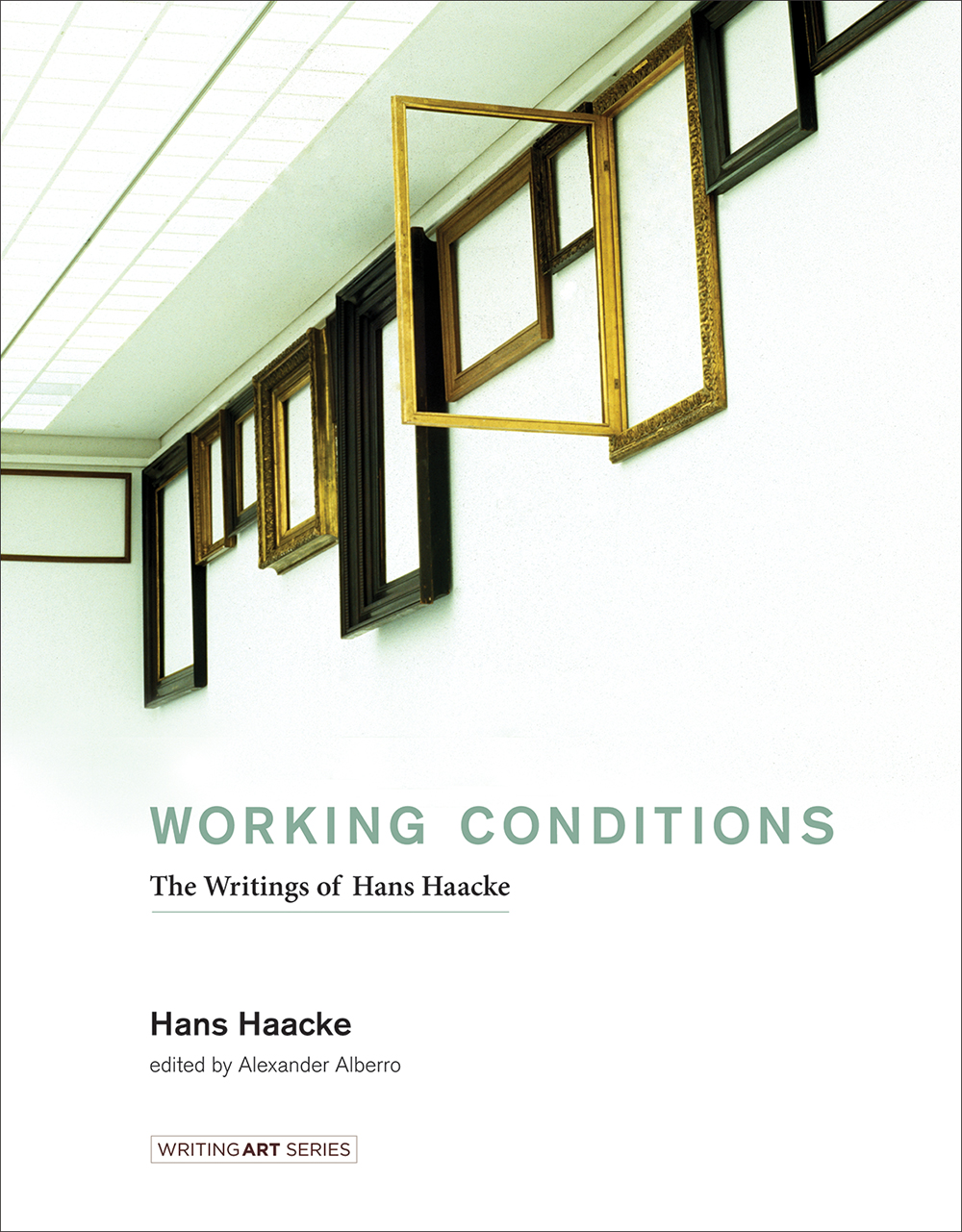
Pierre Bourdieu, Hans Haacke: Free Exchange (1994/1995)
Filed under book | Tags: · art, censorship, contemporary art, institutional critique, multiculturalism, sociology, sociology of art

How can we affirm the independence of critical artists and intellectuals when confronted by the new crusaders of Western culture, the neoconservative champions of morality and good taste, the sponsorship of multinationals and the patronage theorists who have lost all touch with reality? How can we safeguard the world of free exchange which is and must remain the world of artists, writers and scholars?
These are some of the questions discussed by the leading social thinker Pierre Bourdieu and the artist Hans Haacke in this remarkable book. Their frank and open dialogue on contemporary art and culture ranges widely, from censorship and obscenity to the social conditions of artistic creativity. Among the examples they discuss are the controversies surrounding the exhibition of photographs by Robert Mapplethorpe and Andres Serrano, the debates concerning multiculturalism and ethnic diversity, and the uses of art as a means of contesting and disrupting symbolic domination. They also explore the central themes of Hans Haacke’s work, which is used to illustrate the book.
Free Exchange is a timely intervention in current debates and a powerful analysis of the conditions and concerns of critical artists and intellectuals today.
Originally published in French as Libre-échange, Éditions de Seuil/les presses du réel, 1994
Publisher Polity Press, Cambridge, UK, in association with Blackwell Publishers, 1995
ISBN 0745615228, 0745615228
144 pages
review (Vincent Dubois, Politix, in French)
Download (no OCR, black&white)
Comment (0)Philip N. Howard: The Digital Origins of Dictatorship and Democracy: Information Technology and Political Islam (2010)
Filed under book | Tags: · 1990s, 2000s, censorship, democracy, internet, iran, islam, politics, technology

- First book to move beyond potential and hypothetical relationships between technology diffusion and democratic transitions to look at lived experiences for countries under study
- Draws on a statistical study that compares data trends across 74 Muslim countries between 1990 and 2008
- Addresses 2009 presidential elections in Iran
Around the developing world, political leaders face a dilemma: the very information and communication technologies that boost economic fortunes also undermine power structures. Globally, one in ten internet users is a Muslim living in a populous Muslim community. In these countries, young people are developing their political identities–including a transnational Muslim identity–online. In countries where political parties are illegal, the internet is the only infrastructure for democratic discourse. In others, digital technologies such as mobile phones and the internet have given key actors an information infrastructure that is independent of the state. And in countries with large Muslim communities, mobile phones and the internet are helping civil society build systems of political communication independent of the state and beyond easy manipulation by cultural or religious elites.
This book looks at the role that communications technologies play in advancing democratic transitions in Muslim countries. As such, its central question is whether technology holds the potential to substantially enhance democracy. Certainly, no democratic transition has occurred solely because of the internet. But, as Philip Howard argues, no democratic transition can occur today without the internet. According to Howard, the major (and perhaps only meaningful) forum for civic debate in most Muslim countries today is online. Activists both within diasporic communities and within authoritarian states, including Iran, Saudi Arabia and Pakistan, are the drivers of this debate, which centers around issues such as the interpretation of Islamic texts, gender roles, and security issues. Drawing upon material from interviews with telecommunications policy makers and activists in Azerbaijan, Egypt, Tajikistan and Tanzania and a comparative study of 74 countries with large Muslim populations, Howard demonstrates that these forums have been the means to organize activist movements that have lead to successful democratic insurgencies.
Publisher Oxford University Press, 2010
ISBN 0199736413, 9780199736416
285 pages
review (Evgeny Morozov)
Download (updated on 2012-11-11)
Comment (0)