

Edward S. Small: Direct Theory: Experimental Film/Video as Major Genre (1994)
Filed under book | Tags: · aesthetics, avant-garde, cinema, computer film, expanded cinema, experimental film, film, film theory, phenomenology, structural film, video, video art

“Undulating water patterns; designs etched directly into exposed film; computer- generated, pulsating, multihued light tapestries—the visual images that often constitute experimental film and video provide the basis for Edward S. Small’s argument for a new theory defining this often overlooked and misunderstood genre. In a radical revision of film theory incorporating a semiotic system, Small contends that experimental film/video constitutes a mode of theory that bypasses written or spoken words to directly connect Ferdinand de Saussure’s “signifier” and “signified,” the image and the viewer. This new theory leads Small to develop a case for the establishment of experimental film/video as a major genre.
Small contends that the aesthetic of experimental film/video would best be understood as a coordinate major genre separate from genres such as fictive narrative and documentary. He employs eight experimental technical/structural characteristics to demonstrate this thesis: the autonomy of the artist or a-collaborative construction; economic independence; brevity; an affinity for animation and special effects that embraces video technology and computer graphics; use of the phenomenology of mental imagery, including dreams, reveries, and hallucinations; an avoidance of verbal language as either dialogue or narration; an exploration of nonnarrative structure; and a pronounced reflexivity—drawing the audience’s attention to the art of the film through images rather than through the mediation of words.
Along with a theoretical approach, Small provides an overview of the historical development of experimental film as a genre. He covers seven decades beginning in France and Germany in the 1920s with European avant-garde and underground films and ends with a discussion of experimental videos of the 1990s. He highlights certain films and provides a sampling of frames from them to demonstrate the heightened reflexivity when images rather than words are the transmitters: for example, Ralph Steiner’s 1929 H2O, a twelve-minute, wordless, realistic study of water patterns, and Bruce Conner’s 1958 A Movie, which unites his themes of war-weapons-death and sexuality not by narrative digesis but by intellectual montage juxtapositions. Small also examines experimental video productions such as Stephen Beck’s 1977 Video Weavings, which has a simple musical score and abstract images recalling American Indian rugs and tapestries.
Small adds classic and contemporary film theory discussions to this historical survey to further develop his direct-theory argument and his presentation of experimental film/video as a separate major genre. He stresses that the function of experimental film/video is “neither to entertain nor persuade but rather to examine the quite omnipresent yet little understood pictos [semiotic symbols] that mark and measure our postmodern milieu.”
Publisher SIU Press, 1994
ISBN 0809319209, 9780809319206
122 pages
EPUB (updated on 2012-7-9)
Comments (2)Sergei Eisenstein: Selected Works, 1: Writings, 1922-34 (1988)
Filed under book | Tags: · 1920s, 1930s, aesthetics, cinema, film, film theory, ideology, soviet union
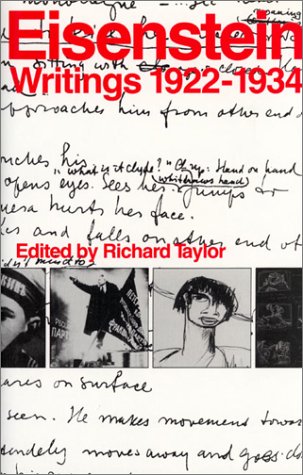
This volume is a collection of writings by Sergei Eisenstein, considered by some to be cinema’s most important theorist and author of aesthetic writings in the 20th century. Some of the writings are of his early silent masterpieces, The Strike and The Battleship Potemkin.
Edited and translated by Richard Taylor
Publisher British Film Institute, London, 1988
ISBN 0851702066, 9780851702063
343 pages
PDF (no OCR; updated on 2012-7-14)
Comment (0)Patricia Pisters: The Matrix of Visual Culture. Working with Deleuze in Film Theory (2003)
Filed under book | Tags: · aesthetics, cinema, cyborg, deterritorialization, film, film theory, immanence, rhizome, time-image, visual culture

This book explores Gilles Deleuze’s contribution to film theory. According to Deleuze, we have come to live in a universe that could be described as metacinematic. His conception of images implies a new kind of camera consciousness, one that determines our perceptions and sense of selves: aspects of our subjectivities are formed in, for instance, action-images, affection-images and time-images. We live in a matrix of visual culture that is always moving and changing. Each image is always connected to an assemblage of affects and forces. This book presents a model, as well as many concrete examples, of how to work with Deleuze in film theory. It asks questions about the universe as metacinema, subjectivity, violence, feminism, monstrosity, and music. Among the contemporary films it discusses within a Deleuzian framework are Strange Days, Fight Club, and Dancer in the Dark.
Publisher Stanford University Press, 2003
Cultural Memory in the Present series
ISBN 0804740283, 9780804740289
303 pages
review (Patricia MacCormack, Senses of Cinema)
PDF (updated on 2012-7-14)
Comment (0)