

The Iron Ring, an Art Project by Cecilia Jonsson (2014)
Filed under brochure | Tags: · art, environment, installation art, metallurgy, mineralogy, mining, plants
While “green mining” aims for a more ecological approach to mining metals, The Iron Ring explores how contaminated mining grounds may benefit from the mining of metals. For this work, 24kg of iron-tainted grass was removed from contaminated mining grounds and transformed into a ring of 2g metallic iron.
The project elaborates on the possibilities to utilize the cleansing process of the naturalized, wild growing grass: Imperata cylindrica. An invasive vile weed, which overlooked tolerance and ability to hyper accumulate iron inside its roots, stems and leaves are left unutilized. The Iron Ring proposes to harvest the grass for the purpose of extracting the ore that is inside them. The result is a scenario for iron mining that, instead of furthering destruction, could actually contribute to the environmental rehabilitation of abandoned metal mines.
The Iron Ring came about through trials and failures, in a process of close collaboration with smiths, scientists, technicians and farmers met along the way.
This e-book consists of two parts. The first is a visual essay by Cecilia Jonsson that reports on the seven chronological steps that were required to create an iron ring out of 24kg of grass harvested from the acidic river banks of a landscape in Spain severely transformed by opencast mining. In the second part, professor James Jackson Griffith, who participated in Jonsson’s preliminary research on mining restoration in Brazil, discusses The Iron Ring from an environmental-philosophical perspective.
Publisher V2_, Rotterdam, 2014
Open Access
PDF (4 MB, EPUB)
Comment (0)Boaventura de Sousa Santos (ed.): Another Knowledge Is Possible: Beyond Northern Epistemologies (2007)
Filed under book | Tags: · biodiversity, capitalism, environment, epistemology, human rights, knowledge, medicine, neoliberalism, social movements
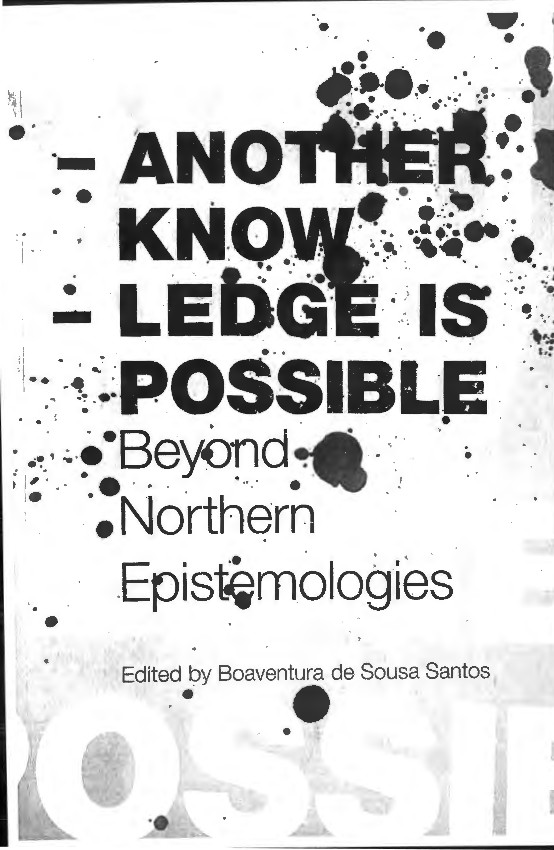
“The main argument of this book is that there is no global social justice without global cognitive justice. Probably more than ever, global capitalism appears as a civilizational paradigm encompassing all domains of social life. The exclusion, oppression, and discrimination it produces have not only economic, social, and political dimensions but also cultural and epistemological ones. Accordingly, to confront this paradigm in all its dimensions is the challenge facing a new critical theory and new emancipatory practices. Contrary to their predecessors, this theory and these practices must start from the premise that the epistemological diversity of the world is immense, as immense as its cultural diversity and that the recognition of such diversity must be at the core of the global resistance against capitalism and of the formulation of alternative forms of sociability.” (from the Introduction)
Another Knowledge Is Possible explores the struggles against moral and cultural imperialism and neoliberal globalization that have taken place over the past few decades, and the alternatives that have emerged in countries throughout the developing world from Brazil and Colombia, to India, South Africa and Mozambique. In particular it looks at the issue of biodiversity, the confrontation between scientific and non-scientific knowledges, and the increasing difficulty experienced by great numbers of people in accessing information and scientific-technological knowledge.
With contributions by Margarita Flórez Alonso, Luis Carlos Arenas, João Paulo Borges Coelho, Arturo Escobar, Yash Ghai, Maria Paula Meneses, João Arriscado Nunes, Lino João de Oliveira Neves, Mauricio Pardo, Shalini Randeria, Laymert Garcia dos Santos, Vandana Shiva, Carlos Frederico Marés de Souza Filho, Tewolde Berhan Gebre Egziabher, Shiv Visvanathan, and Thokozani Xaba.
Publisher Verso, London, 2007
ISBN 9781844672561
447 pages
via the editor, HT kris
PDF (single PDF, updated to an OCR’d version on 2014-5-9 via esco_bar)
PDF (PDF chapters)
Richard H. Grove: Green Imperialism: Colonial Expansion, Tropical Island Edens and the Origins of Environmentalism, 1600-1860 (1995)
Filed under book | Tags: · 1600s, 1700s, 1800s, colonialism, environment, history, nature

“Green Imperialism is the first book to document the origins and early history of environmentalism, concentrating especially on its hitherto unexplained colonial and global aspects. It highlights the significance of Utopian, Physiocratic, and medical thinking in the history of environmentalist ideas. The book shows how the new critique of the colonial impact on the environment depended on the emergence of a coterie of professional scientists, and demonstrates both the importance of the oceanic island “Eden” as a vehicle for new conceptions of nature and the significance of colonial island environments in stimulating conservationist notions.”
Publisher Cambridge University Press, 1995
Studies in Environment and History series
ISBN 0521565138, 9780521565134
540 pages
Reviews: Elvin (London Review of Books, 1995), Carruthers (H-Africa, 1996), Rangarajan (Telegraph, 1995), Harrison (British Journal for the History of Science, 1996), Hughes (Journal of World History, 1996), Harrison (British Journal for the History of Science, 1996), MacKenzie (International History Review, 1996), Luckin (Reviews in History, 1996).
PDF (28 MB, updated on 2015-2-21)
Comment (0)