
László Moholy-Nagy: The Art of Light (2010) [Spanish]
Filed under book, catalogue | Tags: · art, avant-garde, bauhaus, constructivism, film, graphic design, light art, painting, photography, sculpture, typography

An artist and thinker of astounding energy and ability, Laszlo Moholy-Nagy was a true world citizen of the early twentieth century, an ambassador-at-large for Constructivism, Suprematism, Dada and the Bauhaus. He brought the same Constructivist optimism to every medium he tackled, from plexiglass and light sculpture to typography to his photographic experiments in color to his Suprematist canvases, his influential pedagogy at the Bauhaus and at the Institute of Design in Chicago. Moholy-Nagy’s concept of the arts as a totality, his pedagogy and his confidence in the new industrial culture that would level distinctions between art and craft led him into all fields of creative production. The ultimate modernist Renaissance man, Moholy-Nagy was prolific in so many realms that his detractors inevitably charged him with dilettantism. This accusation ignores his very real innovations in photography–for example his photograms–and light sculpture, as well as the fact that the artist’s aims possessed a conceptual unity in their common aspiration to make an “art of light.”
László Moholy-Nagy: The Art of Light presents Moholy-Nagy’s work in all of its glorious unity and diversity. Including more than 200 works, from painting, photography (black and white and color) and photograms to collages, films and graphic design, it emphasizes his greatest years of productivity, from 1922 to the end of his life. The Art of Light is the new definitive volume on this hero of modernism.
László Moholy-Nagy: El Arte de la Luz
Book coordination: Doménico Chiappe, Luisa Lucuix
Editor: Emilio Ruiz Mateo
Publisher: La Fábrica Editorial / Círculo de Bellas Artes, Madrid
ISBN: 8492841257, 9788492841424
264 pages
exhibition (Madrid, 2010)
Comment (0)Tanja Ostojić: Strategies of Success / Curators Series, 2001-2003 (2004) [English/Serbian/French]
Filed under book | Tags: · art, immigration, institutional critique, performance art, photography, power, women
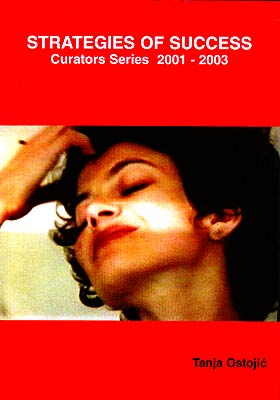
“Tanja Ostojić is an interdisciplinary artist from Belgrade who lives and works in Berlin. In her provocative performances, she investigates the position of women within contemporary cultural and political power regimes. She uses persiflage, provocation and irony as strategies to expose and subvert the exclusionary mechanisms of European immigration policies and the hierarchies within the Western art world.
In the years 2001 to 2003, Tanja Ostojić worked on the series Strategies of Success / Curator Series, which consists of performances, installations, photographs and a journal. In I’ll Be Your Angel (2001) she accompanied the curator Harald Szeemann during the opening of the 49th Venice Biennale, never leaving his side. She “presented” her conceptual body art work Black Square on White (2001), in which her pubic hair was trimmed in a square, by keeping it hidden. Tanja Ostojić’s other public actions include taking a bubble bath with the Italian curator Bartolomeo Pietromarchi and art critic Ludovico Pratesi in the Palazzo delle Esposizioni in Rome as the lovely ending to a shared gala dinner, and washing the feet of the Belgrade-based curator Stevan Vuković in Sofa for Curator (2002). The only traces of the non-public performance with the Albanian curator Edi Muka, Vacation with Curator (2003), are the photographs taken by the paparazzi she hired. In her work Politics of queer curatorial positions: After Rosa von Praunheim, Fassbinder and Bridge Markland (2003) she and the Slovenian curator and theorist Marina Gržinić re-enact an iconographic scene featuring Gabrielle d’Estrées, mistress to King Henry IV of France, and one of her sisters.” source
With texts by Marina Gržinić, Suzana Milevska, Tanja Ostojić.
Publisher Galérie La Box, Paris, with Student Cultural Center, Belgrade, 2004
Translations by Laurence Chamlou, Danielle Charonnet, Dušan Djordjević Mileusnić
ISBN 2910164322, 9782910164324
144 pages
PDF (b/w; no OCR)
Comment (0)François Laruelle: The Concept of Non-Photography (2011) [English]
Filed under book | Tags: · art, non-philosophy, philosophy, philosophy of art, photography, science
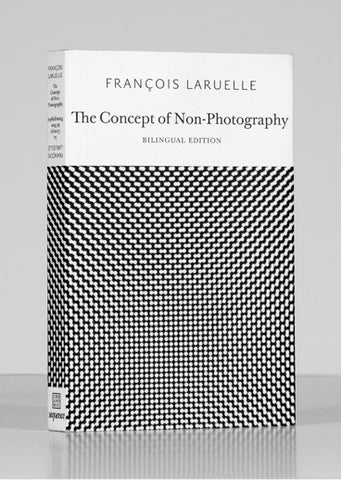
Myriads of negatives tell of the world, speaking among themselves, constituting a vast conversation, filling a photosphere that is located nowhere. But one single photo is enough to express the real that all photographers aspire one day to capture, without ever quite succeeding in doing so. Nevertheless, this real cohabits intimately with negatives, with clichés as embedded in our lives as they are imperceptible. Photographs are the thousand flat facets of an ungraspable identity that only shines – and sometimes very faintly – through something else. What more is there to a photo than a curious and prurient glance? And yet it is also a fascinating secret.
The Concept of Non-Photography develops a rigorous new thinking of the photograph in its relation to science, philosophy and art, and introduces the reader to all of the key concepts of Laruelle’s ‘non-philosophy’.
Translated from French by Robin Mackay
Publisher Urbanomic, United Kingdom, and Sequence Press, New York, 2011
ISBN 0983216916, 9780983216919
143 pages
review (Catherine Kron, DisMagazine)
publisher
publisher
google books
Download (English section of the book only; removed by the publisher on 2012-6-13)