

The Laboratory Planet, 1-4 (2007-2011) [English/French]
Filed under magazine | Tags: · control society, human rights, open spectrum, politics, security, surveillance, tactical media
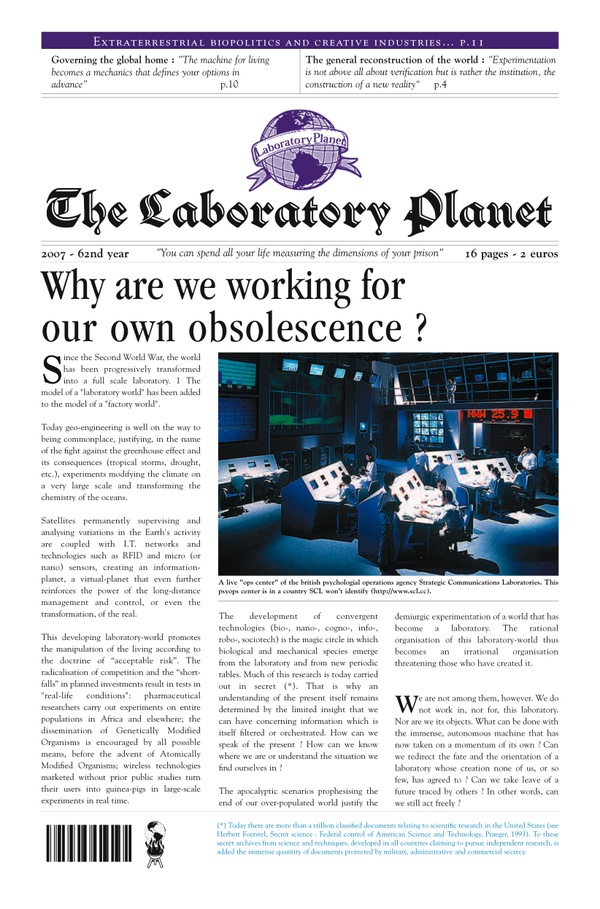
“The Laboratory Planet is a periodic journal of philosophy, science and critical writing on technology. It is published in two versions, English and French, both as print and internet editions. Ewen Chardronnet, Michel Tibon-Cornillot and Bureau d’études, produce Laboratory Planet with a team of artistic researchers, philosophers, scientists and activists. As a journalistic multimedia piece, its online platform discusses geostrategic and tactical media as well as speculative issues lurking behind the ambiguous headlines of the mainstream press.”
Issue 1: Why are we working to our own obsolescence? (2007, English, updated on 2017-12-4)
Issue 1: Pourquoi travaillons nous à notre obsolescence? (2007, French, updated on 2017-12-4)
Issue 2: Hope is not needed to act (July 2008, English, added on 2017-12-4)
Issue 2: Il n’est nul besoin d’espérer pour entreprendre (July 2008, French, updated on 2017-12-4)
Issue 3: The laboratory planet or the terminal phase of nihilism (September 2008, English, updated on 2017-12-4)
Issue 3: La planète laboratoire ou la phase terminale du nihilisme (September 2008, French, updated on 2017-12-4)
Issue 4: La conquète de la Terre par les ordinateurs (October 2011, French, added on 2013-8-1, updated on 2017-12-4)
See also Issue 5.
Matthew Fuller: Media Ecologies: Materialist Energies in Art and Technoculture (2005)
Filed under book | Tags: · art, cctv, hylomorphism, media ecology, memetics, network culture, new media, philosophy, pirate radio, surveillance, technology

In Media Ecologies, Matthew Fuller asks what happens when media systems interact. Complex objects such as media systems—understood here as processes, or elements in a composition as much as “things”—have become informational as much as physical, but without losing any of their fundamental materiality. Fuller looks at this multiplicitous materiality—how it can be sensed, made use of, and how it makes other possibilities tangible. He investigates the ways the different qualities in media systems can be said to mix and interrelate, and, as he writes, “to produce patterns, dangers, and potentials.”
Fuller draws on texts by Felix Guattari and Gilles Deleuze as well as writings by Friedrich Nietzsche, Marshall McLuhan, Donna Haraway, Friedrich Kittler, and others, to define and extend the idea of “media ecology.” Arguing that the only way to find out about what happens when media systems interact is to carry out such interactions, Fuller traces a series of media ecologies—”taking every path in a labyrinth simultaneously,” as he describes one chapter. He looks at contemporary London-based pirate radio and its interweaving of high- and low-tech media systems; the “medial will to power” illustrated by “the camera that ate itself”; how, as seen in a range of compelling interpretations of new media works, the capacities and behaviors of media objects are affected when they are in “abnormal” relationships with other objects; and each step in a sequence of Web pages, Cctv—world wide watch, that encourages viewers to report crimes seen via webcams.
Contributing to debates around standardization, cultural evolution, cybernetic culture, and surveillance, and inventing a politically challenging aesthetic that links them, Media Ecologies, with its various narrative speeds, scales, frames of references, and voices, does not offer the academically traditional unifying framework; rather, Fuller says, it proposes to capture “an explosion of activity and ideas to which it hopes to add an echo.”
Published by MIT Press, 2005
ISBN 026206247X, 9780262062473
265 pages
PDF (updated on 2012-7-15)
Comment (0)Public Netbase: Non Stop Future. New practices in Art and Media (2008)
Filed under book | Tags: · art, commons, networks, new media, public domain, surveillance, tactical media

The publication is both a review of the pioneer days from the perspective of Public Netbase as well as an outlook into the future of art and culture in digital networks. It provides an overview of a critical information economy discourse, insights into Tactical Media strategies and a critique of the loss of public domain and the commons. Based on the extensive archives of Public Netbase, the book features some of the most spectacular and controversial art projects and interventions from 1994 to 2006. It also offers historical documents and manifestos critical of commercialization and control society issues, together with a view into the digital world of tomorrow.
Sections: Discourse; New Art Practices; Tactical Media; Digital Mediaculture, Networking and Participation; Public Netbase; World-information.org
Editors: Branka Ćurčić, Zoran Pantelić / New Media Center_kuda.org
Editorial team: Konrad Becker, Branka Ćurčić, Zoran Pantelić, Felix Stalder, Martin Wassermair
Publisher Revolver – Archiv für aktuelle Kunst, 2008
ISBN 9783865884558
View online (HTML articles)
Comment (0)