

Raúl Ruiz: Poetics of Cinema (1995–) [EN, ES]
Filed under book | Tags: · cinema, film, film theory, image, poetics, theory, unconscious
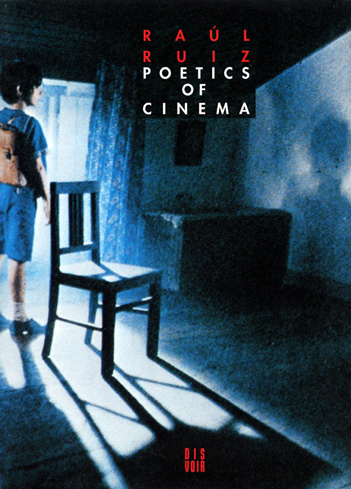
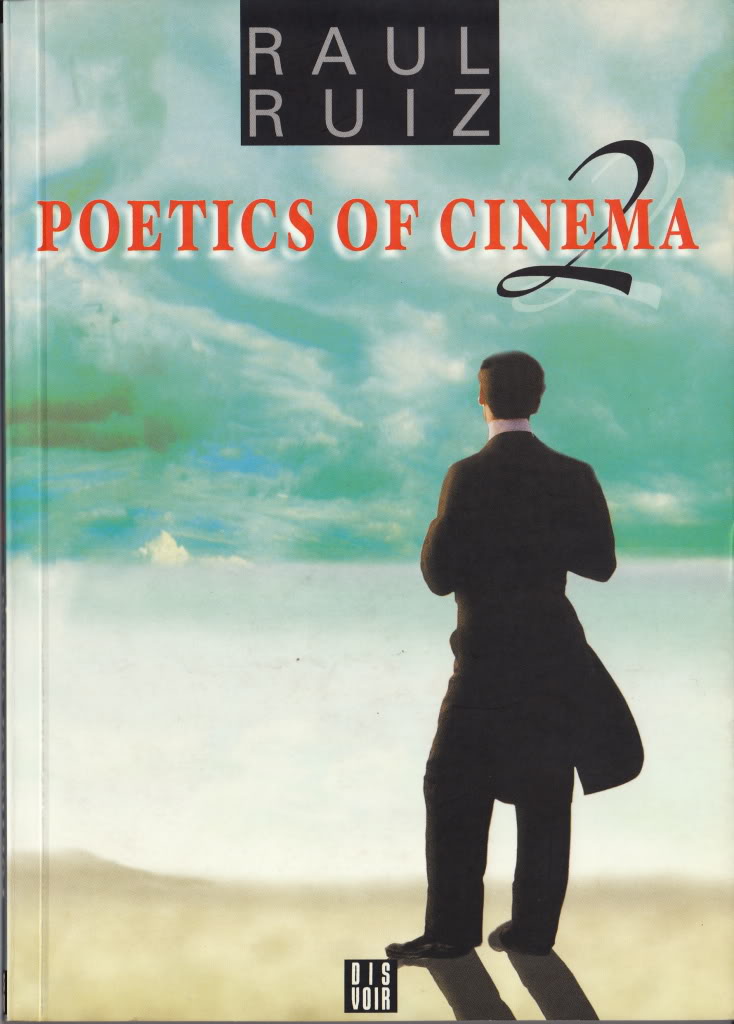
“Chilean filmmaker Raoul Ruiz is the author of some 100 feature-length films, along with numerous plays and multi-media installations. In Poetics of Cinema, Ruiz takes a fresh approach to the major themes haunting our audio-visual civilization: the filmic unconscious, questions of utopia, the inter-contamination of images, the art of the copy, the relations between artistic practices and institutions. Based on a series of lectures given at Duke University in North Carolina, Poetics of Cinema develops an acerbically witty critique of the reigning codes of cinematographic narration, principally derived from the dramatic theories set forth by Aristotle’s Poetics and characterized by Ruiz as the “central-conflict theory.” Ruiz’s knowledge of theology, philosophy, literature and the visual arts never outstrips his imagination. Poetics of Cinema not only offers a singularly pertinent analysis of the seventh art, but also shows us an entirely new way of writing and thinking about images.” (Source)
Translated by Brian Holmes (I) and Carlos Morreo (II)
Publisher Dis Voir, Paris, 1995 & 2007
ISBN 2906571385, 9782906571389 (I), & 2914563256, 9782914563253 (II)
124 & 111 pages
via depositio
Reviews: Michael Goddard (Senses of Cinema, 2004), Acquarello (2007).
Publisher (I), (II)
WorldCat (I), (II)
Poetics of Cinema, 1: Miscellanies (English, 1995; removed on 2015-7-15 upon request of the publisher)
Poetics of Cinema, 2 (English, 2007; removed on 2015-7-12 upon request of the publisher)
Poética del cine (Spanish, trans. Waldo Rojas, 2000, 9 MB)
For more by and about Ruiz see Film Studies For Free.
Comment (0)Sergei Eisenstein: Nonindifferent Nature (1987)
Filed under book | Tags: · aesthetics, architecture, art, cinema, film, literature, painting, theory
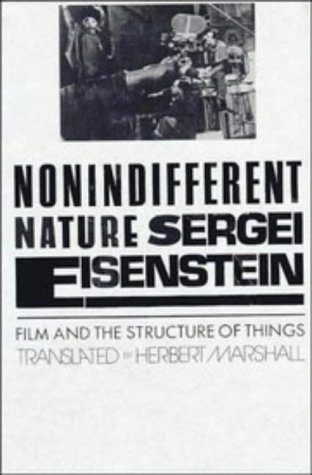
“This is the first publication in English of Eisenstein‘s major theoretical work from the last decade of his life. Almost completed but unrevised at the time of his death in 1948, it comprises three articles from 1939-41 rewritten for the book, together with a substantial text from the period 1945-47. More than a treatise of film theory (though its immediate impetus is clearly the films that Eisenstein worked on at this time, Alexander Nevsky and Ivan the Terrible Parts I and II), Nonindifferent Nature aspires to the status of a contribution to general aesthetics, and its numerous examples are drawn more from the other arts than from cinema. Indeed, apart from analysing, in retrospect, his own work, Eisenstein scarcely touches on film at all. Instead he deals with the novel (Zola, Tolstoy, Wilkie Collins), painting (El Greco, Chinese landscapes), architecture (Chartres Cathedral, Mayan temples), etching (Piranesi), opera (Wagner), poetry (Pushkin), acting (Frederick Lemaitre), music (Bach, jazz), even cartooning (Saul Steinberg).” (from a review by Russell Campbell)
Translated by Herbert Marshall
Publisher Cambridge University Press, 1987
ISBN 0521324157, 9780521324151
xxv+428 pages
via jchill, land
Reviews: Ronald R. Levaco (Los Angeles Times, 1987), Russell Campbell (New Zealand Slavonic Journal, 1991).
PDF (Introduction missing, 7 MB, no OCR)
Comment (0)L. Moholy-Nagy: Vision in Motion (1947)
Filed under book | Tags: · abstraction, architecture, art, art education, bauhaus, biology, design, film, image, industrial design, life, light, literature, machine, motion, painting, perception, photography, poetry, sculpture, technology, visual communication, visual poetry
“This book is written for the artist and the layman, for everyone interested in his relationship to our existing civilization. It is an extension of my previous book, The New Vision. But while The New Vision gave mainly particulars about the educational methods of the old Bauhaus, Vision in Motion concentrates on the work of the Institute of Design, Chicago, and presents a broader, more general view of the interrelatedness of art and life.” (from the author’s foreword)
Publisher Paul Theobald, Chicago, 1947
371 pages
PDF (114 MB, no OCR)
Comments (2)