

Jean-François Lyotard: Discourse, Figure (1971/2011)
Filed under book | Tags: · aesthetics, art, language, phenomenology, philosophy, philosophy of art, poetry, psychoanalysis, semiotics, structuralism

“Discourse, Figure is Lyotard’s thesis. Provoked in part by Lacan’s influential seminars in Paris, Discourse, Figure distinguishes between the meaningfulness of linguistic signs and the meaningfulness of plastic arts such as painting and sculpture. Lyotard argues that because rational thought is discursive and works of art are inherently opaque signs, certain aspects of artistic meaning such as symbols and the pictorial richness of painting will always be beyond reason’s grasp.
A wide-ranging and highly unusual work, Discourse, Figure proceeds from an attentive consideration of the phenomenology of experience to an ambitious meditation on the psychoanalytic account of the subject of experience, structured by the confrontation between phenomenology and psychoanalysis as contending frames within which to think the materialism of consciousness. In addition to prefiguring many of Lyotard’s later concerns, Discourse, Figure captures Lyotard’s passionate engagement with topics beyond phenomenology and psychoanalysis to structuralism, semiotics, poetry, art, and the philosophy of language.”
Originally published in French as Discours, figure by Klincksieck, 1971
Translated by Antony Hudek and Mary Lydon
Introduction by John Mowitt
Publisher University of Minnesota Press, 2011
Cultural Critique Books
ISBN 0816645655, 9780816645657
512 pages
PDF (updated on 2012-11-4)
Comment (0)Joasia Krysa (ed.): Curating Immateriality: The Work of the Curator in the Age of Network Systems (2006)
Filed under book | Tags: · aesthetics, art, collaboration, curating, database, exhibition, internet, internet art, labour, media art, museum, net art, open source, relational aesthetics, software art, technology
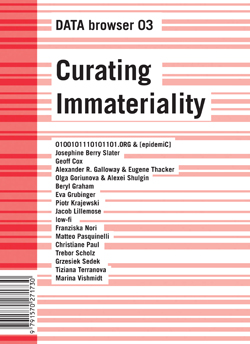
“The site of curatorial production has been expanded to include the space of the Internet and the focus of curatorial attention has been extended from the object to processes to dynamic network systems. As a result, curatorial work has become more widely distributed between multiple agents, including technological networks and software. This upgraded ‘operating system’ of art presents new possibilities of online curating that is collective and distributed — even to the extreme of a self-organising system that curates itself. The curator is part of this entire system but not central to it.
The subtitle of the book makes reference to the essay ‘The Work of Culture in the Age of Cybernetic Systems’ (1988), in which Bill Nichols considered how cybernetics transformed cultural production. He emphasised the shift from mechanical reproduction (symbolised by the camera) to that of cybernetic systems (symbolised by the computer) in relation to the political economy, and pointed to contradictory tendencies inherent in these systems: ‘the negative, currently dominant, tendency toward control, and the positive, more latent potential toward collectivity’. The book continues this general line of inquiry in relation to curating, and extends it by considering how power relations and control are expressed in the context of network systems and immateriality.
In relation to network systems, the emphasis remains on the democratic potential of technological change but also the emergence of what appears as more intensive forms of control. Can the same be said of curating in the context of distributed forms? If so, what does this imply for software curating beyond the rhetoric of free software and open systems?”
Contributors: 0100101110101101.ORG & [epidemiC] | Josephine Berry Slater | Geoff Cox | Alexander R. Galloway & Eugene Thacker | Olga Goriunova & Alexei Shulgin | Beryl Graham | Eva Grubinger | Piotr Krajewski | Jacob Lillemose | low-fi | Franziska Nori | Matteo Pasquinelli | Christiane Paul | Trebor Scholz | Grzesiek Sedek | Tiziana Terranova | Marina Vishmidt
Publisher Autonomedia/I-DAT, 2006
Creative Commons License
DATA browser series, 3
ISBN 1570271739
288 pages
PDF (14 MB, added on 2018-3-29)
PDFs (updated on 2016-12-12)
Karabogdan, Klobučar (eds.): Enigma of the Object: A Collection of Theoretical Writings (2006) [English, Croatian]
Filed under book | Tags: · aesthetics, art, politics, theory

The reader published as part of the presentation of the work Enigma of the object presented within the Biennial of Quadrilateral: Relativism exhibition in the Museum of Modern and Contemporary Art in Rijeka, Croatia, 15.12.2005-26.2.2006.
Contributions by Mieke Bal, Nada Beroš, Zoran Erić, Marina Gržinić, Bojana Kunst, Tomislav Medak, Petar Milat, Žarko Paić, Ana Peraica, Nataša Petrešin, Zoran Roško, Marko Stamenković, Miško Šuvaković, Šefik Tatlić, Ana Vujanović.
Enigma objekta – Zbornik teorijskih tekstova / Enigma of the Object – A Collection of Theoretical Writings
Editors: Gordan Karabogdan, Nikica Klobučar
Publisher: Personal edition: Gordan Karabogdan and Nikica Klobučar, Zagreb, 2006.
ISBN 953-95352-0-4
148 pages