

Lotte H. Eisner: The Haunted Screen: Expressionism in German Cinema and the Influence of Max Reinhardt (1952/1969)
Filed under book | Tags: · 1910s, 1920s, cinema, expressionism, film, film criticism, film history, germany, romanticism, theatre

The expressionist era of German cinema began at the end of the First World War and ended shortly after the coming of sound. From The Cabinet of Dr. Caligari onwards the principal films of this period were characterized by two influences: literary Expressionism, and the innovations of the theatre directors of this period, in particular Max Reinhardt. This book demonstrates the connection between German Romanticism and the cinema through Expressionist writings. It discusses the influence of the theatre: the handling of crowds; the use of different levels, and of selective lighting on a predominately dark stage; the reliance on formalized gesture; the innovation of the intimate theatre. Against this background the principal films of the period are examined in detail. The author explains the key critical concepts of the time, and surveys not only the work of the great directors, such as Fritz Lang and F. W. Murnau, but also the contribution of their writers, cameramen, and designers.
First published as L’Écran démoniaque. Influence de Max Reinhardt et de l’Expressionisme, 1952; revised 1965.
Translated by Roger Greaves
Publisher Thames and Hudson, London, 1969
360 pages
via knappen
Review (Richard B. Byrne, Cinema Journal, 1970)
PDF (116 MB)
Comment (0)See This Sound: Versprechungen von Bild und Ton / Promises in Sound and Vision (2010) [German/English]
Filed under book, catalogue | Tags: · art, art history, audiovisual, avant-garde, cassette culture, dance, electronic art, experimental film, film, fluxus, music, music history, performance, performance art, sound, sound art, synaesthesia, video, video art, vision, visual music
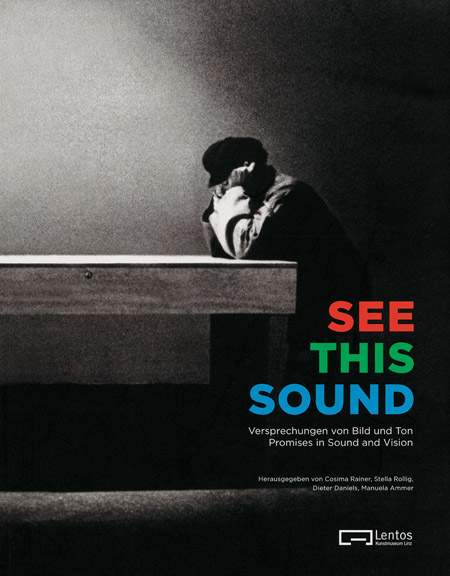
“As the status of sound in art and music evolves and redefines itself, so too does sound art find new ways of describing its history. See This Sound compiles a large number of artists, filmmakers, composers and performers, reaching back into the early twentieth century and into the present to survey overlaps between not only sound and art, sound and film, and the metaphor of cinema as rhythm or symphony. Proceeding chronologically, the book takes the early cinematic “eye music” of Hans Richter as a starting point, noting parallel works by Walter Ruttmann and Oskar Fischinger; moving into the postwar period, the art/cinema/ music experiments of Peter Kubelka, Valie Export and Michael Snow are discussed, establishing precedents to similar work by Rodney Graham, Carsten Nicolai, Jeremy Deller and many others.”
With essays by Helmut Draxler, Diedrich Diederichsen, Gabriele Jutz, Liz Kotz, Heidi Grundmann, Christian Höller, Dieter Daniels, and Manuela Ammer.
Edited by Cosima Rainer, Stella Rollig, Dieter Daniels and Manuela Ammer
Publisher Walther König, Cologne, 2010
ISBN 3865606830, 9783865606839
320 pages
Exhibition website and archive
PDF (19 MB, updated on 2021-7-19)
Comments (7)Martin Walsh: The Brechtian Aspect of Radical Cinema (1981)
Filed under book | Tags: · cinema, film, film criticism, film theory
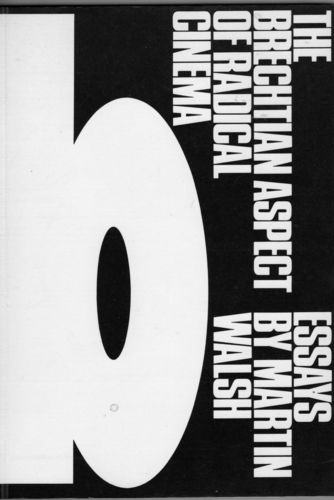
Martin Walsh had been a regular contributor to film magazines in Britain, Canada and the United States and had established himself as a leading proponent of a radical aesthetics of cinema associated with the work of Bertolt Brecht. Keith M. Griffiths, a film-maker and lifelong friend of Walsh, has gathered together for this volume a selection of his published writings, together with some previously unpublished, united around the theme of the Brechtian aspect of radical cinema. Whether discussing Brecht himself, or the Russian film-maker Alexander Medvedkin, or the work of Daniele Huillet and Jean-Marie Straub, these essays are distinguished by their commitment to the clear expression of ideas and problems of great relevance to cinema. (from the back cover)
Edited by Keith M. Griffiths.
Publisher British Film Institute, London, 1981
ISBN 0851701124
136 pages
via cobrarubia1
PDF (6 MB, no OCR)
Comment (0)