
Florian Cramer: Words Made Flesh: Code, Culture, Imagination (2005)
Filed under book | Tags: · art, art history, code, code poetry, computation, experimental literature, kabbalah, language, literature, philosophy, poetry, religion, software, software art, technology
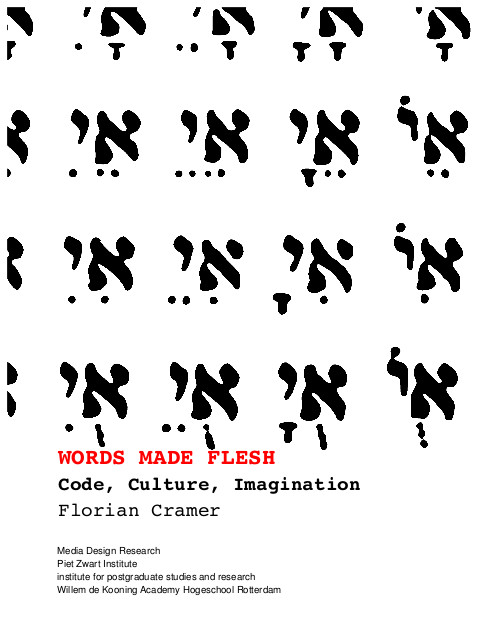
“Executable code existed centuries before the invention of the computer in magic, Kabbalah, musical composition and experimental poetry. These practices are often neglected as a historical pretext of contemporary software culture and electronic arts. Above all, they link computations to a vast speculative imagination that encompasses art, language, technology, philosophy and religion. These speculations in turn inscribe themselves into the technology. Since even the most simple formalism requires symbols with which it can be expressed, and symbols have cultural connotations, any code is loaded with meaning. This booklet writes a small cultural history of imaginative computation, reconstructing both the obsessive persistence and contradictory mutations of the phantasm that symbols turn physical, and words are made flesh.”
Editor: Matthew Fuller, additional corrections: T. Peal
Published within Media Design Research programme, Piet Zwart Institute, Willem de Kooning Academy Hogeschool, Rotterdam
GNU General Public License 2; GNU Free Documentation License 1.2; Creative Commons Attribution-ShareAlike License 2.0
141 pages
Review: Tomáš Javůrek (Joinme, 2018, CZ).
PDF (updated on 2012-10-11)
HTML (added on 2013-7-1)
Sequel: Exe.cut(up)able statements: Poetische Kalküle und Phantasmen des selbstausführenden Texts (2011, in German).
Comment (0)Roy Ascott: Telematic Embrace: Visionary Theories of Art, Technology, and Consciousness (2003)
Filed under book | Tags: · art, conceptual art, consciousness, cyberspace, electronic art, networks, technology, telematics, telepresence

Long before e-mail and the Internet permeated society, Roy Ascott, a pioneering British artist and theorist, coined the term “telematic art” to describe the use of online computer networks as an artistic medium. In Telematic Embrace Edward A. Shanken gathers, for the first time, an impressive compilation of more than three decades of Ascott’s philosophies on aesthetics, interactivity, and the sense of self and community in the telematic world of cyberspace. This book explores Ascott’s ideas on how networked communication has shaped behavior and consciousness within and beyond the realm of what is conventionally defined as art.
Telematics, a powerful marriage of computers and telecommunication, made technologies we now take for granted—such as e-mail and automated teller machines (ATMs)—part of our daily life, and made art a more interactive form of expression. Telematic art challenges traditional relationships between artist, artwork, and audience by allowing nonlocal audiences to influence the emergent qualities of the artwork, which consists of the ebb and flow of electronic information. These essays constitute a unique archaeology of ideas, tracing Ascott’s meditations on the formation of consciousness through the intertwined cultural histories of art and technology from the 1960s to the present.
Shanken’s introduction situates Ascott’s work within a history of ideas in art, technology, and philosophy. Given the increasing role of the Internet and the World Wide Web in the creation of commerce and community at the dawn of this new millennium, scholars, students, laypeople, policymakers, and artists will find this collection informative and thought-provoking.
Edited and with an essay by Edward A. Shanken
Published by University of California Press, 2003
ISBN 0585465916, 9780585465913
427 pages
PDF (updated on 2012-7-24)
Comment (0)Matthew Fuller: Media Ecologies: Materialist Energies in Art and Technoculture (2005)
Filed under book | Tags: · art, cctv, hylomorphism, media ecology, memetics, network culture, new media, philosophy, pirate radio, surveillance, technology

In Media Ecologies, Matthew Fuller asks what happens when media systems interact. Complex objects such as media systems—understood here as processes, or elements in a composition as much as “things”—have become informational as much as physical, but without losing any of their fundamental materiality. Fuller looks at this multiplicitous materiality—how it can be sensed, made use of, and how it makes other possibilities tangible. He investigates the ways the different qualities in media systems can be said to mix and interrelate, and, as he writes, “to produce patterns, dangers, and potentials.”
Fuller draws on texts by Felix Guattari and Gilles Deleuze as well as writings by Friedrich Nietzsche, Marshall McLuhan, Donna Haraway, Friedrich Kittler, and others, to define and extend the idea of “media ecology.” Arguing that the only way to find out about what happens when media systems interact is to carry out such interactions, Fuller traces a series of media ecologies—”taking every path in a labyrinth simultaneously,” as he describes one chapter. He looks at contemporary London-based pirate radio and its interweaving of high- and low-tech media systems; the “medial will to power” illustrated by “the camera that ate itself”; how, as seen in a range of compelling interpretations of new media works, the capacities and behaviors of media objects are affected when they are in “abnormal” relationships with other objects; and each step in a sequence of Web pages, Cctv—world wide watch, that encourages viewers to report crimes seen via webcams.
Contributing to debates around standardization, cultural evolution, cybernetic culture, and surveillance, and inventing a politically challenging aesthetic that links them, Media Ecologies, with its various narrative speeds, scales, frames of references, and voices, does not offer the academically traditional unifying framework; rather, Fuller says, it proposes to capture “an explosion of activity and ideas to which it hopes to add an echo.”
Published by MIT Press, 2005
ISBN 026206247X, 9780262062473
265 pages
PDF (updated on 2012-7-15)
Comment (0)