

Jennifer Gabrys: Program Earth: Environmental Sensing Technology and the Making of a Computational Planet (2016)
Filed under book | Tags: · citizenship, city, climate crisis, computation, data, earth, ecology, environment, experience, individuation, participation, sensors, technology, urbanism

“Sensors are everywhere. Small, flexible, economical, and computationally powerful, they operate ubiquitously in environments. They compile massive amounts of data, including information about air, water, and climate. Never before has such a volume of environmental data been so broadly collected or so widely available.
Grappling with the consequences of wiring our world, Program Earth examines how sensor technologies are programming our environments. As Jennifer Gabrys points out, sensors do not merely record information about an environment. Rather, they generate new environments and environmental relations. At the same time, they give a voice to the entities they monitor: to animals, plants, people, and inanimate objects. This book looks at the ways in which sensors converge with environments to map ecological processes, to track the migration of animals, to check pollutants, to facilitate citizen participation, and to program infrastructure. Through discussing particular instances where sensors are deployed for environmental study and citizen engagement across three areas of environmental sensing, from wild sensing to pollution sensing and urban sensing, Program Earth asks how sensor technologies specifically contribute to new environmental conditions. What are the implications for wiring up environments? How do sensor applications not only program environments, but also program the sorts of citizens and collectives we might become?
Program Earth suggests that the sensor-based monitoring of Earth offers the prospect of making new environments not simply as an extension of the human but rather as new “technogeographies” that connect technology, nature, and people.”
Publisher University of Minnesota Press, 2016
Electronic Mediations series, 49
ISBN 9780816693122, 0816693129
x+357 pages
via publisher
Reviews: Etienne S. Benson (Am J Sociology, 2017), Matthew W. Wilson (Cultural Geographies, 2017).
Interviews: Rorotoko (2016), Ulrik Ekman (Computational Culture, 2017).
Author (with links to related articles)
Publisher
WorldCat
PDF (6 MB)
Comment (0)Hans Haacke: Working Conditions: The Writings of Hans Haacke (2016)
Filed under book | Tags: · art, censorship, environment, information, institutional critique, systems art, systems theory, time
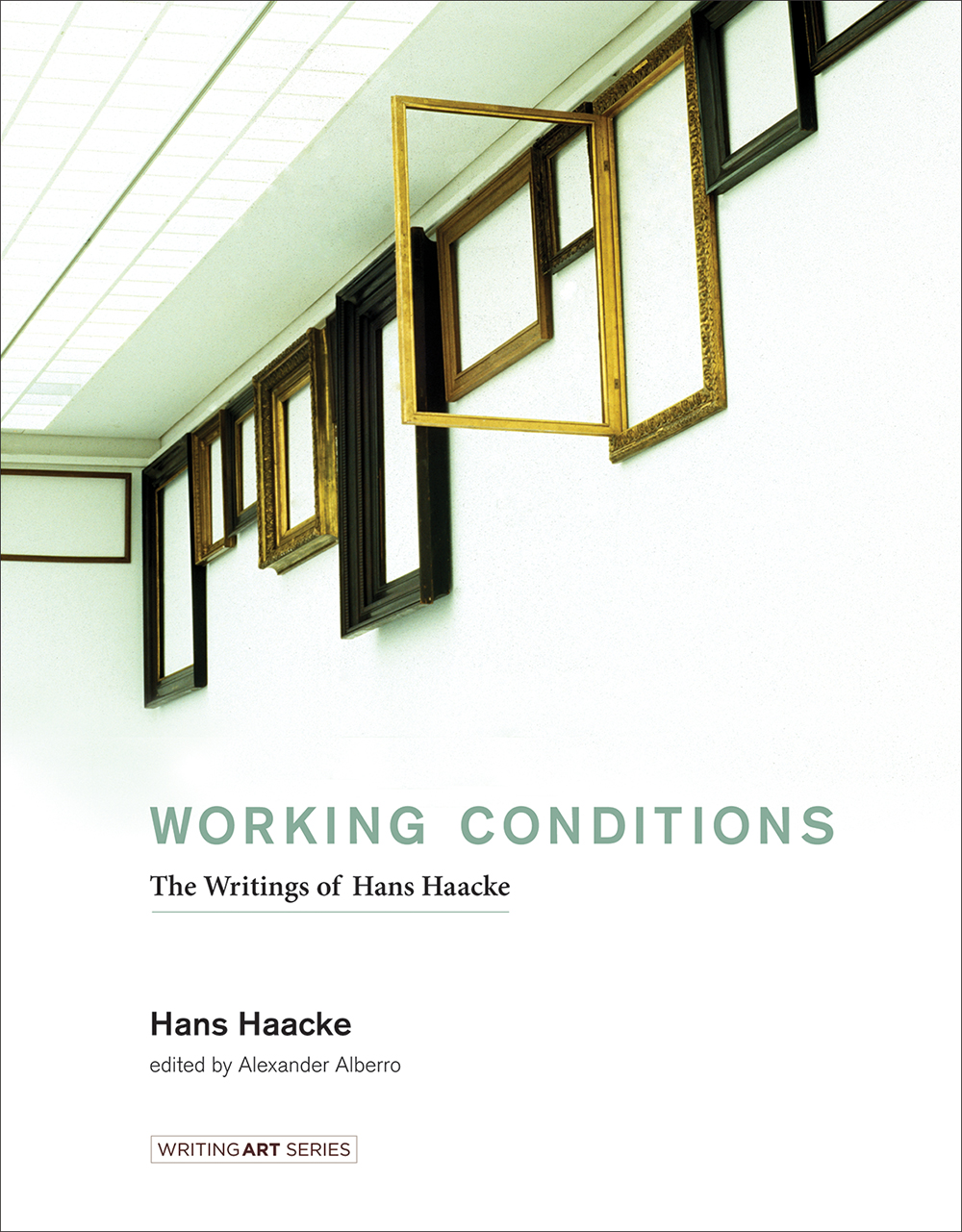
“Hans Haacke’s art articulates the interdependence of multiple elements. An artwork is not merely an object but is also its context—the economic, social, and political conditions of the art world and the world at large. Among his best-known works are MoMA-Poll (1970), which polled museumgoers on their opinions about Nelson Rockefeller and the Nixon administration’s Indochina policy; Gallery-Goers’ Birthplace and Residence Profile (1969), which canvassed visitors to the Howard Wise Gallery in Manhattan; and the famously canceled 1971 solo exhibition at the Guggenheim Museum, which was meant to display, among other things, works on two New York real estate empires.
This volume collects writings by Haacke that explain and document his practice. The texts, some of which have never before been published, run from straightforward descriptions to wide-ranging reflections and full-throated polemics. They include correspondence with MoMA and the Guggenheim and a letter refusing to represent the United States at the 1969 São Paulo Biennial; the title piece, “Working Conditions,” which discusses corporate influence on the art world; Haacke’s thinking about “real-time social systems”; and texts written for museum catalogs on various artworks, including GERMANIA, in the German Pavilion of the 1993 Venice Biennial; DER BEVÖLKERUNG (To the Population) of 2000 at the Berlin Reichstag; Mixed Messages, an exhibition of objects from the Victoria and Albert Museum (2001); and Gift Horse, unveiled on the fourth plinth in Trafalgar Square in 2015.”
Edited and with an Introduction by Alexander Alberro
Publisher MIT Press, 2016
Writing Art series
ISBN 9780262034838, 0262034832
lii+290 pages
Review: Greg Lindquist (Brooklyn Rail, 2016), Sophie Cras (Critique d’art, 2016, FR), Chelsea Weathers (CAA Reviews, 2018).
PDF (7 MB, updated on 2023-2-14)
Comment (1)Technosphere Magazine (2016-2019)
Filed under dossier, magazine | Tags: · anthropocene, anthropotechnics, creolization, earth, environment, human, infrastructure, technology, technosphere, theory

“Exploring the amorphous fabric of technologies, environments, and humans shaping Earth’s critical future.
The technosphere is the defining matrix and main driver behind the ongoing transition of this planet into the new geological epoch of humankind, the Anthropocene. Stemming from the ubiquity of human culture and global technologies, it forms a new and highly dynamic component of the Earth system, amorphous in its gestalt yet powerful in altering the history of this planet and the conditions for life on it. Mobilizing and transforming massive amounts of materials and energy, it is comparable in scale and function to other terrestrial spheres such as the bio- and hydrosphere, with which it connects and intersects. Put differently, it constitutes a form of a higher ecology generated by the cumulative interweaving of technologies and natural environments to the point where both become inseparable.
Manifest since at least the mid-twentieth century with the onset of the “Great Acceleration,” the technosphere has now reached an enormous, not yet determinate potential to alter the surface of the Earth as well as its great depths – from the orbital level to the deep sea. Owing to the capability of a single species to actuate technics that radically transform our planet, the technosphere thus represents a steep rupture and a qualitative shift in the way our planet has functioned for millions of years. How does the technosphere operate? How does it reorganize and re-functionalize the physicality and chemistry of living and non-living matter? And how does it change the ways we perceive the world?”
“Technosphere Magazine maps out specific dimensions, condensations, aggregations, “apparatuses,” problematics, conflict zones, ruptures, and operational failures, through and by which the technosphere becomes visible.” (from Editorial)
Editors-in-chief: Katrin Klingan, Christoph Rosol
Editorial team: Anujah Fernando, Ana María Guzmán Olmos, Nick Houde, Anna Luhn, Christoph Rosol, Johanna Schindler, Mira Witte
Illustrations: Nina Jäger
Publisher Haus der Kulturen der Welt (HKW), Berlin, 2016-2019
Open access
HTML
Dossiers: Anthropotechnics, Arctic, Borders, Creolized Technologies, Earth, Human, Infrastructure, Land & Sea, Machine Listening, Materials, Metabolic Systems, Phosphorus, Risk Equipment, Spheres, Substances, Trauma, Trust (HTML, updated on 2019-5-30)