

Trading Zones: Camera Work in Artistic and Ethnographic Research (2022)
Filed under book | Tags: · anthropology, artistic research, ethnography, film, video
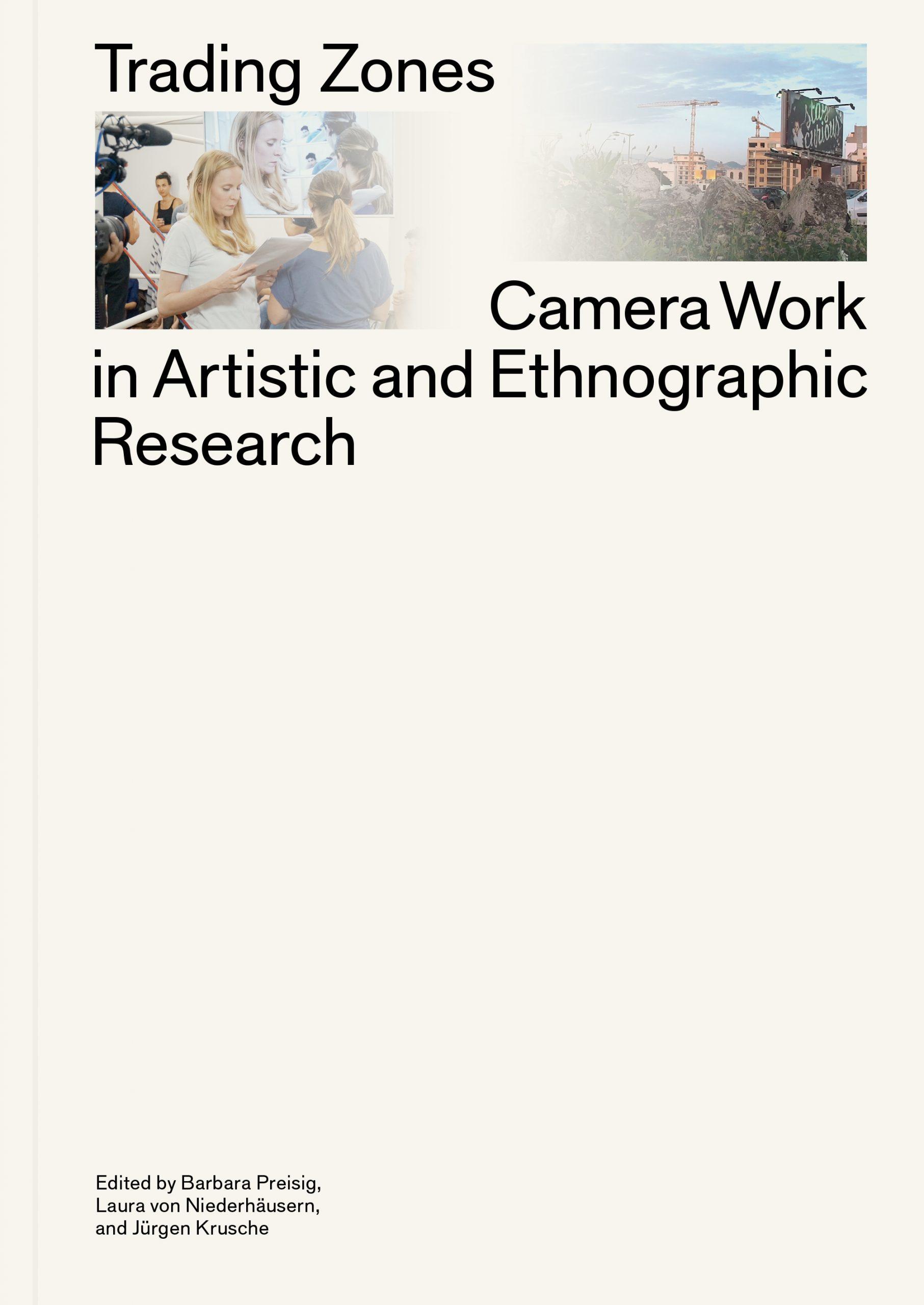
“This book introduces camera-based practices at the intersections of artistic and ethnographic research that critically examine the means of their own production and social embeddedness. In shared practices such as recording in the field, editing in post-production and modes of presentation, the camera is involved as an agent rather than an innocent device. How does the camera grapple with the invisible and how does it reveal what the camerawoman is unable to see? How do films, videos and photographs provide access to vulnerable knowledges and what presentation formats can extend the linearity of narration?
Taking account of their own situatedness and the limits of representation, many of this book’s contributors attempt to speak with — rather than about — the other. These negotiations appearing in the featured projects open up a shared field of artistic and ethnographic inquiry, whose potential — for experiments and reflections — is far from exhausted.”
Contributions by Sepideh Abtahi, Shirin Barghnavard, Laura Coppens, Louis Henderson, Heidrun Holzfeind, Mina Keshavarz, Daniel Kötter, Jürgen Krusche, Bärbel Küster, Bina Elisabeth Mohn, Laura von Niederhäusern, Uriel Orlow, Barbara Preisig, Rani al Raji, Nahid Rezaei, Anette Rose, Sahar Salahshoori, Christoph Schenker, Amira Solh, Lena Maria Thüring, Zheng Mahler.
Edited by Barbara Preisig, Laura von Niederhäusern, and Jürgen Krusche
Publisher Archive Books, Berlin
Creative Commons BY-NC-ND 4.0 license
ISBN 9783948212827
164 pages
PDF (from publisher, 148 MB)
PDF (reduced size, 5 MB)
Arturo Escobar: Territories of Difference: Place, Movements, Life, Redes (2008)
Filed under book | Tags: · anthropology, assemblage, biodiversity, black people, complexity theory, decoloniality, epistemology, ethnography, governance, indigenous peoples, modernity, nature, politics, self-organization, social movements, state, territory

“In Territories of Difference, Arturo Escobar, author of the widely debated book Encountering Development, analyzes the politics of difference enacted by specific place-based ethnic and environmental movements in the context of neoliberal globalization. His analysis is based on his many years of engagement with a group of Afro-Colombian activists of Colombia’s Pacific rainforest region, the Proceso de Comunidades Negras (PCN). Escobar offers a detailed ethnographic account of PCN’s visions, strategies, and practices, and he chronicles and analyzes the movement’s struggles for autonomy, territory, justice, and cultural recognition. Yet he also does much more. Consistently emphasizing the value of local activist knowledge for both understanding and social action and drawing on multiple strands of critical scholarship, Escobar proposes new ways for scholars and activists to examine and apprehend the momentous, complex processes engulfing regions such as the Colombian Pacific today.
Escobar illuminates many interrelated dynamics, including the Colombian government’s policies of development and pluralism that created conditions for the emergence of black and indigenous social movements and those movements’ efforts to steer the region in particular directions. He examines attempts by capitalists to appropriate the rainforest and extract resources, by developers to set the region on the path of modernist progress, and by biologists and others to defend this incredibly rich biodiversity “hot-spot” from the most predatory activities of capitalists and developers. He also looks at the attempts of academics, activists, and intellectuals to understand all of these complicated processes. Territories of Difference is Escobar’s effort to think with Afro-Colombian intellectual-activists who aim to move beyond the limits of Eurocentric paradigms as they confront the ravages of neoliberal globalization and seek to defend their place-based cultures and territories.”
Publisher Duke University Press, 2008
New Ecologies for the Twenty-first Century series, 1
ISBN 9780822343271, 0822343274
xvi+435 pages
Reviews: Laura Fano Morrissey (Development, 2009), Christopher L. Chiappari (Latin American Politics & Society, 2010), Pierre Hamel (American Journal of Sociology, 2010), Lilly U. Nguyen (Interactions, 2010), Rodrigo A. Lima de Medeiros & Guilherme F. W. Radomsky (Sociedade e Estado, 2010, BR-PT), Manuel J. Prieto (Revista de geografía Norte Grande, 2010, ES), Jeffrey S. Juris (American Anthropologist, 2011), Cornelia Butler Flora (J Agric Environ Ethics, 2011), Claudia Steiner (Americas, 2011), Paul Routledge, Juanita Sundberg, Marcus Power, & Arturo Escobar (Progress in Human Geography, 2012).
PDF (5 MB)
Comment (0)Georgina Born: Rationalizing Culture: IRCAM, Boulez, and the Institutionalization of the Musical Avantgarde (1995)
Filed under book | Tags: · anthropology, avant-garde, computer music, electroacoustic music, ethnography, music
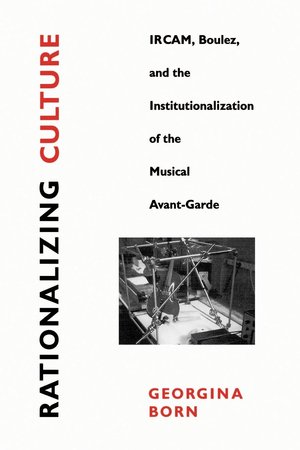
“Anthropologist Georgina Born presents an ethnography of the renowned Institut de Recherche et de Coordination Acoustique/Musique (IRCAM) in Paris. As a year-long participant-observer, Born studied the social and cultural economy of an institution for research and production of avant-garde and computer music. She gives a unique portrait of IRCAM’s composers, computer scientists, technicians, and secretaries, interrogating the effects of the cultural philosophy of the controversial avant-garde composer, Pierre Boulez, who directed the institute until 1992.
Born depicts a major artistic institution trying to maintain its status and legitimacy in an era increasingly dominated by market forces, and in a volatile political and cultural climate. She illuminates the erosion of the legitimacy of art and science in the face of growing commercial and political pressures. By tracing how IRCAM has tried to accomodate these pressures while preserving its autonomy, Born reveals the contradictory effects of institutionalizing an avant-garde.”
Publisher University of California Press, Berkeley, CA, 1995
ISBN 0520202163, 9780520202160
xvi+390 pages
Reviews: Tia DeNora (Am J of Sociology, 1996), Eduardo de la Fuente (Culture and Policy, 1996), Simon Emmerson (Review: J Royal Musical Association, 1997), Timothy Dowd (Contemporary Sociology, 1997), Paul D. Lopes (American Ethnologist, 1998), Elizabeth Hinkle-Turner (Computer Music J, 1999).
PDF (17 MB)
Comment (0)